

Every couple deserves a beautiful wedding. Not just couples with unlimited budgets, celebrity connections, or family wealth accumulated across generations — every couple, regardless of financial circumstance, deserves a celebration that feels genuinely meaningful, visually beautiful, and emotionally unforgettable.
The wedding industry does not always make this easy to believe. Glossy wedding magazines, Instagram highlight reels, and the relentless social pressure to produce an ever-more-elaborate celebration conspire to make couples feel that a beautiful wedding is synonymous with an expensive one. That cutting costs means cutting quality. That budget constraints are something to be ashamed of rather than navigated with intelligence and creativity.
None of this is true.
Some of the most beautiful, most emotionally resonant, and most genuinely memorable weddings happen on modest budgets — planned by couples who made intentional choices about where to invest, where to economize, and how to create maximum impact with available resources. Budget wedding planning is not about settling for less. It is about spending smarter, prioritizing ruthlessly, and channeling creativity in place of cash wherever possible.
This comprehensive guide delivers the complete framework for planning a beautiful wedding on a realistic budget — covering every major expense category, the specific strategies that produce genuine savings without visible compromise, and the mindset shifts that make budget wedding planning empowering rather than stressful.
Step 1: Establish Your Real Budget Before Anything Else
The single most important step in budget wedding planning is also the most frequently skipped — establishing a completely honest, completely realistic budget before making a single other decision.
Many couples begin their wedding planning by browsing venues, looking at photographers, and imagining their dream celebration — and only then attempt to reconcile their vision with their financial reality. This sequence produces stress, disappointment, and the kind of financial overcommitment that follows couples into their marriage as debt.
The right sequence is the reverse. Budget first. Vision second.
How to establish your wedding budget:
Start with what you actually have — not what you hope to save, borrow, or receive as gifts, but what is currently available and confirmed. Add any confirmed financial contributions from family members — but only contributions that have been explicitly offered and agreed upon, not assumed or hoped for.
Be completely honest about your borrowing capacity and appetite. Wedding debt is real, common, and genuinely damaging to the financial foundation of a new marriage. If you choose to finance part of your wedding, do so with clear eyes about the repayment timeline and its impact on your shared financial life.
Set your non-negotiables:
Before allocating budget to specific categories, identify two to three elements of your wedding that genuinely matter most to you as a couple — the things that would make the day feel incomplete or disappointing if compromised. Perhaps it is exceptional photography. Perhaps it is a particular venue. Perhaps it is the quality of food. Whatever your non-negotiables are — protect them in the budget first and find savings everywhere else.
Step 2: Guest List — The Highest-Impact Budget Decision
Of all the decisions in wedding planning, none has a more direct, more dramatic, and more immediate impact on total budget than the size of your guest list.
Every additional guest at an Indian wedding costs money across multiple categories simultaneously — catering, seating, invitations, favors, accommodation for outstation guests, and often venue size upgrades required to accommodate larger numbers. The average per-head cost at a mid-range Indian wedding in 2026 ranges from ₹2,000 to ₹5,000 per guest — meaning every ten guests added to the list represents ₹20,000 to ₹50,000 in additional expense.
The guest list audit:
Review your combined guest list with ruthless honesty. Divide guests into three categories: must-invite (people whose absence would genuinely distress you), should-invite (important relationships but not essential), and nice-to-invite (acquaintances, colleagues, and distant connections whose invitation is driven by social obligation rather than genuine desire for their presence).
Trim the nice-to-invite category entirely and be judicious about the should-invite category. Every name removed from your list creates genuine budget breathing room across multiple expense categories simultaneously.
The intimate wedding advantage:
Smaller weddings consistently produce more intimate, more emotionally present, and more personally meaningful celebrations than large ones. When you know and genuinely care about every guest in the room, the energy of the celebration is qualitatively different — more connected, more joyful, and more focused on the couple at its center.
Step 3: Venue — Where the Biggest Savings Live
Venue costs represent one of the largest single expense items in most Indian weddings — and also one of the categories with the greatest potential for intelligent savings.
Consider non-traditional venues:
The most significant venue savings come from thinking beyond conventional wedding halls and hotel banquet spaces. A family member’s garden or farmhouse, a community hall transformed with creative decor, a beautiful outdoor public space, a rooftop venue, or a restaurant buyout for an intimate celebration — all of these options can provide beautiful, atmospheric settings at a fraction of conventional venue costs.
Timing flexibility creates major savings:
Wedding venues charge significantly different rates depending on the day of the week and the time of year. Weekday weddings — Tuesday through Thursday — can cost 30% to 50% less than equivalent Saturday bookings at the same venue. Off-season bookings — avoiding the peak October to February wedding season — similarly unlock significant discounts. If your schedule has any flexibility at all, these timing choices represent the highest-value savings available in the entire budget.
Negotiate package inclusions:
When booking conventional venues, negotiate aggressively for package inclusions rather than simply accepting the quoted price. Request complimentary parking, upgraded catering minimums, additional event hours, included AV equipment, or extended setup and breakdown time in exchange for booking commitment. Venues have significant flexibility in what they include — but only offer it to couples who ask.
Venue buyout for all functions:
If you are planning multiple wedding functions — Mehendi, Sangeet, ceremony, and reception — hosting all functions at a single venue eliminates the transportation, logistics, and duplicate setup costs of multiple venues. The cost efficiency of a single venue for all events is substantial.
Step 4: Catering — Eating Well Without Overspending
Food and beverage typically represents 30% to 40% of a total Indian wedding budget — making it the single largest expense category for most couples and therefore the category with the greatest absolute savings potential.
Menu engineering for budget efficiency:
The most impactful catering budget decision is menu design. A thoughtfully curated menu of fewer, higher-quality dishes produces both a better guest experience and a lower per-head cost than an exhaustive spread where many items go untouched. Work with your caterer to identify the dishes your specific guest profile will most appreciate and build around those.
Station-style service versus traditional service:
Live food stations — where chefs prepare specific dishes to order in front of guests — create a more engaging, more experiential dining experience than conventional buffet service while often costing less. Stations also reduce food waste significantly because preparation is calibrated to demand rather than predetermined quantities.
Limit the bar:
Alcohol expenditure can dramatically inflate catering costs. Consider a curated limited bar — offering a thoughtfully selected wine, beer, and one or two signature cocktails rather than a full open bar with every spirit available. Alternatively, offer alcohol only during specific event windows rather than throughout the entire celebration.
Cake versus dessert table:
A professionally crafted tiered wedding cake is expensive. A beautifully styled dessert table featuring a smaller cutting cake supplemented by Indian mithai, miniature sweets, and dessert bites creates more visual impact, more variety for guests, and costs significantly less than an equivalent elaborately decorated multi-tier cake.
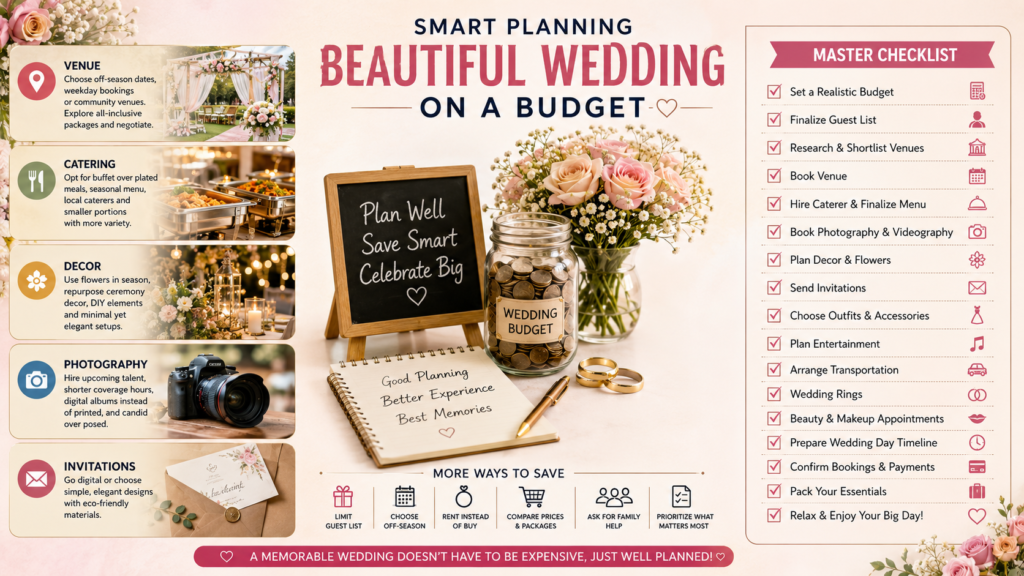
Step 5: Decor — Maximum Visual Impact at Minimum Cost
Wedding decor is the category where creativity most powerfully substitutes for cash — and where many budget weddings actually outshine expensive ones through the personality, thoughtfulness, and originality of their approach.
Flowers versus alternatives:
Fresh flowers are expensive — particularly in the quantities required to create the floral installations that define contemporary Indian wedding aesthetics. Consider strategic alternatives: lush greenery installations cost significantly less than equivalent floral arrangements while creating equally beautiful visual backdrops. Dried flowers, preserved blooms, paper flowers, and fabric florals provide beautiful visual impact with zero waste and reusability value.
Where fresh flowers are used, concentrate them strategically — a spectacular mandap installation, a beautiful table centrepiece, a floral backdrop for photographs — rather than distributing them thinly across every surface in quantities insufficient to create real impact anywhere.
Lighting as the primary decor tool:
Lighting is the single most transformative and most cost-effective decor investment available. A venue that looks ordinary under its standard lighting becomes magical under warm string lights, fairy lights, uplighting in wedding palette colors, or candlelight. Investing in lighting and reducing floral expenditure accordingly produces better visual results at lower cost — a genuinely counterintuitive discovery that experienced wedding planners consistently confirm.
DIY where your skills genuinely support it:
DIY decor can produce genuine savings — but only where the couple or their support network possesses actual skills in the relevant area. DIY invitation design by a genuinely talented designer friend, handmade table centerpieces by craft-skilled family members, or homemade favors with genuine personal meaning all represent legitimate DIY savings. Attempting DIY beyond your actual skill level produces poor results and considerable stress — know your limits honestly.
Rent rather than buy:
For decor elements used only once — furniture, specialty crockery, linens, statement decorative pieces — renting is almost always more cost-effective than purchasing. A growing market of wedding decor rental companies in Indian cities now offers high-quality, visually distinctive pieces at accessible rental rates.
Step 6: Photography and Videography — Where Not to Cut
If there is one budget category where cutting costs carries genuine long-term regret risk, it is photography and videography. Unlike every other wedding expense — the venue, the food, the flowers — your photographs and video are the only elements of your wedding day that you will continue experiencing for the rest of your life.
Compromising significantly on photography budget to fund more flowers or a more elaborate venue is one of the most commonly reported post-wedding regrets among couples who planned on tight budgets. The flowers are gone. The food is eaten. The photographs remain.
Where to find genuine value:
Emerging photographers who are building their portfolio — typically one to three years into their professional career — offer significantly lower prices than established photographers of comparable technical ability. Review their portfolios carefully and verify their consistency across complete wedding galleries rather than highlight images.
Photography students from reputable institutes who are completing their commercial portfolios sometimes offer coverage at very accessible rates in exchange for portfolio usage rights — a legitimate option for couples with tight budgets and a genuine appetite for creative, less conventional documentation.
Package negotiation:
Negotiate your photography package to prioritize deliverables you will actually use. Many couples pay for extensive video coverage they rarely watch while underinvesting in photographs they return to constantly. Understand your actual usage patterns and build your package accordingly.
Step 7: Invitations and Stationery — Going Digital
Wedding invitation and stationery costs accumulate surprisingly quickly — design fees, printing costs, paper quality upgrades, envelope addressing, and postage combine to represent a meaningful budget line item.
Digital invitations:
Beautiful, professionally designed digital wedding invitations — delivered via WhatsApp, email, or dedicated wedding websites — are now completely socially accepted across virtually all Indian social contexts. They eliminate printing, postage, and paper costs entirely while offering interactive features — RSVP functionality, venue mapping, schedule details, accommodation information — that paper invitations cannot match.
For guests for whom a physical invitation feels important — grandparents, very senior family members — print a small run of physical invitations for the most important recipients while sending digital invitations to the broader guest list.
Wedding website:
A free wedding website — available through platforms including WedMeGood, Appy Couple, and Zola — centralizes all wedding information for guests, eliminates the need for printed information inserts, and creates a beautiful digital hub for sharing photographs, registry information, and schedule updates.
Step 8: Honeymoon — Separate Budget, Separate Planning
Many couples make the mistake of including honeymoon costs within their wedding budget — creating a combined figure that is difficult to manage and often leads to compromising either the wedding or the honeymoon.
Treat honeymoon as a completely separate budget with separate funding. This mental and practical separation allows cleaner decision-making in both categories and prevents the wedding planning stress of honeymoon costs bleeding into wedding vendor negotiations.
Honeymoon savings without sacrifice:
Traveling in shoulder season — avoiding peak holiday periods — reduces flight and accommodation costs by 20% to 40% without compromising destination quality. Domestic Indian honeymoon destinations — Coorg, Rishikesh, Goa, Andaman, Himachal Pradesh — offer extraordinary experiences at a fraction of international honeymoon costs. Booking flight and accommodation packages through reputable travel platforms consistently produces better value than independent booking for equivalent quality.
The Budget Wedding Planning Master Checklist
✅ Total budget established — honestly and completely
✅ Non-negotiable priorities identified and protected
✅ Guest list audited and reduced to genuine invitees
✅ Venue alternatives explored beyond conventional halls
✅ Weekday or off-season date considered for venue savings
✅ Venue package inclusions negotiated aggressively
✅ Menu engineered for quality over quantity
✅ Bar service curated rather than fully open
✅ Lighting prioritized as primary decor investment
✅ Fresh floral use concentrated strategically
✅ Rental options explored for all one-use decor items
✅ Photography budget protected as non-negotiable
✅ Digital invitations adopted for majority of guest list
✅ Wedding website created as information hub
✅ Honeymoon budgeted separately from wedding
✅ DIY limited to genuinely skilled areas only
✅ All vendor quotes compared — minimum three per category
✅ All contracts read completely before signing
✅ Contingency fund of 10% of total budget reserved
FAQs
FAQ 1: What is a realistic budget for a mid-range Indian wedding in 2026?
A mid-range Indian wedding in 2026 with 100 to 150 guests across two to three functions typically costs between ₹8,00,000 and ₹20,00,000 depending on city, venue choice, and vendor quality. Intimate weddings of 30 to 50 guests can be beautifully executed for ₹3,00,000 to ₹6,00,000 with intelligent planning and strategic vendor choices.
FAQ 2: Which wedding expense should never be compromised regardless of budget pressure?
Photography should be the last budget item cut and the first protected. Your photographs outlast every other wedding expense — the venue rental ends, the food is consumed, the flowers fade — but your photographs remain for decades. The long-term regret of poor wedding photography consistently outweighs the short-term saving achieved by cutting this budget.
FAQ 3: How much should I keep as a contingency fund in my wedding budget?
Reserve a minimum 10% of your total wedding budget as a contingency fund for unexpected costs, last-minute requirements, and the inevitable small expenses that appear in every wedding planning process. Do not allocate this contingency to planned expenses — treat it as genuinely reserved for surprises and access it only when genuinely necessary.
FAQ 4: Are digital wedding invitations socially acceptable in India in 2026?
Yes — digital wedding invitations are now completely socially accepted across virtually all Indian social contexts in 2026. WhatsApp and email invitations are used by couples across all economic and social backgrounds. For very senior family members or formal contexts where a physical invitation feels important, print a small selective run while sending digital invitations to the broader guest list.
FAQ 5: What is the most effective single change to reduce wedding costs significantly?
Reducing the guest list is the single most impactful budget action available. Every guest removed from the list saves money across multiple categories simultaneously — catering, seating, venue size, invitations, and favors. Reducing a guest list from 200 to 150 guests at average Indian wedding per-head costs can save ₹1,00,000 to ₹2,50,000 or more across the full budget.
FAQ 6: Should I hire a wedding planner on a tight budget?
Counterintuitively — yes, for most couples. A skilled wedding planner with established vendor relationships negotiates discounts, prevents costly mistakes, and manages logistics that would otherwise consume enormous amounts of your time and emotional energy. Many planners offer day-of coordination packages at accessible price points that provide professional execution without full planning fees. The savings generated through planner vendor negotiations frequently offset or exceed the planner’s fee.