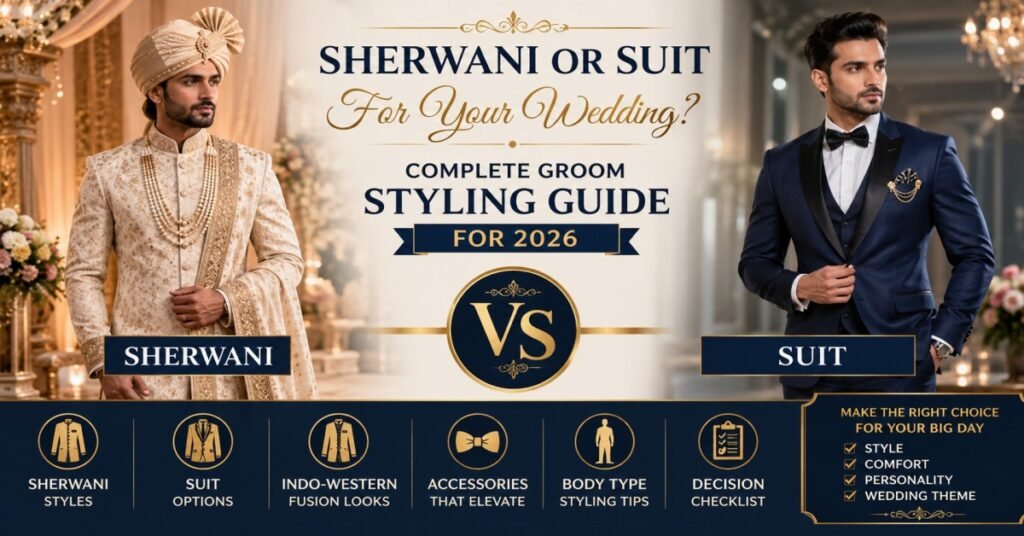
The groom’s wedding outfit has undergone a quiet revolution over the past decade — and in 2026, the choices available to the modern Indian groom are more exciting, more diverse, and more personally expressive than at any previous point in the history of South Asian wedding fashion.
For generations, the decision was relatively straightforward. A traditional Indian wedding meant a sherwani — elaborately embroidered, richly fabricated, and culturally rooted in centuries of South Asian sartorial heritage. A modern or Western-influenced celebration meant a suit — sharp, structured, and universally understood as the international language of formal male elegance.
But 2026 has dissolved these boundaries almost entirely. Today’s groom navigates a landscape where Indo-Western fusion silhouettes blur the line between sherwani and suit, where fabric and embellishment choices span traditional handloom weaves to contemporary performance fabrics, and where personal expression is celebrated as enthusiastically as cultural tradition.
The central question — sherwani or suit — is no longer a simple binary. It is the beginning of a rich creative conversation about cultural identity, aesthetic vision, occasion appropriateness, and the kind of man you want to present to the world on the most photographed day of your life.
This comprehensive groom styling guide for 2026 helps you navigate that conversation with clarity — covering the complete sherwani landscape, the full spectrum of suit options, the fusion alternatives that bridge both worlds, accessory guidance, body-type considerations, and the practical factors that should inform your final decision.
Understanding the Sherwani: India’s Royal Groom Uniform
The sherwani is not simply a garment — it is a cultural statement with centuries of history behind it. Originating in the Mughal court tradition and refined through generations of subcontinental tailoring mastery, the sherwani represents the highest expression of South Asian masculine formal dress.
What Makes a Sherwani
A sherwani is a long coat-like garment — typically knee-length to ankle-length — worn over a kurta and paired with churidar or salwar trousers. Its defining characteristics include a mandarin or Nehru collar, a front opening fastened with buttons or hooks, and structured tailoring that creates a commanding, regal silhouette.
The sherwani’s cultural richness comes from its embellishment — intricate embroidery in zari (gold or silver metallic thread), Zardozi beadwork, Resham threadwork, or stone embellishment that transforms the garment from mere clothing into a work of craft. The quality, complexity, and placement of embellishment is the primary determinant of a sherwani’s cost and visual impact.
Sherwani Styles Trending in 2026
Classic Ivory and Gold Sherwani:
The most enduring and photographically magnificent bridal sherwani combination — ivory or cream silk with gold zari embroidery — remains the aspirational standard in 2026. It is simultaneously traditional, regal, and visually spectacular. The ivory-gold combination photographs with extraordinary luminosity and reads as both culturally authentic and timelessly elegant.
Pastel Sherwanis:
One of the strongest trends in groom fashion for 2026 — pastel sherwanis in dusty rose, sage green, powder blue, and soft lavender have moved from a surprising choice to a mainstream statement. These softer tones coordinate beautifully with brides in complementary pastel lehengas and create wedding photographs with a cohesive, contemporary aesthetic that stands apart from the jewel-tone traditions of previous decades.
Heavily Embroidered Statement Sherwanis:
For grooms who want maximum visual impact, heavily embroidered sherwanis with all-over or dense half-and-half embroidery patterns represent the maximalist end of 2026 sherwani fashion. These garments are extraordinary to behold and create unforgettable wedding photographs — but require the confidence to wear them with the authority they demand.
Minimalist Bandhgala Sherwani:
The Bandhgala — a shorter, more structured sherwani variant with cleaner lines and restrained embellishment — has become increasingly popular among grooms who want the cultural grounding of traditional Indian formal wear with a more modern, understated aesthetic. It bridges the sherwani and suit worlds beautifully.
Velvet Sherwanis:
For winter weddings and evening ceremonies, velvet sherwanis in deep jewel tones — royal navy, deep burgundy, forest green, or rich plum — create a magnificent sensory richness. The way velvet catches and absorbs light gives these sherwanis a visual depth that no other fabric can replicate.
Sherwani Fabrics in 2026
Silk: The traditional and most prestigious sherwani fabric — available in Banarasi silk, raw silk, dupion silk, and pure silk variations. Silk sherwanis drape magnificently and carry embellishment beautifully.
Brocade: Jacquard-woven fabric with patterns integrated into the weave structure — creating a self-patterned texture that adds visual interest without requiring heavy surface embroidery.
Velvet: Ideal for winter and evening ceremonies — rich, warm, and extraordinarily photogenic.
Georgette and Crepe: Lightweight alternatives suitable for warmer climates and outdoor summer ceremonies where heavier fabrics would be impractical.
Linen and Cotton Blends: Growing in popularity for eco-conscious grooms and summer destination weddings — breathable, comfortable, and increasingly available in beautifully crafted designs that honor the sherwani tradition without the weight of traditional fabrics.
The Complete Suit Guide for Indian Grooms in 2026
The suit remains a powerful choice for Indian grooms in 2026 — particularly for reception events, civil ceremonies, destination weddings with international guest lists, and grooms whose personal style is fundamentally contemporary rather than traditionally rooted.
When a Suit Makes the Right Statement
The suit is appropriate and often the superior choice when the wedding aesthetic is intentionally modern or Western-influenced, when the venue is a contemporary hotel or international destination property rather than a heritage or traditional venue, when the groom’s bride is wearing a Western or contemporary bridal look, when the wedding includes multiple functions where outfit changes are planned and the suit serves a specific aesthetic role, or when the groom simply feels most authentically himself in a suit rather than a sherwani.
Suit Styles Trending for Indian Grooms in 2026
The Three-Piece Suit:
The three-piece — jacket, waistcoat, and trousers in matching fabric — provides maximum formality and the kind of comprehensive, polished presentation that suits the gravity of a wedding day. In 2026, three-piece suits for Indian grooms are appearing in rich fabrics — velvet, brocade, Banarasi-inspired jacquard — that bridge the gap between Western tailoring tradition and Indian textile heritage.
The Bandhgala Suit:
Perhaps the most elegant solution to the sherwani-versus-suit dilemma — the Bandhgala is a Nehru-collar suit jacket that is simultaneously Indian in its collar construction and Western in its structured tailoring. It reads as formal and contemporary while maintaining unmistakably Indian cultural DNA. In 2026, the Bandhgala is having a significant moment — adopted by style-conscious grooms who want a uniquely Indian formal look without the full commitment of a traditional sherwani.
Tuxedo for Receptions:
For evening reception functions — particularly those in contemporary hotel ballrooms or rooftop venues — a well-cut tuxedo creates a distinct and memorable visual statement. Indian grooms in 2026 are embracing tuxedos in non-traditional colors — midnight blue, deep emerald, burgundy — that feel more personal and distinctive than classic black while maintaining the tuxedo’s inherent formality and drama.
Contemporary Slim-Fit Suits:
Clean, contemporary slim-fit suits in premium fabrics — wool, linen, or silk blends — in sophisticated colors like charcoal, steel blue, champagne, or warm greige represent a more understated but equally elegant groom option. These suit beautifully for civil ceremonies, intimate celebrations, and grooms whose personal style vocabulary is minimal and precise.
Suit Fabrics for Indian Grooms in 2026
Wool and Wool Blends: The gold standard of suit fabric — structured, breathable with the right weight, and draping with a precision that synthetic fabrics cannot match. Ideal for winter and air-conditioned venue receptions.
Linen: The superior choice for summer and outdoor weddings — breathable, relaxed in its texture, and increasingly accepted as a legitimate premium fabric rather than a casual compromise.
Silk and Silk Blends: Particularly appropriate for Indian groom suits — silk’s natural sheen gives suits an inherent richness that bridges the visual impact gap between suits and sherwanis.
Velvet: For evening reception suits — velvet creates extraordinary visual impact and photographs magnificently under the warm lighting of wedding reception spaces.
Brocade and Jacquard: Indian grooms in 2026 are increasingly choosing suits constructed from traditional Indian brocade and jacquard fabrics — creating garments that are structurally Western but texturally and visually Indian.
Indo-Western Fusion: The Best of Both Worlds
The most exciting development in Indian groom fashion for 2026 is the maturation of Indo-Western fusion — silhouettes and combinations that draw deliberately from both traditions to create something genuinely new.
Key Fusion Looks for 2026
Kurta with Tailored Trousers:
A beautifully crafted long kurta — in silk, brocade, or fine cotton — paired with tailored straight-cut or slim trousers rather than traditional churidar creates a fusion silhouette that is simultaneously Indian and contemporary. The combination is more relaxed than a sherwani, more culturally rooted than a suit, and remarkably versatile across ceremony types.
Jacket over Kurta:
A structured blazer-style jacket — either in matching or contrast fabric — worn over a simple kurta creates a layered fusion look that photographs beautifully and allows creative play with texture, color, and pattern mixing. This combination has become one of the most popular groom looks for Sangeet and Mehendi functions in 2026.
Dhoti with Bandhgala:
A crisp white or ivory dhoti paired with a structured Bandhgala jacket creates a fusion look that is distinctly South Indian in its lower half and broadly pan-Indian in its upper construction. This combination has gained significant traction in 2026 among grooms from South Indian families who want to honor regional tradition within a contemporary framework.
Nehru Jacket over Western Trousers:
A richly embellished Nehru jacket worn over a plain white dress shirt and slim Western trousers — perhaps with a pocket square and formal shoes — creates an accessible, visually distinctive fusion look that works particularly well for cocktail and reception functions.
Choosing Between Sherwani and Suit: The Decision Framework
Rather than prescribing a single answer, the right choice emerges from honestly evaluating the following factors:
Cultural Context and Family Expectations
For traditional Indian ceremonies — particularly those in families with strong regional cultural identities — a sherwani is not merely a style choice but an expression of respect for cultural tradition. Understanding your family’s expectations and the cultural weight that attaches to your clothing choice is important context.
However, family expectations should inform rather than dictate your decision. A groom who feels deeply uncomfortable in traditional dress will not wear it with the ease and confidence that makes any outfit look its best.
Wedding Type and Venue
A heritage Rajasthani palace wedding calls for a sherwani with the same cultural logic that a formal ballroom reception calls for a tuxedo. The venue and wedding aesthetic create a visual language — and your outfit should speak that language fluently.
Beach destination weddings, contemporary hotel celebrations, and intimate civil ceremonies generally permit and often actively favor more contemporary choices. Multi-function weddings may appropriately feature both — a sherwani for the ceremony and a suit for the reception.
Your Bride’s Outfit
Groom and bride outfits should create visual coherence in wedding photographs without matching too literally. If your bride is wearing a heavily embellished red or ivory lehenga, a coordinating sherwani creates the cultural and visual harmony that photographs most beautifully. If she is wearing a contemporary gown or a minimalist saree, a suit creates a more cohesive visual pairing.
Your Body Type
Tall and lean frames: Almost every silhouette works — both sherwanis and suits drape beautifully on lean tall frames. Full-length sherwanis with vertical embellishment patterns are particularly spectacular.
Shorter frames: Opt for shorter sherwanis or well-tailored suits with vertical pinstripes or patterns that elongate the silhouette. Avoid extremely long or voluminous sherwanis that overwhelm a shorter frame.
Athletic and broad-shouldered frames: Structured suits showcase athletic builds magnificently. For sherwanis, choose designs with minimal shoulder embellishment that does not add visual width.
Fuller figures: Choose well-tailored garments with structured internal construction that creates clean lines rather than clinging to the body. Dark solid colors in both sherwanis and suits create a slimming, commanding appearance.
Your Personal Comfort and Confidence
The most beautifully styled groom in the most expensive sherwani will still look less impressive than a groom wearing whatever he chose with complete ease and genuine confidence. Your comfort in your clothes — physical comfort and psychological comfort — is the most important styling variable of all.
Accessory Guide for Grooms in 2026
For Sherwani Grooms
Safa or Pagdi (Turban): The traditional groom’s headwear that completes the sherwani look — available in matching or coordinating fabric with distinctive regional variations. Rajasthani turbans, Punjabi pagdis, and Marathi mundavalya all bring distinct regional character to the complete look.
Kalgi: The traditional turban ornament — typically a brooch of polki diamonds, emeralds, or pearls with an aigrette feather — that adds regal finishing to traditional turban styles.
Mala (Garland Necklace): A long necklace of polki, kundan, or pearl beads that adds appropriate jewelry to the sherwani look without overwhelming its embellishment.
Mojari or Jutti: Traditional embroidered footwear that completes the cultural coherence of a sherwani outfit — available in leather and fabric versions in coordinating or contrast colors.
Brooch or Buttonhole: A decorative brooch or floral buttonhole at the sherwani chest pocket adds a personal styling detail that photographs beautifully in close-up portrait shots.
For Suit Grooms
Pocket Square: The single most impactful suit accessory — a beautifully folded pocket square in a fabric or color that references the bride’s palette creates visual connection between the couple’s outfits without literal matching.
Tie or Bow Tie: A silk tie or bow tie in a color or pattern that coordinates with the overall wedding palette. Bow ties create a more distinctive and formal statement for evening receptions.
Cufflinks: Quality cufflinks in precious metal — gold, silver, or rose gold — add a personal refinement detail that is particularly visible in the close-up hand photographs taken during ring exchange ceremonies.
Formal Shoes: Oxford or Derby shoes in black or tan leather for classic suits. Patent leather for tuxedos. Velvet loafers for a more distinctive contemporary statement that has gained significant traction in Indian groom fashion for 2026.
Watch: A quality dress watch — worn on the wrist away from the ring — adds a sophisticated personal detail visible throughout the day.
Final Checklist Before You Decide
✅ Cultural context and family expectations considered
✅ Wedding type, venue, and aesthetic evaluated
✅ Bride's outfit palette and style coordinated
✅ Body type guidance applied to silhouette choice
✅ Personal comfort and confidence assessed honestly
✅ Budget established and realistic for chosen option
✅ Multiple functions considered — one outfit or several
✅ Fabric appropriate for season and venue type
✅ Accessories planned and coordinated
✅ Minimum two fittings scheduled with your tailor
✅ Full outfit trial — including accessories — completed
✅ Outfit confirmed comfortable for extended wear
✅ Photographs taken in full outfit at trial fitting
✅ Your gut says yes with complete confidence
FAQs
FAQ 1: Can an Indian groom wear a suit instead of a sherwani for the main wedding ceremony?
Absolutely — a suit is a completely valid and increasingly popular choice for Indian groom wedding ceremonies in 2026. The decision depends on the cultural context of your wedding, your personal aesthetic, and your comfort. Many contemporary Indian grooms choose suits — particularly Bandhgala suits or richly fabricated three-piece suits — that feel both formally appropriate and personally authentic.
FAQ 2: What is the price difference between a sherwani and a suit in India in 2026?
Entry-level ready-to-wear sherwanis start at approximately ₹8,000 to ₹20,000. Mid-range designer sherwanis range from ₹20,000 to ₹80,000. Premium and custom sherwanis range from ₹80,000 to ₹5,00,000 and above for couture pieces. Quality suits follow a similar range — bespoke tailored suits from established tailors start at approximately ₹25,000 and designer suits range from ₹50,000 to ₹3,00,000 and above.
FAQ 3: How many outfit changes do most grooms have during Indian wedding celebrations?
Most Indian grooms across multi-day wedding celebrations make two to four outfit changes — typically one outfit per major function. A common combination is a sherwani for the main wedding ceremony, a different sherwani or bandhgala for Sangeet, a more casual kurta for Mehendi, and a suit or tuxedo for the reception. Each function has its own aesthetic register and outfit change creates visual distinction between events.
FAQ 4: How far in advance should a groom order a custom sherwani or suit?
Order custom sherwanis and bespoke suits a minimum of three to four months before the wedding — allowing time for fabric sourcing, initial construction, multiple fitting sessions, embroidery completion if applicable, and final alterations. For heavily embroidered couture sherwanis from established designers, six months lead time is advisable. Never leave custom groom outfit ordering to the last minute — rushed tailoring almost always produces compromised results.
FAQ 5: What colors should the groom avoid wearing to not clash with the bride?
Communicate your planned outfit color to your bride — or ideally coordinate your color palette together — well in advance of both outfits being finalized. Generally avoid wearing the same primary color as the bride to prevent visual merging in photographs. Avoid white and ivory if the bride is wearing a white or ivory bridal gown. Coordinate rather than match — complementary colors that work harmoniously together in photographs rather than being identical.
FAQ 6: What is the most important factor in making a groom look his absolute best?
Fit — without any close competition. The most expensive sherwani or the most prestigious designer suit looks mediocre when it does not fit correctly. A well-fitted mid-range garment consistently outperforms an ill-fitted luxury one in both appearance and confidence. Invest in multiple professional fitting sessions with your tailor and do not accept any garment until it fits your specific body with precision. Everything else — fabric, embellishment, accessories — is secondary to the fundamental correctness of the fit.