Attending a wedding is one of life’s genuine privileges. You have been personally invited to witness and celebrate one of the most significant moments in another person’s life — welcomed into an intimate circle of family and friends to share in joy, love, and the particular magic that surrounds two people beginning their shared journey.
With that privilege comes responsibility.
Wedding guest etiquette is not a list of arbitrary rules designed to restrict your freedom or police your behavior. It is a framework of consideration — a set of choices that ensures your presence at someone else’s celebration enhances rather than detracts from their experience. Every etiquette principle, when traced back to its origin, is simply an expression of one fundamental value: this day is about the couple, not about you.
In India’s rich and diverse wedding culture — where celebrations span multiple days, involve hundreds of guests, observe deep cultural and religious protocols, and carry profound familial significance — the scope of guest etiquette is particularly broad. The choices you make about what to wear, when to arrive, how to behave during ceremonies, how you handle your smartphone, and dozens of other small decisions collectively determine whether you are the kind of guest the couple will remember with warmth and gratitude or one they will quietly wish had not attended.
This comprehensive guide covers everything a wedding guest needs to know about what not to wear and what not to do — across Indian and general wedding contexts — so you can attend every celebration with the confidence that comes from genuine consideration for the people at its center.
Part One: What Not to Wear
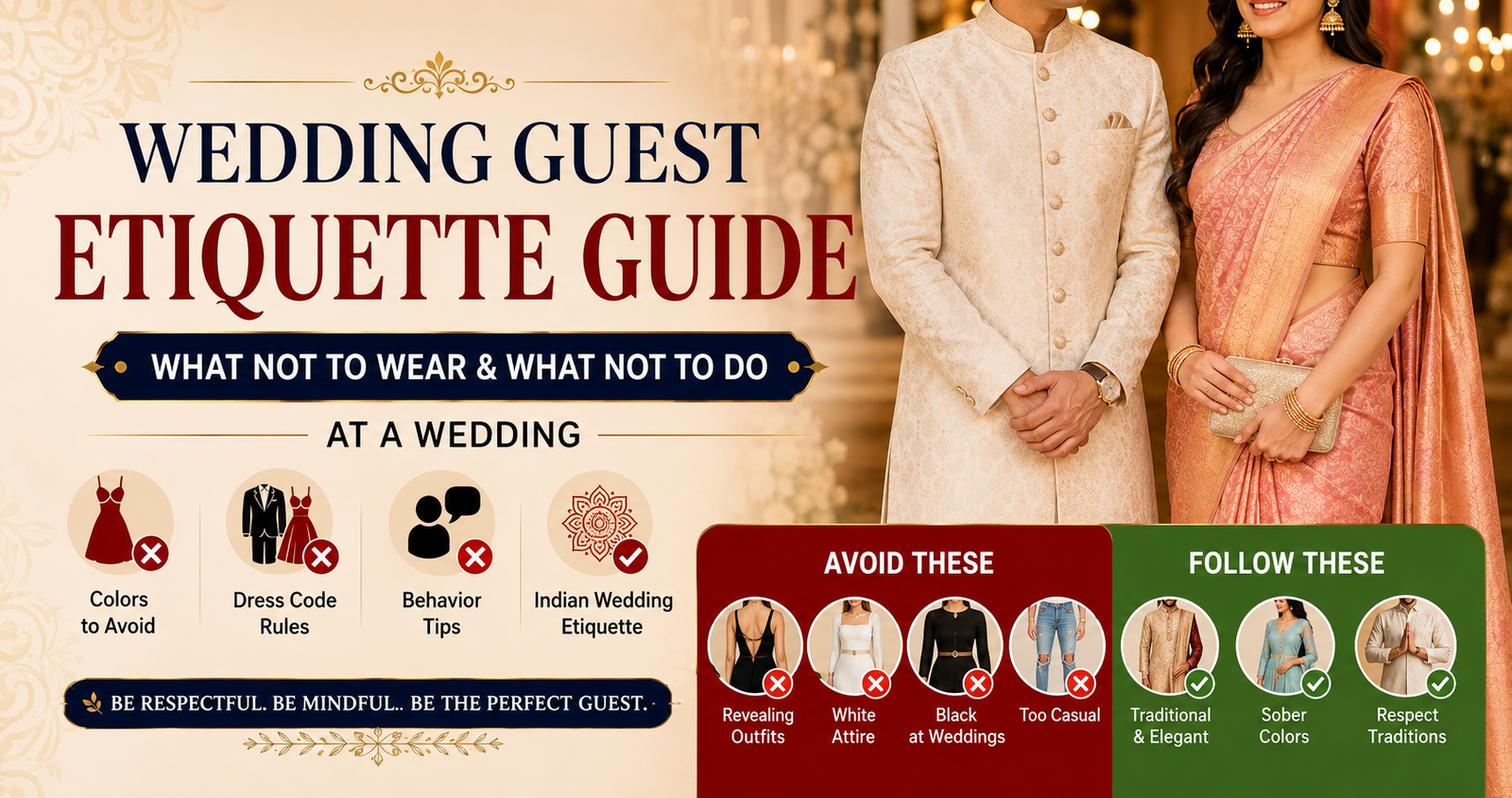
1. Never Wear White or Ivory as a Guest
In the context of Indian weddings — particularly Hindu ceremonies — white is traditionally associated with mourning and is considered deeply inauspicious for festive celebrations. Wearing white as a wedding guest in a traditional Indian context is not merely a fashion misstep — it carries cultural significance that can cause genuine offense to the couple and their families.
For Western-style weddings and receptions in India, the same restriction applies for a different reason — white and ivory are the traditional colors of bridal dress in Western wedding tradition. Wearing white to a Western-style wedding reception places you in direct visual competition with the bride and is universally considered one of the most fundamental violations of wedding guest dress etiquette.
The rule is simple: regardless of wedding style or cultural context, avoid white, ivory, cream, and off-white as primary outfit colors when attending any wedding as a guest.
2. Never Try to Outshine the Bride
The bride is the visual focal point of her wedding day — and every guest’s outfit choice should honor rather than compete with that reality. This principle manifests differently depending on the wedding’s aesthetic and cultural context, but its application is universal.
Practically, this means avoiding:
Heavily embellished bridal-adjacent outfits in the same color family as the bride’s known outfit. Deep red and heavy gold color combinations which closely approximate traditional bridal aesthetics in most Indian wedding traditions. Extremely elaborate or attention-commanding outfits that draw the eye away from the couple in group photographs and candid moments. Wearing a veil, floral headpiece, or any headwear that in any cultural context approximates bridal adornment.
Research the bride’s outfit color where possible through mutual friends or the bride’s social media — and make a conscious effort to complement rather than clash with or duplicate her palette.
3. Never Wear Black to a Traditional Indian Wedding
Black is a complex color in Indian wedding culture. While it has become more widely accepted at contemporary urban Indian receptions and Western-style celebrations, traditional Hindu wedding ceremonies and conservative South Indian, Rajasthani, and Gujarati wedding contexts still regard black as inauspicious — associated with negative energy and inappropriate for joyful celebrations.
As a general rule of safety and cultural consideration, avoid black as the primary color of your outfit for traditional Indian wedding ceremonies and functions. If you genuinely prefer dark colors, deep navy, dark green, and deep purple are beautiful alternatives that carry none of the cultural associations of black.
At contemporary receptions and Western-style Indian celebrations, black is generally appropriate — but when in doubt, ask a mutual friend or family member who understands the couple’s cultural expectations before committing to a black outfit.
4. Avoid Overly Revealing or Inappropriate Clothing
Indian weddings — particularly those with religious ceremonies — are occasions that demand modest and culturally respectful dress. Revealing outfits — low-cut necklines, very short hemlines, backless designs, or extremely body-hugging silhouettes — are inappropriate for religious ceremony settings and show poor consideration for the cultural context of the celebration.
This applies particularly to:
Mandap ceremonies where Hindu rituals are performed — conservative dress is expected as a mark of respect for the sacred nature of the proceedings. Gurudwara ceremonies where Sikh weddings are solemnized — head covering is obligatory and modest dress is required. Muslim nikah ceremonies — conservative dress covering arms and legs is expected for all guests regardless of their own religious background. Church ceremonies for Christian weddings — modest, formal dress is appropriate with shoulders covered.
As a guest entering a religious ceremony, your clothing choices are a form of respect for the setting, the tradition, and the families who have planned the celebration within their cultural framework.
5. Do Not Dress Too Casually
Weddings — even intimate and relaxed ones — are formal occasions that merit thoughtful dress. Attending in casual jeans, sneakers, or everyday clothing shows a lack of respect for the significance of the occasion and for the effort the couple has invested in their celebration.
If you are uncertain about the expected formality level — check the invitation for dress code guidance, observe the venue and timing for contextual clues (a palace venue at evening suggests greater formality than a garden venue at noon), or ask a mutual contact who knows the couple’s expectations.
When in doubt, always dress slightly more formally than you think necessary. Overdressing at a wedding is easily forgiven. Underdressing is more difficult to recover from socially.
6. Avoid Matching the Wedding Party Colors
Many couples coordinate their wedding party — bridesmaids, groomsmen, family members — in specific colors that create visual coherence in photographs. Arriving in the same or very similar color as the designated wedding party color creates confusion in group photographs, visual disruption in candid coverage, and a general sense of awkward competition that the couple notices even if they are too gracious to mention it.
If you know the wedding party colors in advance — through social media, mutual friends, or the invitation itself — consciously avoid them in your outfit selection.
Part Two: What Not to Do
7. Do Not Arrive Late
Arriving late to a wedding ceremony is one of the most disruptive and disrespectful things a guest can do. Wedding ceremonies begin at scheduled times for carefully coordinated logistical reasons — the photographer is positioned, the musicians are cued, the processional is about to begin. A guest arriving after the ceremony has started disrupts the proceedings, distracts other guests, and in photographic and video coverage creates visual intrusions that the couple will see every time they revisit their wedding documentation.
Plan to arrive at least fifteen to twenty minutes before the stated ceremony start time. Account for traffic, parking, and the inevitably longer time required to navigate a large venue for the first time. If you do arrive late despite best efforts, enter as quietly and unobtrusively as possible — never walk in front of the couple or down the main aisle after proceedings have begun.
8. Do Not Make It About Your Social Media
The smartphone has created an entirely new category of wedding guest behavior — and most of it is problematic. Wedding guests who spend the ceremony filming on their phones, jostling for position to capture moments, or holding up devices that block the view of other guests and the professional photographer create significant disruption and a visual record full of phones and screens rather than genuine human moments.
Specific behaviors to avoid:
Never hold your phone up during the ceremony in ways that block other guests or appear in the professional photographer’s frame. Never step into the aisle or move from your seat during the ceremony to capture a better angle for your personal photography. Never use flash photography during the ceremony — flash from guest phones disrupts the carefully managed lighting the professional photographer is working with and creates unflattering harsh light in candid photographs.
Follow the couple’s stated photography policy — an increasing number of couples are requesting unplugged ceremonies, where guests put away their devices entirely for the ceremony duration. This policy is not a restriction on your personal freedom — it is a gift the couple is asking you to give them: your genuine, undivided, undistracted presence.
9. Do Not Skip the RSVP or Change Your Response Last Minute
The RSVP is not a formality — it is operational information that the couple uses to plan catering quantities, seating arrangements, accommodation, and dozens of other logistics. Failing to RSVP by the stated deadline creates genuine planning problems for the couple. RSVPing yes and then not attending wastes a seat, a meal, and a favor that could have been allocated to another guest. RSVPing no and then attending creates catering shortfalls and seating disruptions that are operationally difficult to resolve on a wedding day.
Respond to wedding invitations promptly and accurately. If your plans change after RSVPing, communicate the change to the couple or their coordinator as early as possible — not on the day itself. The etiquette principle here is simple: your attendance decision has operational consequences for other people. Handle it responsibly.
10. Do Not Give Unsolicited Opinions or Make Comparisons
A wedding day is not an appropriate occasion for sharing your opinions about the couple’s choices — the venue, the menu, the decor, the music, the ceremony length, or any other element that reflects the couple’s personal taste and planning decisions.
Comments like “I think your previous partner was better” — obviously unconscionable but occasionally made by socially oblivious guests — represent the extreme end of a broader principle: keep critical or comparative opinions entirely to yourself at a wedding. The couple has made hundreds of decisions over months of planning — each one representing their genuine best effort to create a celebration they love. Your role as a guest is to celebrate those decisions, not to audit them.
Similarly, avoid comparing the wedding unfavorably to other weddings you have attended — “at Priya’s wedding, the food was so much better” — a comment that is both unkind and completely unnecessary in any conceivable social context.
11. Do Not Drink Irresponsibly
If the wedding features a bar, exercise the same judgment about alcohol consumption that you would in any professional social context. Getting visibly intoxicated at a wedding creates embarrassment for you, disruption for other guests, and genuinely uncomfortable memories for the couple — who will associate your behavior with their wedding day for the rest of their lives.
Know your limits and respect them firmly in a wedding context. The photographs and videos from the day are permanent — and so is the memory of guests whose behavior made the evening uncomfortable for those around them.
12. Do Not Bring Uninvited Guests
Wedding invitations are carefully calibrated to specific individuals — the guest count, the seating arrangement, the catering quantities, and often the venue capacity are all planned around confirmed attendees. Bringing an uninvited guest — a partner not included on the invitation, a friend you assumed could join, or a child when the event is adults-only — creates real operational problems for the couple’s coordinator and can cause genuine distress on what should be a smoothly flowing day.
If you would like to bring someone not mentioned on your invitation — a new partner, a family member — ask the couple directly and well in advance. Never simply arrive with an additional person and assume it will be accommodated without notice.
13. Do Not Monopolize the Couple’s Time
The bride and groom are simultaneously hosting hundreds of guests, fulfilling family obligations, performing ceremonial rituals, sitting for photographs, and attempting to be present for each other in the midst of an extraordinarily demanding day. Their time and attention on their wedding day is genuinely scarce.
Respect this reality as a guest. Keep your personal conversations with the couple brief and joyful — congratulate them warmly, express your happiness for them genuinely, and allow them to circulate to their many other guests. Do not pull them aside for extended personal conversations, unresolved relationship discussions, or requests that consume their limited attention.
Save the longer, more personal conversations for after the wedding when the couple has time, energy, and presence to engage fully with you.
14. Do Not Post Photographs Before the Couple Does
In 2026, this is one of the most important and most frequently violated elements of wedding guest etiquette. Posting photographs from the wedding to your own social media accounts before the couple has had the opportunity to share their own images deprives them of the experience of being the first to share their wedding story with the world — a genuinely meaningful aspect of the post-wedding experience for most couples.
As a basic rule of courtesy, wait until the couple has posted their own photographs before sharing yours. If you are unsure of their timeline, simply ask — most couples appreciate the thoughtfulness of the question.
15. Do Not Neglect the Thank You
The invitation to attend a wedding — including the considerable expense of hosting you for a meal, potentially accommodation, and all the hospitality a wedding day entails — is a generous act of welcome that merits acknowledgment. Send a genuine written thank-you note or message to the couple after the wedding — not merely a social media comment on their wedding photographs, but a personal communication that expresses your genuine appreciation for being included.
This small act of courtesy is one of the most consistently neglected elements of wedding guest etiquette — and one that the couple notices and appreciates far more than most guests realize.
FAQs
FAQ 1: Can a wedding guest wear red to an Indian wedding?
Deep red is traditionally associated with bridal dress in many North Indian Hindu wedding traditions and should generally be avoided by guests to prevent visually approximating the bride’s appearance. Lighter reds, pinks, and coral tones are typically fine. When in doubt about whether your specific shade of red is appropriate, choose an alternative color to eliminate the question entirely.
FAQ 2: What does an unplugged wedding ceremony mean and must I comply?
An unplugged ceremony is one where the couple requests that guests put away all phones and cameras during the ceremony and remain fully present. This request — increasingly common in 2026 — is a heartfelt expression of what the couple wants from their guests: genuine presence over documentation. Complying is not optional etiquette — it is basic respect for the couple’s stated wishes on their own wedding day.
FAQ 3: Is it acceptable to bring children to a wedding if they are not invited?
No. If an invitation is addressed only to adults or does not specifically include children by name, bringing children is not acceptable. Contact the couple well in advance if childcare arrangements are genuinely impossible and you need to discuss options. Never simply arrive with uninvited children and expect the situation to be accommodated without prior communication and agreement.
FAQ 4: How much should I spend on a wedding gift?
Wedding gift amounts vary by relationship closeness, regional custom, and financial circumstance. A general guideline for Indian weddings in 2026 — close friends and family typically give ₹2,000 to ₹10,000 or more depending on closeness. Colleagues and acquaintances typically give ₹1,000 to ₹3,000. The gift should reflect genuine goodwill — never give less than you can afford, but equally never feel pressured to exceed your comfortable means.
FAQ 5: What should I do if I accidentally wear something similar to another guest?
Smile, compliment their taste, and move on gracefully. Accidentally matching another guest is a social non-event — the only thing that could make it awkward is drawing attention to it or reacting with visible distress. Focus on the celebration and allow the coincidence to become a light-hearted shared moment rather than a source of social tension.
FAQ 6: Is it rude to leave a wedding reception early?
Leaving before the formal conclusion of a reception is acceptable provided it is done discreetly and without making a production of your departure. Quietly say goodbye to the couple or a close family member if you can do so without interrupting a moment, and slip away without drawing attention. Never leave during the first dance, the cake cutting, or any other designated ceremonial moment — wait for a natural pause between events