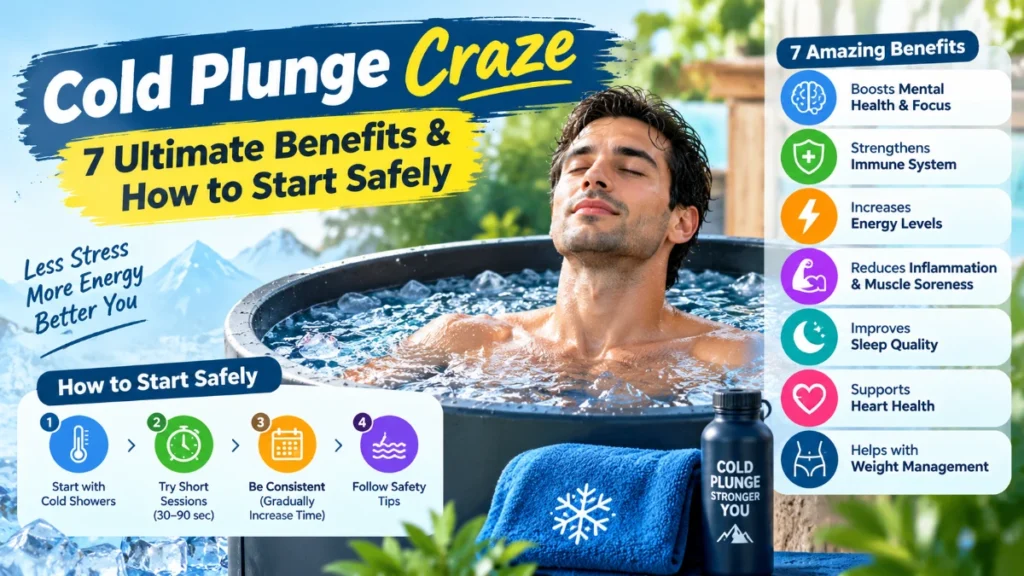
The cold plunge craze has officially evolved from an eccentric Nordic ritual into a worldwide health phenomenon. From elite UFC fighters and Olympic athletes to tech executives and everyday wellness seekers, people everywhere are intentionally submerging their bodies into near-freezing water.
While taking an icy dip might look like an agonizing stunt designed for viral social media views, the physiological science backing the cold plunge craze tells a radically different story. Deliberate cold exposure triggers a cascade of neurochemical shifts, anti-inflammatory pathways, and metabolic boosts that can transform your daily vitality.
However, jumping into ice water without a roadmap carries legitimate risks. In this ultimate guide, you will discover why the cold plunge craze has captured the world’s attention, unpack seven evidence-based health benefits, and learn a foolproof, step-by-step protocol to start safely at home.
What Sparked the Global Cold Plunge Craze?
Cold water immersion (CWI) is far from brand-new. Ancient Greek physicians prescribed cold baths for fatigue, and cultures across Scandinavia and Eastern Europe have celebrated cold water bathing for centuries. Yet the modern cold plunge craze exploded over the past few years due to two major catalysts:
- The Wim Hof Revolution: The Dutch extreme athlete popularized deep breathing coupled with extreme cold exposure, demonstrating measurable control over the sympathetic nervous system in clinical trials.
- Neuroscience and Biohacking Insights: Renowned researchers and platforms like the Stanford Medicine Huberman Lab spotlighted cold exposure as one of the most potent, non-pharmacological methods to stimulate long-lasting dopamine release.
Today, at the epicenter of the cold plunge craze is a collective desire to break free from our over-comfortable, temperature-controlled lives and build genuine biological resilience.
Pro-Tip: If you practice temperature therapy, balance is key. Check out our comprehensive guide on [Sauna vs. Cold Plunge: Which Recovery Tool Wins?] to learn how to stack heat and cold for optimal vascular health.
7 Science-Backed Benefits Behind the Cold Plunge Craze
Why are millions enduring freezing temperatures every single week? Here are seven profound, scientifically proven benefits fueling the cold plunge craze.
Preview unavailable Caption: Deliberate cold immersion triggers a 250% increase in baseline dopamine and accelerates muscle recovery.
1. Massive, Sustained Dopamine Elevation
Unlike temporary dopamine spikes triggered by sugar, social media, or caffeine—which are inevitably followed by an energy crash—cold exposure causes a gradual and sustained rise in dopamine.
A landmark study published in the European Journal of Applied Physiology (PubMed) observed that deliberate immersion in 57°F (14°C) water stimulated a 250% increase in blood dopamine concentrations alongside a 530% surge in norepinephrine. This prolonged elevation lasts for hours, enhancing mental clarity, motivation, and positive mood without an afternoon dip.
2. Accelerated Muscle Recovery and Soreness Reduction
One reason the cold plunge craze gained early traction among professional athletes is its ability to combat Delayed Onset Muscle Soreness (DOMS). Freezing water triggers immediate vasoconstriction (narrowing of blood vessels), driving blood inward toward vital organs.
Once you step out, rapid vasodilation occurs, flushing muscles with freshly oxygenated blood and clearing metabolic waste. According to a systematic review in Sports Medicine, athletes using cold water therapy demonstrated significantly lower perceived fatigue and improved subjective recovery within 48 hours post-exercise.
3. Activation of Calorie-Burning Brown Adipose Tissue
Most body fat is white adipose tissue (energy-storing). However, humans also possess metabolically active Brown Adipose Tissue (BAT).
Brown fat contains high concentrations of iron-rich mitochondria that burn calories directly through a process called non-shivering thermogenesis to produce heat. Regular participation in the cold plunge craze conditions your body to activate BAT, improving resting metabolic rate and insulin sensitivity.
4. Fortified Stress Resilience and Autonomic Control
Enthusiasts of the cold plunge craze frequently cite mental toughness as their primary motivator. When your skin contacts freezing water, your body enters a fight-or-flight state: your breath hitches, heart rate elevates, and adrenaline floods your veins.
By actively controlling your respiration (calm, long exhales) during this shock, you train your prefrontal cortex to override primal panic signals. This translates directly to everyday life: you become far less reactive to stressful meetings, relationship tension, or unexpected crises.
How the Cold Plunge Craze Influences Mental Resilience and Mood
Deliberate cold exposure acts as a form of controlled hormesis—a biological phenomenon where a transient, mild stressor stimulates deep cellular repair and adaptive strength.
As the cold plunge craze spreads from elite athletes to everyday workers, clinical psychologists are noticing its impact on anxiety reduction. Cold shock triggers the vagus nerve, which stimulates parasympathetic tone once the initial shock subsides, contributing to higher Heart Rate Variability (HRV) and lower resting heart rates over time.
5. Enhanced Immune System Readiness
Clinical trials evaluating cold immersion protocols have demonstrated that individuals trained in breathing exercises and cold exposure exhibit significantly higher levels of anti-inflammatory cytokines (such as IL-10) and produce lower levels of inflammatory proteins when exposed to immune challenges. Regular cold exposure helps your immune system mount prompt, efficient defenses while curtailing chronic background inflammation.
6. Superior Sleep Quality and Circadian Alignment
Your core body temperature must decrease by approximately 1–2°F to initiate deep, restorative non-REM sleep. Although a plunge immediately spikes alertness, the post-immersion rebound causes core body temperature to drop steadily an hour or two later. Incorporating your plunge earlier in the day helps synchronize your circadian rhythms for restorative night rest.
7. Natural Joint and Inflammation Relief
Cold therapy serves as an anesthetic for nerve endings while reducing localized fluid retention (edema). Those managing chronic joint stiffness, rheumatoid discomfort, or tendonitis find that localized and full-body cold immersion provides natural, drug-free pain relief.
Safe Immersion Guidelines: Temperatures & Timing
Entering freezing water without parameters can lead to hypothermia or cold shock accidents. Follow this reference framework before stepping in:
| Experience Tier | Recommended Water Temp | Safe Immersion Duration | Frequency per Week |
|---|---|---|---|
| Absolute Beginner | 55°F – 60°F (13°C – 15°C) | 1 to 2 minutes | 2–3 times |
| Intermediate | 50°F – 54°F (10°C – 12°C) | 2 to 3 minutes | 3–4 times |
| Advanced Biohacker | 42°F – 49°F (5°C – 9°C) | 3 to 5 minutes | 3–5 times |
The 11-Minute Rule: Groundbreaking research by Dr. Susanna Søberg suggests that you only need a cumulative total of 11 minutes of cold exposure per week (spread across 2 to 4 sessions) to capture nearly all metabolic and mental health benefits of the cold plunge craze. More is not necessarily better!
How to Join the Cold Plunge Craze Safely: Step-by-Step Protocol
Before diving headfirst into the cold plunge craze, you must respect the adaptation curve of your vascular system. Use this tested, step-by-step roadmap:
Step 1: Pre-Adaptation with Cold Showers
Never begin your cold journey by jumping into a tub filled with ice cubes. Start in your home shower:
- Finish your warm daily shower with 30 seconds of pure cold water.
- Increase this duration by 15 seconds every three days until you can comfortably endure 2 full minutes.
- Learn foundational breath management beforehand; review our guide on [Mastering Diaphragmatic Breathwork for Stress and Recovery] to stabilize your heart rate under cold stress.
Step 2: Breath Control and Calm Entry
- Never hold your breath when stepping into cold water. Breath-holding amplifies panic and spikes blood pressure.
- Step into the tub smoothly up to your clavicles. Keep your hands submerged or placed gently on your thighs.
- Focus on an extended exhale: breathe in for 4 seconds through your nose, and exhale slowly for 6 to 8 seconds through your mouth.
Step 3: Avoid Staying in Too Long
A major trap in the cold plunge craze is turning immersion into an ego-driven endurance contest. 3 minutes at 50°F is more than enough. Staying past your shivering threshold introduces the risk of “afterdrop”—a dangerous phenomenon where cold blood from your extremities circulates back to your core after exiting, dropping core temperature further.
Step 4: Natural Re-Warming Protocol
- Step out of the tub onto a dry towel or non-slip mat.
- Avoid immediately hopping into a scorching hot shower. Allowing your body to warm up using its own muscular thermogenesis (gentle movement or shivering) maximizes the metabolic conversion of brown fat.
- Sip warm herbal tea, put on warm woolen layers, and move your body gently.
Critical Safety Warnings and Contraindications
While participating in the cold plunge craze is empowering for healthy adults, deliberate cold immersion causes dramatic cardiovascular shifts. Cold water triggers the mammalian dive reflex alongside severe peripheral vasoconstriction, driving blood pressure up rapidly.
Medical Caution: Consult a physician before starting cold water immersion if you have:
- Cardiovascular disease, history of stroke, or arrhythmia
- Uncontrolled high blood pressure (hypertension)
- Raynaud’s Syndrome or severe peripheral neuropathy
- Pregnancy
- Never plunge alone in natural bodies of open water (rivers, lakes, or oceans) where cold shock could lead to drowning.
For clinical recommendations on safe cardiovascular conditioning, consult the Mayo Clinic Health Information Portal.
Essential Equipment to Embrace the Cold Plunge Craze
You don’t need a $10,000 luxury commercial tub to participate in the cold plunge craze. Depending on your budget and space, here are your best setups:
- The Starter Tub ($80 – $150): Portable, inflatable insulated pods. Add 3 to 4 bags of supermarket ice for a weekly session.
- The DIY Chest Freezer ($250 – $500): A converted chest freezer sealed with marine-grade sealant and managed with a digital temperature controller and GFCI outlet.
- All-in-One Commercial Plunges ($2,500 – $7,000+): Complete with built-in cooling chillers, continuous filtration, UV sanitation, and smartphone temperature scheduling.
Also Check : The Ultimate Rise of Functional Fitness in 2027: Workouts That Fit Real Life
Frequently Asked Questions (FAQ)
Is the cold plunge craze just a passing gimmick?
No. While social media algorithms have accelerated its virality, cold water therapy is grounded in peer-reviewed human biology. The measurable increases in norepinephrine, neuroplasticity markers, and brown adipose tissue activity are proven physiological responses.
Should I cold plunge before or after weight lifting?
If your primary goal is maximal muscle hypertrophy (muscle size), avoid plunging within 4 to 6 hours after lifting weights. The cold blunts natural inflammatory signaling (mTOR pathway) required for muscle fiber growth. For strength athletes, plunge on rest days or before workouts to maximize dopamine and energy without compromising gains.
Can I plunge every single day?
Yes, but it is not mandatory. Sticking to 3 to 4 sessions per week (reaching the recommended 11 minutes total) gives you virtually all the health benefits without placing excessive demand on your endocrine system.
Final Verdict: Embrace the Cold with Confidence
Embracing the cold plunge craze does not mean you have to endure torturous, freezing conditions without guidance. By understanding the neurochemical and vascular science, respecting your body’s limits, and following a gradual, steady protocol, cold immersion becomes one of the most transformative habits in your lifestyle.
Step into the cold, master your breath, and unlock unprecedented focus, energy, and resilience today.