
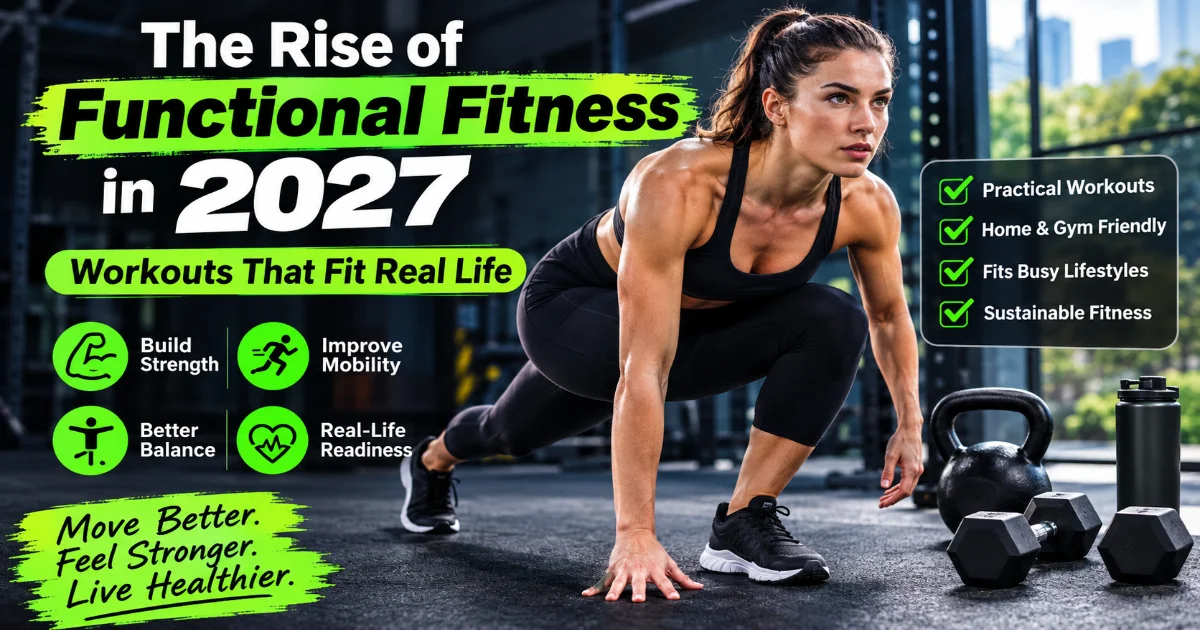
Fitness is changing. People no longer exercise only to lose weight or build muscles. In 2027, more people are expected to focus on workouts that help them feel stronger, move better and handle everyday activities with greater ease.
This is where functional fitness in 2027 is likely to become even more important.
Functional fitness focuses on movements that are useful in daily life. These movements include squatting, pushing, pulling, carrying, bending, walking and balancing. The goal is simple: build a body that is not only fit for the gym but also ready for real life.
For busy people, this approach can also make exercise easier to maintain. A functional workout does not always require expensive equipment or long hours at the gym. In many cases, a short and well-planned session can train several muscle groups at once.
What Is Functional Fitness?
Functional fitness is a type of exercise that improves the way your body performs everyday movements. Instead of focusing only on one muscle, functional exercises often train several muscles and joints together.
For example, a squat uses the legs, hips and core. This movement is similar to sitting down and standing up. Likewise, carrying a weight can help develop the strength needed to carry shopping bags, luggage or other objects.
Common functional exercises include:
- Squats
- Lunges
- Push-ups
- Rows
- Step-ups
- Carries
- Planks
- Dead bugs
- Balance exercises
These exercises can be changed according to a person’s fitness level. Therefore, functional training can work for beginners as well as experienced gym-goers.
Why Functional Fitness Will Matter in 2027
One reason for the growing popularity of functional training is that people want practical results from their workouts.
A person may not care about lifting the heaviest weight in the gym. However, they may want to climb stairs without feeling tired, carry heavy bags comfortably or improve their balance and mobility.
Functional fitness can support these goals.
In addition, modern life is busy. Many people struggle to follow long workout programmes. As a result, shorter and more efficient training sessions are becoming more attractive.
A workout that combines squats, push-ups, lunges and carries can train strength, coordination and stability in a single session.
This makes functional fitness suitable for people who want to get the most value from the time they spend exercising.
Workouts That Fit Real Life
The biggest advantage of functional training is its flexibility.
You do not need to spend two hours in a gym. You can build a useful workout around simple movements and adjust the intensity according to your ability.
For example, a basic full-body routine may include:
1. Squats
Squats strengthen the lower body and improve a movement pattern used regularly in daily life.
Beginners can start with bodyweight squats. As strength improves, resistance can be added gradually.
2. Push-Ups
Push-ups train the chest, shoulders, arms and core.
If regular push-ups are difficult, beginners can start with wall push-ups or incline push-ups.
3. Rows
Rows strengthen the back and arms. They can be performed with resistance bands, dumbbells or other suitable equipment.
A strong back can also support better posture and overall upper-body strength.
4. Lunges
Lunges challenge the legs while also requiring balance and coordination.
Reverse lunges are often easier for beginners to control than more advanced variations.
5. Farmer’s Carries
Farmer’s carries involve walking while holding weights.
This simple exercise can train grip strength, the upper body and the core while improving overall stability.
6. Step-Ups
Step-ups are a practical exercise because they train movements similar to climbing stairs.
They can be performed using a stable platform or step.
7. Core Stability Exercises
Exercises such as planks and dead bugs can help develop core control.
The goal is not simply to train the abdominal muscles. A strong and stable core also supports movement throughout the body.
A Simple Functional Fitness Workout
Here is an example of a basic workout that can fit into a busy schedule.
Start with a five-minute warm-up. Walk, march in place or perform gentle mobility movements.
Then complete the following exercises:
- Squats – 10 to 15 repetitions
- Incline or regular push-ups – 8 to 12 repetitions
- Rows – 10 to 15 repetitions
- Reverse lunges – 8 to 10 repetitions per leg
- Farmer’s carries – 20 to 30 seconds
- Plank – 20 to 40 seconds
Repeat the circuit two or three times depending on your fitness level.
Take enough rest to maintain good form.
Beginners should start slowly. More experienced individuals can increase the resistance or difficulty over time.
Why Short Workouts Are Becoming More Popular
Not everyone has time for a long gym session.
Work, studies, family responsibilities and travel can make it difficult to follow a complicated exercise schedule. Therefore, fitness programmes that fit into daily life may become more popular in 2027.
A 20-minute workout may be easier to maintain than a 90-minute routine.
Consistency is important. A shorter workout performed regularly can become a sustainable habit.
For instance, a person can exercise for 20 to 30 minutes three or four times a week. On other days, they can stay active through walking, cycling or other enjoyable activities.
The best workout plan is often the one that a person can continue for a long time.
Functional Fitness at Home
Another reason behind the growth of functional fitness is that it can be done almost anywhere.
A person can train at home, outdoors or in a gym.
For beginners, bodyweight exercises may be enough to start. Later, simple equipment can add variety and resistance.
Useful equipment may include:
- Resistance bands
- Dumbbells
- A kettlebell
- An exercise mat
- A stable step or bench
However, equipment is not always necessary.
Bodyweight squats, lunges, push-ups and planks can form the foundation of an effective home workout.
This flexibility makes functional fitness useful for people who do not have access to a gym.
Functional Fitness for Different Age Groups
Functional training can be adjusted for different ages and fitness levels.
A young athlete may use heavy weights and explosive movements. On the other hand, an older beginner may focus on chair squats, light resistance exercises and balance training.
The exercises may be different, but the main goal remains similar: improve strength, mobility and confidence in movement.
For this reason, functional fitness can support people at different stages of life.
However, people with injuries, medical conditions or movement limitations should speak with an appropriately qualified healthcare professional before starting a new exercise programme.
Technology and Personalised Fitness
Technology is also changing the way people exercise.
Fitness watches, mobile apps and other wearable devices can help people track activity and monitor their training habits.
In 2027, more fitness programmes may become personalised.
For example, technology may help users understand their activity levels and recovery patterns. This information can help people make better decisions about when to train and when to rest.
Still, technology should support a fitness routine rather than control it.
A person does not need to track every movement or every calorie to make progress. Simple and consistent exercise remains important.
The Importance of Mobility and Balance
Strength is only one part of fitness.
Mobility and balance can also play an important role in everyday movement. Therefore, many functional workouts include exercises that improve control and stability.
Simple activities such as controlled lunges, single-leg movements and mobility exercises can help improve body awareness.
Mobility training can also make workouts feel more comfortable when combined with appropriate strength training.
Rather than treating strength and mobility as separate goals, functional training often brings them together.
How to Make Functional Fitness Part of Your Routine
Starting does not need to be complicated.
Choose a few basic exercises and focus on performing them with good technique. Then increase the difficulty gradually.
A simple weekly routine could look like this:
Day 1: Full-body functional strength workout
Day 2: Walking, cycling or another light activity
Day 3: Rest or mobility exercises
Day 4: Full-body functional workout
Day 5: Walking or recreational activity
Day 6: Optional short workout
Day 7: Rest and recovery
This is only an example. The best routine depends on your schedule, fitness level and personal goals.
The key is to create a routine that fits your life instead of forcing your life to fit around an unrealistic workout programme.
The Future of Functional Fitness
The rise of functional fitness in 2027 reflects a wider change in the fitness industry.
People are increasingly looking for workouts that are practical, flexible and sustainable. They want to feel strong in everyday life, not only during a gym session.
As a result, future workout programmes may combine:
- Strength training
- Mobility exercises
- Balance training
- Cardiovascular activity
- Shorter workout sessions
- Home-based training
- Personalised fitness technology
Functional fitness does not mean that traditional gym training will disappear. Weightlifting, bodybuilding, running, cycling and other forms of exercise will continue to have their own benefits.
Instead, functional training can become an important part of a balanced fitness routine.
Final Thoughts
Functional fitness in 2027 is likely to appeal to people because it focuses on something practical: becoming stronger for everyday life.
The goal is not to follow the most complicated workout or spend endless hours exercising. Instead, it is about improving strength, movement, balance and mobility in a way that fits your schedule.
A good workout should support your life.
Whether you exercise at home, in a gym or outdoors, the most important factor is consistency. Start with simple movements, focus on proper technique and progress gradually.
In the end, the best fitness routine is one that helps you move well, feel strong and continue exercising for years to come.
Frequently Asked Questions
What is functional fitness?
Functional fitness is a type of exercise that focuses on improving movements used in everyday life. It often includes exercises such as squats, lunges, pushing, pulling and carrying.
Is functional fitness good for beginners?
Yes. Functional exercises can be modified for beginners. A person can start with bodyweight movements or easier variations and gradually increase the difficulty.
Can I do functional fitness at home?
Yes. Many functional workouts can be performed at home using bodyweight exercises. Resistance bands, dumbbells or kettlebells can also be added if available.
How often should I do functional workouts?
The ideal frequency depends on your fitness level and recovery. Many people can start with two or three strength-focused sessions per week and adjust their routine over time.
Will functional fitness help with everyday activities?
Functional exercises are designed around movement patterns that can support everyday physical activities. The benefits will depend on the exercises, training consistency and individual fitness level.




Pingback: Cold Plunge Craze: 7 Ultimate Benefits & How to Start Safely