
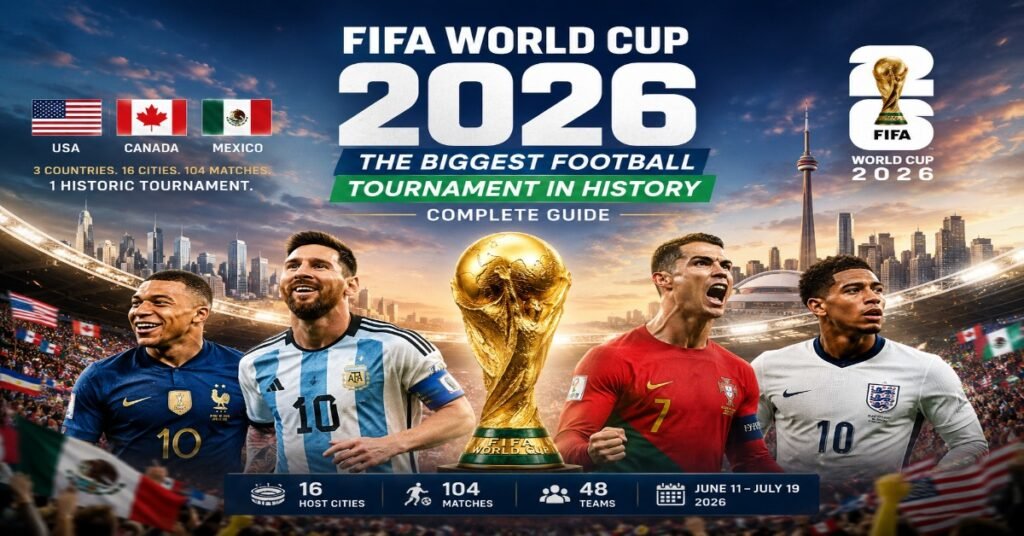
Opening: A Tournament Like No Other
Once every four years, the world stops and watches football. But on June 11, 2026, something different will happen. Something unprecedented. Something that will redefine what the world’s most beloved sporting event can look and feel like.
The 23rd FIFA World Cup has arrived — and it is not just bigger than anything that came before it. It is categorically different. Forty-eight nations. One hundred and four matches. Sixteen cities. Three countries on one continent. A tournament stretching from the sun-scorched stadiums of Mexico to the glistening waterfronts of Vancouver — spanning climates, cultures, time zones, and football traditions across 39 extraordinary days.
If the 1994 World Cup in the United States was a tournament that introduced the game to a new continent, then FIFA World Cup 2026 is the tournament that proves North America has fully, passionately, and permanently fallen in love with football.
This is your complete, detailed guide to everything you need to know.
Quick Facts — FIFA World Cup 2026 at a Glance
| Detail | Information |
|---|---|
| Official Name | FIFA World Cup 2026 / FIFA World Cup 26™ |
| Edition | 23rd FIFA World Cup |
| Host Countries | United States, Canada, Mexico |
| Total Teams | 48 (expanded from 32) |
| Total Matches | 104 (up from 64 in 2022) |
| Total Venues | 16 stadiums across 16 cities |
| Tournament Dates | June 11 – July 19, 2026 |
| Opening Match | Mexico vs South Africa at Estadio Azteca, Mexico City (June 11) |
| Final Venue | MetLife Stadium, New York/New Jersey (July 19) |
| Group Stage Format | 12 groups of 4 teams |
| Knockout Structure | Round of 32 → Round of 16 → QF → SF → Final |
| Debut Nations | Cape Verde, Curaçao, Jordan, Uzbekistan |
| Defending Champions | Argentina (Qatar 2022) |
| India TV Rights | Zee Entertainment (expected confirmation) |
Section 1: Why FIFA World Cup 2026 Is Truly Historic
The 48-Team Revolution
Every World Cup carries the tag of “biggest ever.” But 2026 earns it in a way that no previous edition has. The decision by FIFA to expand the tournament from 32 to 48 participating teams is the most significant structural change to the competition in a generation.
In every World Cup from 1998 to 2022, thirty-two nations participated. At Qatar 2022, 64 matches were played. In 2026, 104 matches will be contested — a 62.5% increase in total game volume. This expansion means 16 additional nations will experience their first World Cup, or return after long absences, bringing with them entirely new audiences, new storylines, and new footballing identities.
The expanded format also introduces the Round of 32 as a permanent feature of the knockout stage — for the first time in World Cup history, 32 teams will contest a round of knockout football before the Round of 16. This means the four semifinalists will each have played eight matches to reach that stage, rather than seven — making the physical demands of 2026 the most challenging the tournament has ever placed on its participants.
The First Three-Nation Co-Host
Not since Japan and South Korea shared hosting duties in 2002 has a World Cup been hosted by more than one country. But where 2002 involved two neighboring nations, 2026 goes three — and across a continent of staggering size and diversity.
The United States, Canada, and Mexico have together bid for and won the right to host football’s grandest occasion, creating a tournament footprint that spans from Toronto in the north to Guadalajara in the south, and from Los Angeles on the Pacific Coast to Boston and Philadelphia on the Atlantic. Fans following their teams through the knockout rounds could find themselves travelling thousands of miles between matches — a logistical and experiential adventure unlike anything previous World Cups have offered.
North America’s Return After 32 Years
The last time North America hosted a World Cup was 1994, when the United States staged a tournament that became the most attended in the competition’s history — 3.6 million fans across the group and knockout stages. That record has stood for three decades. In 2026, with 104 matches compared to 1994’s 52, combined across three countries, the attendance record is expected to be shattered comprehensively.
The 1994 tournament also lit a spark in American football culture. Major League Soccer was launched as a direct consequence in 1996. An entire generation of American sports fans discovered the beautiful game. Three decades on, the United States is a mature football nation with world-class infrastructure, fanatical club-level support, and a national team competing seriously at international level. Canada and Mexico bring their own passionate, deeply embedded football cultures to the party. The time is absolutely right.
Section 2: Tournament Format — How It Works
Group Stage
The 48 qualified teams are divided into 12 groups of 4 teams. Every team plays three group-stage matches — one against each of their group opponents.
The top two teams from each group qualify automatically for the Round of 32. In addition, the eight best third-placed teams across all 12 groups also advance, bringing the total number of Round of 32 participants to 32.
The final round of group-stage matches within each group is always played simultaneously, protecting the competitive integrity of results. No team can benefit from knowing another game’s outcome before their own match ends.
Knockout Rounds — Stage by Stage
| Round | No. of Teams | Matches | Dates |
|---|---|---|---|
| Round of 32 | 32 | 16 matches | June 28 – July 3 |
| Round of 16 | 16 | 8 matches | July 4 – July 7 |
| Quarter-finals | 8 | 4 matches | July 9 – July 11 |
| Semi-finals | 4 | 2 matches | July 14 – July 15 |
| Third-Place Play-off | 2 | 1 match | July 18 |
| Final | 2 | 1 match | July 19 |
The Pathway System
FIFA has introduced a structured two-pathway knockout bracket designed to keep the highest-ranked and most marketable teams separated until the semi-finals. Spain (FIFA ranking 1st), France (3rd), England (4th), and Argentina (2nd) have all been placed in separate bracket pathways — meaning, if all four progress from their groups, they cannot face one another until the last four.
This ensures maximum excitement in the later stages and avoids the scenario where two giants eliminate each other in the quarter-finals.
Section 3: Complete Schedule — Key Dates
| Phase | Date(s) |
|---|---|
| Opening match (Mexico vs South Africa) | June 11, 2026 |
| Group Stage | June 11 – June 27 |
| Round of 32 | June 28 – July 3 |
| Round of 16 | July 4 – July 7 |
| Quarter-finals | July 9 – July 11 |
| Semi-finals | July 14 – July 15 |
| Third-place play-off | July 18, 2026 |
| Final — MetLife Stadium | July 19, 2026 |
Section 4: The 16 Host Venues — A Stadium-by-Stadium Guide
United States (11 Venues)
The United States provides the tournament’s largest infrastructure, hosting 11 of the 16 venues — including both semi-finals and the grand final itself. Predominantly NFL stadiums, these venues have been temporarily converted for football, with new natural grass pitches installed, stadium names replaced with city-based tournament names, and seating reconfigured for optimal sightlines.
| FIFA Tournament Name | Actual Stadium | City | Capacity | Key Matches |
|---|---|---|---|---|
| New York New Jersey Stadium | MetLife Stadium | East Rutherford, NJ | 78,576 | Final (July 19) |
| Dallas Stadium | AT&T Stadium | Arlington, TX | 94,000 | Semi-final |
| Atlanta Stadium | Mercedes-Benz Stadium | Atlanta, GA | ~72,000 | Semi-final |
| Miami Stadium | Hard Rock Stadium | Miami Gardens, FL | ~65,000 | Third-place play-off |
| Los Angeles Stadium | SoFi Stadium | Inglewood, CA | ~70,000 | Key group + KO matches |
| Houston Stadium | NRG Stadium | Houston, TX | ~72,000 | Group + KO matches |
| San Francisco Bay Area Stadium | Levi’s Stadium | Santa Clara, CA | ~68,000 | Group + KO matches |
| Seattle Stadium | Lumen Field | Seattle, WA | ~69,000 | Group + KO matches |
| Philadelphia Stadium | Lincoln Financial Field | Philadelphia, PA | ~69,000 | Group + KO matches |
| Boston Stadium | Gillette Stadium | Foxborough, MA | ~65,000 | Group + KO matches |
| Kansas City Stadium | Arrowhead Stadium | Kansas City, MO | ~76,000 | Group + KO matches |
Notable fact: AT&T Stadium in Dallas, at 94,000 seats, is the largest venue in the tournament — making it the biggest stadium ever to host a FIFA World Cup semi-final.
Notable fact: MetLife Stadium (FIFA name: New York New Jersey Stadium) is the Final venue. It is undergoing significant renovation including the installation of a natural grass pitch and removal of 1,740 corner seats to accommodate a full-size football surface.
Mexico (3 Venues)
Mexico becomes the first nation in history to host World Cup matches at three separate tournaments — having previously hosted in 1970 and 1986.
| FIFA Tournament Name | Actual Stadium | City | Capacity | Historic Significance |
|---|---|---|---|---|
| Mexico City Stadium | Estadio Azteca | Mexico City | ~87,000 | First stadium to host 3 World Cups; Opening Match venue |
| Guadalajara Stadium | Estadio Akron | Guadalajara | ~49,000 | Group stage matches |
| Monterrey Stadium | Estadio BBVA | Monterrey | ~53,000 | Group stage matches |
Estadio Azteca is the undisputed crown jewel of the three Mexican venues — a cathedral of football history. It staged the 1970 final (Brazil 4-1 Italy) and the 1986 final (Argentina 3-2 West Germany), and was the location of Diego Maradona’s legendary “Hand of God” goal and the equally legendary “Goal of the Century” at Mexico 1986. Hosting the 2026 opening match adds another chapter to its extraordinary story.
Canada (2 Venues)
Canada makes its debut as a World Cup host nation in 2026, with two venues across its two largest cities.
| FIFA Tournament Name | Actual Stadium | City | Capacity | Notable Feature |
|---|---|---|---|---|
| Toronto Stadium | BMO Field | Toronto, Ontario | ~45,000 | Received $146 million renovation for the tournament |
| Vancouver Stadium | BC Place | Vancouver, BC | ~54,000 | Retractable roof — weather-proof |
BMO Field, despite being the tournament’s smallest venue, received a $146 million renovation programme specifically to prepare it for World Cup football — demonstrating the scale of Canada’s commitment to the event. BC Place in Vancouver offers the unique advantage of a retractable roof, offering guaranteed shelter from weather — a significant operational consideration for FIFA.
Section 5: The 12 Groups — All 48 Teams
The Group Stage draw took place on December 5, 2025. Here are all 12 groups:
| Group | Teams |
|---|---|
| A | Mexico, South Africa, South Korea, Czechia |
| B | Canada, Switzerland, Qatar, Bosnia & Herzegovina |
| C | Brazil, TBD, TBD, TBD |
| D | USA, Paraguay, Australia, Türkiye |
| E | TBD |
| F | TBD |
| G | TBD |
| H | TBD |
| I | TBD |
| J | Argentina, TBD, TBD, TBD |
| K | TBD |
| L | England, TBD, TBD, TBD |
Note: Full group compositions and confirmed results are being updated as the tournament progresses. Groups C, E–I, K are subject to confirmation.
The Host Nations’ Groups
Mexico (Group A) faces one of the toughest group draws — South Korea, Czechia and South Africa form a formidable challenge. This is arguably the most competitive of all 12 groups.
USA (Group D) faces Paraguay, Australia, and Türkiye in a manageable but not straightforward group. USMNT open against Paraguay in Los Angeles.
Canada (Group B) are drawn against Switzerland, Qatar, and Bosnia & Herzegovina — and will play all three group matches on home soil, beginning in Toronto before moving to Vancouver.
Section 6: The Stars — Players to Watch
Lionel Messi (Argentina)
At 38 years old when this World Cup begins, Lionel Messi faces the most emotionally charged tournament of his extraordinary career. Having lifted the FIFA World Cup trophy in Qatar 2022 — the one major honour that had eluded him across his entire career — he now arrives in 2026 as both the defending champion’s talisman and a man playing what is almost certainly his last World Cup.
Every moment Messi touches the ball in 2026 will carry the weight of a farewell. The question that consumes Argentine football is not whether he will be great — it is whether his body can sustain the demands of eight matches across a gruelling 39-day tournament.
Cristiano Ronaldo (Portugal)
At 41, Cristiano Ronaldo’s very presence in a World Cup squad would represent one of sport’s great acts of longevity. Portugal’s participation means Ronaldo has the chance to bow out on the world’s biggest stage. Whether he starts, impacts from the bench, or plays a leadership role for the next generation — Bruno Fernandes, João Félix, Diogo Jota — his storyline is one of the tournament’s most compelling.
Lamine Yamal (Spain)
Just 18 years old, Lamine Yamal of Barcelona is the most exciting young player on the planet and the face of tournament favourites Spain. Having lit up Euro 2024 with performances of breathtaking audacity and skill, Yamal arrives at this World Cup as the player the world most wants to see. If Spain go deep — and they are strong favourites to do exactly that — Yamal will be the player everyone is talking about.
Kylian Mbappé (France)
Real Madrid’s Kylian Mbappé is the most expensive player in football history, and France arrive at this tournament with perhaps the deepest squad of any nation. Mbappé’s partnership with Antoine Griezmann, Ousmane Dembélé, and a formidable midfield makes France the team with the most complete, balanced roster. Many analysts rate France as the team most capable of winning every single match they play — regardless of opponent.
Erling Haaland (Norway)
The most feared goalscorer in club football, Erling Haaland now brings his extraordinary goal-scoring machinery to the World Cup stage. Norway have qualified for the first time in decades, and their primary weapon is a player who has averaged more than a goal per game throughout his career. If Haaland fires, Norway could be the tournament’s great dark horse.
Vinícius Júnior (Brazil)
Brazil have not won a World Cup since 2002 — their longest gap between titles — and the pressure on Vinícius Júnior to finally break that drought is immense. The Real Madrid winger is one of the world’s two or three most dangerous attackers and brings a directness and unpredictability that defenders genuinely struggle to contain. Brazil’s tournament chances rest significantly on his form and fitness.
Jude Bellingham (England)
Real Madrid’s Jude Bellingham embodies England’s most realistic claim to winning a first-ever World Cup. Composed, technically exceptional, and capable of both goalscoring and midfield dominance, Bellingham is the kind of player around whom tournament victories are built. England, under whatever tactical framework their manager has established, will look to him for inspiration in the critical moments.
Section 7: Title Contenders — Who Will Win It?
Spain — Favourites
Spain enter as the overwhelming favourites. The reigning European Champions, having won Euro 2024 convincingly, they are also the world’s top-ranked nation. Their squad blends technical superiority with genuine depth — Lamine Yamal, Pedri, Rodri, Nico Williams, Mikel Oyarzabal, Fabián Ruiz. More significantly, Spain’s team functions as a cohesive unit rather than a collection of individual stars. That collective coherence is what often separates World Cup winners from merely talented squads.
Current betting odds place Spain at approximately 5/1 to 9/2 (around 16% probability).
France — Equally Dangerous
France arguably possess the strongest squad on paper — possibly the deepest of any nation. Mbappé, Griezmann, Dembélé, Camavinga, Tchouaméni — the talent extends across every position. France’s weakness historically has been converting squad quality into tournament performance, but under strong management they are genuine co-favourites. Current odds place France at roughly 6/1 (12–13% probability).
England — Overdue?
England have never won a World Cup outside of their home tournament in 1966, and the question of whether 2026 is finally “their time” has become a national obsession. Bellingham, Saka, Foden, Kane — England possess attacking talent to challenge any nation. Their group draw in Group L appears manageable. Current odds: approximately 6/1 to 7/1 (12%).
Argentina — Defending Champions
Argentina arrive as defending champions, but defending a World Cup title is one of football’s hardest achievements — only Brazil managed it (1958 and 1962). The central question is the role and physical condition of Lionel Messi. Around him, Lautaro Martínez, Julián Álvarez, Enzo Fernández, Rodrigo De Paul and Alexis Mac Allister form a formidable core. Argentina are priced at roughly 8/1 to 10/1 (9–10%).
Brazil — Talent Seeking Direction
Brazil’s talent level — led by Vinícius Júnior, Raphinha, and Marquinhos — places them firmly among contenders. Their challenge is tactical and psychological rather than technical. Brazil have the quality to beat anyone on any given day; the question is whether they can sustain the consistency and composure that a championship run demands. Odds: approximately 8/1 to 9/1 (8–9%).
Dark Horses: Portugal, Germany, Netherlands, Norway
Portugal (11/1), with Bruno Fernandes leading a talented squad, could go deep. Germany (14/1) — built around the exceptionally gifted Florian Wirtz — are rebuilding but capable of a deep run. Netherlands (22/1) with Virgil van Dijk providing leadership. And Norway (35/1), with Haaland as the ultimate wildcard — capable of single-handedly deciding knockout matches.
Title Contenders Summary Table
| Team | Win Probability | Key Player | Strength |
|---|---|---|---|
| Spain | ~16% | Lamine Yamal | Cohesion + technical quality |
| France | ~13% | Kylian Mbappé | Squad depth |
| England | ~12% | Jude Bellingham | Balanced squad |
| Argentina | ~9% | Lionel Messi | Experience + defending champions |
| Brazil | ~8–9% | Vinícius Júnior | Elite attack |
| Portugal | ~6–7% | Bruno Fernandes | Star quality |
| Germany | ~5–6% | Florian Wirtz | Tactical evolution |
| Netherlands | ~3–4% | Van Dijk | Defensive solidity |
| Norway | ~3% | Erling Haaland | Goal-scoring weapon |
Section 8: The Debut Nations — Football’s New Voices
One of the most moving aspects of every World Cup is the arrival of debut nations — countries experiencing the tournament for the very first time, bringing their people’s dreams to the world’s grandest stage.
Cape Verde
Cape Verde — a small Atlantic island nation off the coast of West Africa — make their historic World Cup debut. The Tubarões Azuis (Blue Sharks) have enjoyed remarkable recent progress in African football. Their squad is built around players from Portuguese and European club football, and while a deep run is unlikely, their presence enriches the tournament culturally and emotionally.
Curaçao
The small Caribbean island of Curaçao makes its debut — a significant milestone for Caribbean football and a source of immense national pride for a territory of fewer than 200,000 people.
Jordan
Jordan’s debut is one of the most significant moments for football in the Arab world since Qatar 2022. The Nashama (Brave Ones) qualified after a remarkable run through the Asian qualification process, bringing an entire region’s passion to the global stage.
Uzbekistan
Central Asia’s most populous nation, Uzbekistan, qualifies for its first ever World Cup — representing a growing football infrastructure across a region of over 35 million people, and part of the game’s expansion across previously under-represented territories.
Section 9: India and the World Cup — Broadcast Rights and Fan Guide
The Broadcast Rights Drama
For Indian football fans, the weeks leading up to the 2026 World Cup have been as dramatic off the pitch as anything happening on it. A prolonged uncertainty over who would secure the broadcast rights to air the tournament in India — one of the world’s largest and fastest-growing football markets — has finally moved toward resolution.
FIFA set a high asking price for India’s broadcast rights, which initially deterred major Indian broadcasters. The standoff created genuine concern that Indian fans might not be able to watch the tournament on mainstream television. However, Zee Entertainment Enterprises has reportedly stepped in to close a deal, covering both television broadcast and digital streaming rights.
This would end months of uncertainty and ensure that Indian fans can follow all 104 matches of the tournament — including the Messi farewell, Spain’s title push, and the historic opening match — on both TV screens and mobile devices.
What This Means for Indian Fans
| Platform | Expected Coverage |
|---|---|
| TV Broadcast | Zee channels (confirmation pending) |
| Live Streaming | Zee’s digital streaming platform |
| Coverage | All 104 matches expected |
| Languages | Hindi, English (and possibly regional languages) |
Note: Zee Entertainment’s deal was reportedly near finalisation as of late May 2026. Indian fans should verify the confirmed channel details from official announcements before June 11.
India and Football’s Growing Market
India’s football fanbase — already among the world’s largest for following European club football — represents enormous untapped potential for FIFA. The fact that rights negotiations stretched to the wire reflects both the value FIFA places on the Indian market and the commercial complexity of serving over 1.4 billion potential viewers. The resolution of this standoff is a positive development for the long-term growth of football’s commercial and cultural footprint in India.
Section 10: Key Records and Historical Context
What Is at Stake Historically
- Most World Cup titles: Brazil hold the all-time record with 5 titles (1958, 1962, 1970, 1994, 2002). A 2026 Brazil win would tie them at 5 and revive the greatest winning dynasty in the game’s history.
- Back-to-back champions: Only Brazil has ever successfully defended a World Cup title (1958 and 1962). Argentina have a chance to become only the second nation to achieve this feat.
- Third World Cup for Estadio Azteca: No stadium in World Cup history has hosted matches across three different tournaments. Estadio Azteca achieves this milestone in 2026.
- First three-nation host: The USA, Canada and Mexico become the first trio of nations to co-host a World Cup.
- Largest tournament: 48 teams and 104 matches represent the largest World Cup in history by every measure.
World Cup Winners — Historical Record
| Nation | Titles | Years |
|---|---|---|
| Brazil | 5 | 1958, 1962, 1970, 1994, 2002 |
| Germany | 4 | 1954, 1974, 1990, 2014 |
| Italy | 4 | 1934, 1938, 1982, 2006 |
| Argentina | 3 | 1978, 1986, 2022 |
| France | 2 | 1998, 2018 |
| Uruguay | 2 | 1930, 1950 |
| England | 1 | 1966 |
| Spain | 1 | 2010 |
Section 11: The Economic and Cultural Scale of 2026
Revenue and Investment
FIFA has generated close to $4 billion in broadcasting revenue alone during the 2026 World Cup cycle — a testament to the tournament’s unmatched global commercial value. Ticket prices on the official platform range from approximately $60 for group stage matches to upwards of $10,000 for premium final seats — reflecting both the scale of global demand and FIFA’s implementation of dynamic pricing for the first time at a World Cup.
The combined economic impact across all three host nations is projected to run into tens of billions of dollars — in tourism, hospitality, infrastructure, media, and local business activity.
Stadium Naming for the Tournament
In a significant move to protect its commercial partners and prevent ambush marketing, FIFA has assigned every venue a neutral city-based tournament name for the duration of the competition. Thus, MetLife Stadium becomes the “New York New Jersey Stadium,” SoFi Stadium becomes the “Los Angeles Stadium,” and so on across all 16 venues. This is a first for the World Cup at this scale and reflects FIFA’s increasingly sophisticated approach to commercial rights management.
Section 12: 10 Things That Make FIFA 2026 Uniquely Special
- First 48-team World Cup — 16 more nations than ever before, creating new stories and new rivalries.
- Three-nation host — The USA, Canada, and Mexico combining forces for the first time in World Cup history.
- 104 matches — More football than any previous edition by a wide margin.
- Estadio Azteca’s third World Cup — The most historic stadium in the tournament’s history achieves an unprecedented milestone.
- Round of 32 — A completely new knockout round added to the structure.
- Messi’s likely final World Cup — The greatest player of his generation bowing out on the world’s biggest stage.
- Four debut nations — Cape Verde, Curaçao, Jordan, and Uzbekistan making their first-ever appearances.
- North America’s return after 32 years — A continent transformed by football’s growth in three decades.
- Lamine Yamal’s global coming-of-age — The 18-year-old phenomenon could become the tournament’s defining star.
- MetLife Stadium final — New York/New Jersey hosting the biggest single sporting event on Earth on July 19.
Section 13: FAQs — Everything You Need to Know
Q: When does FIFA World Cup 2026 start?
A: The tournament begins on June 11, 2026, with Mexico vs South Africa at Estadio Azteca in Mexico City.
Q: Where is the FIFA World Cup 2026 final?
A: The final is at MetLife Stadium (FIFA name: New York New Jersey Stadium) in East Rutherford, New Jersey, USA, on July 19, 2026.
Q: How many teams are in FIFA World Cup 2026?
A: 48 teams — expanded from 32 in previous editions.
Q: How many matches will be played?
A: 104 total matches — 72 in the group stage and 32 in the knockout rounds.
Q: Which countries are hosting FIFA World Cup 2026?
A: The United States (11 venues), Mexico (3 venues), and Canada (2 venues) — totalling 16 host cities.
Q: Who are the favourites to win FIFA World Cup 2026?
A: Spain and France lead the betting, followed by England, Argentina, Brazil, and Portugal.
Q: Where can Indian fans watch FIFA World Cup 2026?
A: Zee Entertainment Enterprises is reportedly in the final stages of securing broadcast and streaming rights for India. Official confirmation is expected before June 11.
Q: Is this Messi’s last World Cup?
A: Lionel Messi is 38 at the tournament’s start. While not officially confirmed as his last, it is widely expected to be his final World Cup appearance.
Q: Which nations are making their World Cup debut in 2026?
A: Cape Verde, Curaçao, Jordan, and Uzbekistan are all appearing at their first-ever FIFA World Cup.
Q: Which stadium hosts the most matches in 2026?
A: The exact match distribution across venues is confirmed by FIFA, with larger venues hosting semi-finals and the final receiving the most high-profile fixtures. AT&T Stadium (Dallas) at 94,000 seats hosts a semi-final; MetLife Stadium hosts the final.
Conclusion: Football’s Greatest Chapter Begins
There are moments in sporting history that feel genuinely different — where the scale, the timing, the cast, and the setting converge to create something that transcends competition and becomes cultural memory.
FIFA World Cup 2026 has all the ingredients. Forty-eight nations. Four debut countries with dreams as big as any veteran. Lionel Messi writing one final, magical chapter. Lamine Yamal announcing himself as the new king of world football. Spain and France locked in a battle for supremacy. Brazil chasing an end to a 24-year title drought. England imagining 60 years of hurt finally ending.
From the historic opening whistle at Estadio Azteca on June 11 to the final’s crescendo at MetLife Stadium on July 19, this tournament will produce moments, heroes, heartbreaks, and history that the world will still be talking about decades from now.
For football fans in India and across the globe — whatever screen you’re watching it on, whatever time zone you’re adjusting your sleep schedule for — FIFA World Cup 2026 is worth every bit of the wait.
The world’s greatest sporting event has never been bigger. It starts now.