There is a reason destination weddings in India have captured the imagination of couples across the world. Imagine exchanging vows in a centuries-old Rajasthani palace as the desert sun sets behind ancient battlements. Or standing beneath a floral mandap on a Goan beach as the Arabian Sea shimmers in the distance. Or celebrating in the misty hills of Coorg surrounded by coffee plantations and the quiet grandeur of the Western Ghats.
India offers a destination wedding landscape that is simply incomparable — a country where royal heritage, extraordinary natural beauty, diverse cultural traditions, world-class hospitality infrastructure, and a deeply embedded celebration culture combine to create wedding experiences that guests remember for the rest of their lives.
In 2026, destination weddings in India have evolved into a sophisticated, well-serviced industry — with dedicated wedding planners, specialist vendors, luxury heritage properties, and logistical infrastructure that makes producing a world-class multi-day celebration in virtually any corner of the country more achievable than ever before.
But destination weddings are also genuinely complex undertakings. The distance, the logistics, the vendor coordination, the guest management, and the sheer scale of most Indian destination weddings create planning challenges that require methodical organization, professional support, and significantly more lead time than a local wedding.
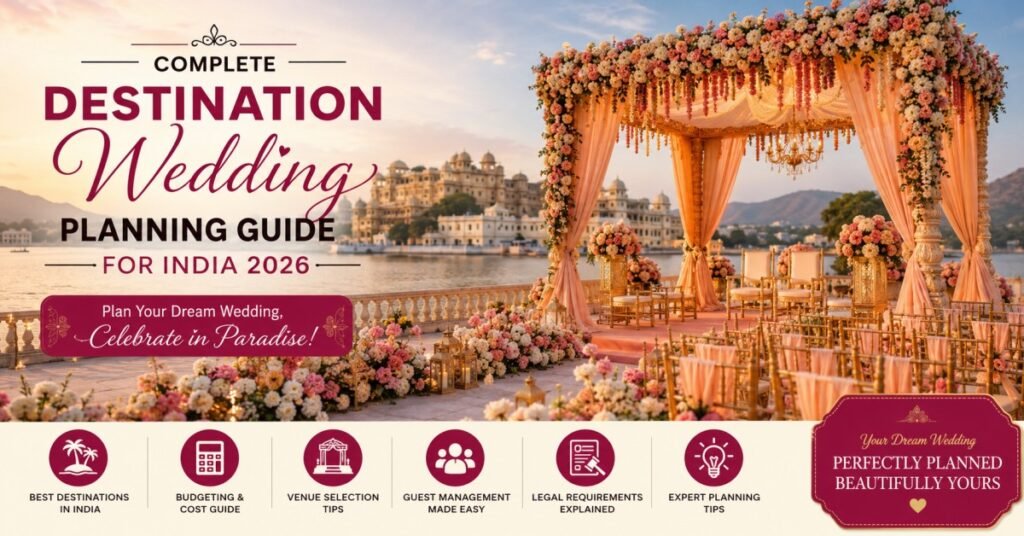
This complete destination wedding planning guide for India 2026 covers everything — from choosing your destination and venue through budget planning, vendor selection, guest management, legal requirements, and the week-of logistics that determine whether your destination wedding unfolds as the magical experience it is meant to be.
Why India for Your Destination Wedding?
Before diving into planning specifics, understanding what makes India exceptional as a destination wedding location helps frame every subsequent decision.
Unmatched venue diversity: No country on earth offers the range of wedding venue options that India provides — Rajasthani palace hotels (called palace hotels or heritage properties), Goan beach resorts, Kerala backwater estates, Himalayan mountain retreats, Udaipur lake palaces, Coorg plantation bungalows, and contemporary luxury resort properties that have been purpose-built for large-scale celebrations. Every aesthetic, every mood, every vision has a corresponding venue somewhere in India.
Deep celebration culture: India’s cultural relationship with weddings — as multi-day celebrations of community, joy, and family — means that the infrastructure, the hospitality mindset, and the vendor ecosystem that supports exceptional destination weddings is deeply embedded. Indian hospitality professionals understand celebration at scale in a way that few other cultures match.
Value for international budgets: For international couples and NRI families, India’s destination wedding market offers extraordinary value compared to equivalent venue and hospitality experiences in Europe or the Americas. Palace hotels and luxury resort properties that would cost extraordinary sums in Western markets are achievable at a fraction of the price in India — without any compromise in the quality of the experience.
Cultural richness: A destination wedding in India is not simply a wedding at a beautiful location — it is an immersion in one of the world’s most extraordinary living cultures. Your guests do not just attend a wedding — they experience India, with all its color, cuisine, music, and cultural depth. This experiential dimension elevates a destination wedding in India above simple event logistics into something genuinely transformative.
Step 1: Choose Your Destination
India’s destination wedding landscape divides into several distinct regions, each with its own character, aesthetic, logistics profile, and seasonal considerations.
Rajasthan — The Palace Wedding Capital
Rajasthan is India’s undisputed destination wedding capital — and for very good reason. The state’s extraordinary heritage hotel infrastructure — converted Maharaja palaces, forts, and havelis operating as luxury properties — provides a backdrop for weddings that is genuinely unlike anything available anywhere else in the world.
Key destinations: Udaipur (the City of Lakes — consistently ranked among the world’s most romantic cities), Jaipur (the Pink City with its magnificent fort and palace properties), Jodhpur (the Blue City with the dramatic Mehrangarh Fort backdrop), Jaisalmer (the desert golden city with its extraordinary sand dune landscapes), and Pushkar (a sacred lake town with intimate heritage property options).
Best season: October through February — Rajasthan’s winter months offer comfortable temperatures ideal for outdoor ceremonies and celebrations. March through June brings intense heat. July through September is monsoon season.
Best for: Couples wanting royal heritage aesthetics, dramatic architectural backdrops, large multi-day celebrations with 200 to 500 guests.
Goa — The Beach Wedding Paradise
Goa offers India’s most accessible and internationally familiar destination wedding experience — combining beautiful beaches, Portuguese colonial architecture, a cosmopolitan hospitality culture, and excellent air connectivity from both Indian and international airports.
Key destinations: North Goa for luxury beach resort properties and vibrant social atmosphere, South Goa for quieter, more exclusive beach wedding venues with larger private spaces, and heritage properties in Old Goa’s colonial quarter for couples wanting architectural character over pure beach setting.
Best season: November through February — Goa’s dry season with reliable sunshine and cool evenings perfect for outdoor beach ceremonies.
Best for: Couples wanting beach aesthetics, international guest accessibility, relaxed coastal atmosphere, intimate to medium-scale celebrations of 50 to 200 guests.
Kerala — The Backwater Wedding Destination
Kerala offers a destination wedding experience defined by extraordinary natural beauty — the famous backwaters, lush tropical landscapes, coconut-lined shores, and the peaceful unhurried quality that makes this corner of India so distinctive.
Key destinations: Alleppey (Alappuzha) for backwater and houseboat wedding experiences, Kovalam and Varkala for cliff-top and beach wedding venues, Munnar for misty hill station plantation settings, and Kumarakom for intimate lake-side luxury properties.
Best season: December through March avoids both the southwest monsoon (June to August) and the northeast monsoon (October to November). Kerala’s monsoon season is dramatic and beautiful but operationally challenging for outdoor weddings.
Best for: Couples wanting natural tropical beauty, intimate smaller celebrations of 30 to 100 guests, Ayurvedic wellness experiences for guests, distinctly South Indian cultural context.
Himachal Pradesh and Uttarakhand — The Mountain Wedding Destinations
For couples drawn to dramatic mountain landscapes, the Himalayan destinations of Himachal Pradesh and Uttarakhand offer wedding experiences of extraordinary natural grandeur — snow-capped peaks, cedar forests, and the spiritual energy of India’s sacred mountain traditions.
Key destinations: Shimla and Kasauli in Himachal Pradesh for colonial hill station character, Manali for dramatic high-altitude mountain settings, Mussoorie and Dehradun in Uttarakhand for accessible Himalayan wedding venues, and Rishikesh for spiritually infused mountain river settings.
Best season: April through June and September through November — avoiding peak summer heat in the plains and harsh winter conditions at high altitudes.
Best for: Intimate celebrations under 100 guests, couples wanting natural mountain grandeur, spiritually meaningful settings, adventurous guests who appreciate outdoor experiences.
Other Notable Destinations
Coorg, Karnataka: Misty coffee plantation estates offering intimate, nature-immersive wedding experiences for smaller guest lists.
Ranthambore, Rajasthan: Wildlife sanctuary adjacent luxury properties combining royal Rajasthani heritage with extraordinary wildlife experience for adventurous guests.
Pondicherry: French colonial architecture and Bay of Bengal coastal setting offering a unique Indo-French aesthetic for intimate weddings.
Andaman Islands: For truly distinctive destination weddings combining pristine tropical island beauty with the adventure of India’s most remote spectacular destination.
Step 2: Set Your Destination Wedding Budget
Destination weddings are inherently more expensive than local celebrations — and understanding the complete cost picture from the beginning prevents the budget overruns that derail destination wedding planning.
Major budget categories:
Venue rental: Heritage palace and luxury resort venue rentals for full property buyout — the preferred arrangement for most Indian destination weddings — range from ₹5,00,000 to ₹50,00,000 and above per day depending on the property’s size, heritage status, and luxury positioning.
Guest accommodation: In a full property buyout arrangement, guest room costs are bundled with venue rental. In partial buyout arrangements, room blocks must be separately negotiated and typically represent the largest single budget line item.
Food and beverage: Multi-day destination weddings with multiple functions — Mehendi, Sangeet, wedding ceremony, and reception — require extensive catering. Budget ₹2,000 to ₹8,000 per person per meal for quality catering at destination wedding properties.
Decor and florals: Destination wedding decor — including transportation of specialty decor elements, floral installations, lighting design, and set dressing for multiple function spaces — represents a significant investment. Budget ₹5,00,000 to ₹30,00,000 for quality destination wedding decor across multiple functions.
Photography and videography: Premium destination wedding photography and videography — capturing the extraordinary visual opportunities of palace and landscape settings — ranges from ₹1,50,000 to ₹10,00,000 and above for full-coverage multi-day documentation.
Guest travel and logistics: Flights, ground transportation, airport transfers, and in-destination logistics for guests represent either a hosted expense (paid by the couple) or a coordinated but self-funded expense. Clarify your policy early and communicate it clearly.
Entertainment: Live musicians, DJs, cultural performers, classical dancers, and the spectacular entertainment that defines Indian destination weddings ranges widely based on performer caliber and number of performances.
Wedding planner fees: Professional destination wedding planners typically charge 10% to 15% of total wedding budget or a flat professional fee — an investment that almost always pays for itself through vendor negotiations, logistics management, and crisis prevention.
Step 3: Hire a Destination Wedding Planner
For destination weddings — where you are planning a complex multi-day event in a location you may not live near or be fully familiar with — a professional wedding planner is not a luxury. It is a necessity.
What a destination wedding planner provides:
Local vendor knowledge and established relationships that produce better quality, better pricing, and greater reliability than independently sourced vendors. Venue negotiation expertise — destination wedding planners negotiate venue contracts regularly and know exactly what is achievable in terms of pricing, inclusions, and flexibility. Day-of logistics management that ensures every element of a complex multi-day celebration unfolds on schedule regardless of the inevitable unexpected developments. Guest management support — coordinating accommodation, transportation, activities, and communication for large groups of guests across multiple days. Crisis management — the ability to solve problems quickly and creatively when things do not go according to plan, which in destination wedding planning is a when rather than an if.
How to choose your destination wedding planner:
Look for planners with a specific portfolio of destination weddings in your chosen location. Request references from past destination wedding clients specifically — not just general event clients. Understand their fee structure completely before signing. Ensure clear communication about your vision, your non-negotiables, and your decision-making process before engagement.
Step 4: Venue Selection and Booking
Your venue is the foundation upon which every other destination wedding decision is built — and it should be chosen and booked before any other vendor.
Full property buyout versus partial booking:
Full property buyout — where you book every room in the property for the duration of your wedding — is the preferred arrangement for most destination weddings for compelling reasons. It gives you complete privacy and exclusivity. It eliminates the uncomfortable coexistence with unrelated hotel guests. It simplifies accommodation management for your guest list. And it gives you complete operational control over every space in the property.
However, full property buyouts are significantly more expensive and require minimum room commitments that may exceed your guest list. For smaller guest lists, a partial buyout of specific venue spaces while maintaining flexible accommodation arrangements may be more practical.
Venue site visit:
Never book a destination wedding venue without a physical site visit. Photographs and virtual tours reveal the venue’s beauty — they do not reveal its operational realities, its sound challenges, its logistical constraints, or the countless details that determine whether it works for your specific celebration vision. Visit during the season closest to your wedding date to accurately assess light conditions, temperature, and landscape appearance.
Questions to ask the venue:
What is the maximum guest capacity for outdoor ceremony and indoor reception spaces? What is the noise curfew and are there restrictions on amplified music? What are the food and beverage minimums and can we bring external caterers? What is the venue’s generator capacity for power backup? What accommodation is available on-site and what is the nearest overflow accommodation? Is the venue accessible for elderly and mobility-challenged guests?
Step 5: Guest Management
Managing guests at a destination wedding is operationally complex — and poor guest management is one of the most common causes of destination wedding stress for couples and guests alike.
Communication timeline:
Send save-the-dates minimum twelve months before the wedding — destination weddings require significantly more advance notice than local celebrations to allow guests to arrange travel, accommodation, and time off work. Follow with detailed information packets covering travel options, accommodation details, the wedding itinerary across all days, dress codes for each function, and local destination information that helps guests prepare for and enjoy their time.
Accommodation management:
Negotiate a room block at your venue and nearby overflow properties — securing rooms at agreed rates for your guest group. Provide guests with clear booking instructions and deadlines. For full property buyout situations, communicate clearly whether accommodation is hosted or self-funded and ensure the per-night cost is transparent to guests making attendance decisions.
Guest experience programming:
One of the greatest advantages of destination weddings — and one of the most appreciated elements by guests — is the opportunity to curate guest experiences beyond the wedding functions themselves. Arrange optional group activities — heritage tours, Ayurvedic experiences, cooking classes, wildlife safaris, adventure activities — that allow guests to experience the destination together and create shared memories extending beyond the wedding itself.
Transportation logistics:
Arrange coordinated airport transfers for arriving guests — the chaos of guests independently navigating unfamiliar destinations creates stress and scheduling problems that organized transfers eliminate. Arrange shuttle transportation between venue, accommodation, and any off-site event locations throughout the wedding dates.
Step 6: Legal Requirements for Indian Weddings
Indian marriages are governed by different legal frameworks depending on religious tradition — Hindu Marriage Act, Muslim Personal Law, Christian Marriage Act, or the Special Marriage Act for interfaith or civil marriages.
For NRI and international couples:
Marriages performed in India are valid in India under the applicable religious or civil law. For recognition in your country of residence, the marriage certificate issued in India must typically be authenticated through apostille or embassy attestation — the specific requirements depend on your country of residence and its treaty arrangements with India.
For destination weddings involving non-Indian nationals:
Ensure the officiant conducting your ceremony is legally authorized to solemnize marriages under Indian law. Marriages conducted purely as ceremonial events without legal solemnization in India require separate legal marriage registration — either in India under the Special Marriage Act or in your country of residence.
Consult an Indian family law specialist and your home country’s embassy for precise current requirements — legal requirements change and vary significantly by nationality and religious tradition.
Step 7: The Final Month Countdown
The month before your destination wedding requires focused attention on logistics coordination and confirmation.
Four weeks before:
Confirm all vendor contracts, payments, and logistics with every supplier. Send final guest communication covering full itinerary, travel details, dress codes, and contact information for on-ground coordination. Confirm all accommodation bookings and room assignments.
Two weeks before:
Conduct final venue walkthrough with your planner to confirm setup logistics, timing, and any venue-side requirements. Confirm all entertainment bookings, equipment requirements, and performance schedules.
One week before:
Travel to destination with key family members for setup supervision and final vendor meetings. Confirm all transportation logistics including airport transfers for arriving guests. Ensure all decor materials and specialty items have arrived at the venue.
Day before:
Full venue walkthrough confirming all setups across all function spaces. Final confirmation with catering team on menu, timing, and service arrangements. Rehearsal for ceremony proceedings. And most importantly — genuine rest. The most important thing you can do the day before your wedding is sleep well, eat well, and arrive at your own celebration feeling genuinely present and ready to enjoy every moment.
FAQs
FAQ 1: How far in advance should destination wedding planning begin?
Begin planning eighteen to twenty-four months before your destination wedding date. Popular venues and in-demand vendors book out significantly in advance — particularly for peak season dates between October and February. Earlier planning also provides greater flexibility in vendor selection and more time to manage the complex logistics a destination wedding requires.
FAQ 2: What is the ideal guest count for a destination wedding in India?
Destination weddings in India work beautifully across a wide range of guest counts — from intimate celebrations of thirty to fifty guests at boutique heritage properties to grand celebrations of three hundred to five hundred guests at major palace hotel properties. The ideal count depends on your venue’s capacity, your budget, and your vision for the intimacy versus grandeur of the celebration.
FAQ 3: How do we handle guests who cannot afford destination wedding travel costs?
Be transparent in your save-the-date communication about the destination and approximate travel costs involved. Consider hosting key travel or accommodation elements for close family members whose attendance is most important to you. Understand gracefully that destination weddings inherently have smaller attendance than local celebrations — and embrace the intimacy this creates rather than feeling guilty about it.
FAQ 4: Is a wedding planner essential for a destination wedding in India?
Yes — for virtually all couples planning a destination wedding in India, a professional wedding planner is essential rather than optional. The vendor coordination complexity, venue negotiation requirements, guest logistics management, and day-of execution demands of a multi-day destination celebration in an unfamiliar location are beyond what most couples can manage effectively while also being present and emotionally available for their own wedding.
FAQ 5: What is the best destination in India for an international couple’s wedding?
Rajasthan — particularly Udaipur and Jaipur — consistently represents the best overall destination for international couples marrying in India. The combination of extraordinary palace heritage venues, excellent international air connectivity, established destination wedding infrastructure, spectacular visual backdrops, and the authentic cultural immersion that international guests find most compelling makes Rajasthan the definitive answer for most international couples.
FAQ 6: How do we manage dietary requirements for international guests at an Indian destination wedding?
Communicate dietary requirements to your venue catering team a minimum of four weeks before the wedding. Quality destination wedding properties in India have significant experience accommodating diverse dietary needs — vegan, gluten-free, halal, kosher-adjacent, and severe allergy requirements. Ensure your wedding planner maintains a complete dietary requirement register for all guests and confirms with catering management that every requirement is specifically accounted for in menu planning and service arrangements.