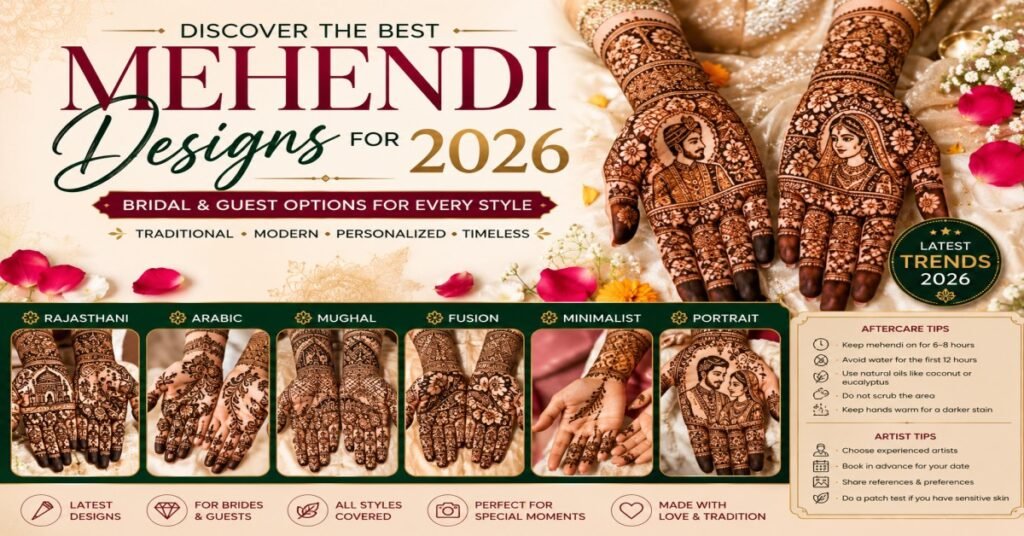
Few beauty traditions carry the emotional depth, artistic richness, and celebratory significance of mehendi. Applied to the hands and feet of brides and their loved ones before a wedding, mehendi is simultaneously body art, cultural ritual, and deeply personal adornment marking one of life’s most significant transitions.
In 2026, the mehendi landscape has evolved into something extraordinarily exciting. Centuries-old traditional motifs now coexist with contemporary minimalist aesthetics, fusion designs blending regional Indian styles with international art influences, and personalized storytelling elements that transform each bride’s mehendi into a uniquely autobiographical work of art.
Whether you are a bride seeking breathtaking full-coverage bridal designs, a wedding guest wanting a beautiful accent that complements your outfit, or simply someone who loves this ancient art form — this complete guide covers every significant mehendi design category, style direction, and trend defining 2026.
Why Mehendi Remains Culturally Irreplaceable
Mehendi — derived from the Sanskrit word mendhika referring to the henna plant Lawsonia inermis — has been applied to the body across South Asia, the Middle East, and North Africa for over five thousand years. The paste is made from dried henna leaves ground into powder, mixed with lemon juice, sugar, and essential oils that help release lawsone — the natural dye molecule that binds to skin’s keratin proteins creating the characteristic reddish-brown stain.
In Indian wedding culture, the Mehendi ceremony held one to two days before the wedding is a dedicated celebration where the bride receives her application surrounded by female family members and friends. Music, singing, dancing, and the intimate joy of female friendship define this gathering — making it one of the most emotionally treasured events in the entire wedding calendar.
The depth of color achieved is traditionally believed to reflect the depth of the husband’s love — a charming folk tradition that gives bridal mehendi color intensity an emotional significance beyond its beauty.
Key Mehendi Trends in 2026
Personalized Storytelling Designs
The defining bridal mehendi trend of 2026 is personalization — where the bride’s design incorporates specific elements from her own love story. Miniature portrait silhouettes of the bride and groom, significant dates in Roman or Devanagari numerals, tiny illustrations of meaningful objects — the place they met, shared hobbies, favorite flowers, beloved pets — are woven seamlessly into surrounding traditional motifs.
These designs require exceptional artist skill and advance planning but create uniquely personal works of art that photograph magnificently and hold profound sentimental value for decades.
Fusion Indo-Western Styles
2026 continues celebrating fusion mehendi that blends Indian traditional elements with Western floral illustration, geometric precision, and fine-line tattooing aesthetics. The result feels simultaneously culturally rooted and genuinely contemporary — resonating powerfully with modern brides who want cultural connection without restriction to purely traditional aesthetics.
Minimalist Mehendi
Among younger brides and wedding guests, minimalist mehendi has moved from niche preference to mainstream trend. Single statement motifs on the back of the hand, delicate vine patterns spiraling up a single finger, or geometric mandala designs on the palm represent this aesthetic — generating equally stunning photographs with fraction of the application time.
Color and White Mehendi
While traditional henna produces its characteristic reddish-brown stain, white and gold non-henna decorative paste has become increasingly popular for wedding guests and specific design accents. White mehendi in particular creates a striking fashion-forward aesthetic that photographs beautifully against darker skin tones.
Matching Couple Mehendi
The tradition of hiding the groom’s name in bridal mehendi has evolved into full matching couple designs — where the groom’s hands receive complementary elements mirroring the bride’s design. This sweet trend creates beautiful visual narratives in wedding photographs.
Best Bridal Mehendi Designs for 2026
1. Full Rajasthani Bridal Mehendi
Rajasthani style remains the gold standard of traditional Indian bridal mehendi — the most requested design for brides wanting comprehensive maximalist coverage from fingertips to elbow extending onto the feet.
Rajasthani mehendi is defined by extraordinary density — designs cover virtually every millimeter with interlocking motifs. The traditional vocabulary includes paisley patterns called keri, peacocks symbolizing beauty and grace, lotus flowers representing purity, elaborate mandala patterns, fine mesh jali work backgrounds, dancing bride and groom figures, elephants symbolizing royalty, and the characteristic keri border framing designs at the wrist.
In 2026, Rajasthani bridal mehendi features finer and more precise linework than previous years — individual motifs are more delicately rendered, creating designs of extraordinary intricacy that reward close examination with endless layers of detail. Personalized story elements are woven throughout with remarkable artistry.
Best for: Traditional ceremonies, brides wanting maximum coverage, culturally rooted designs
Application time: Three to five hours
Color depth: Deep burgundy to near-black
2. Mughal Bridal Mehendi
Drawing from the magnificent Mughal artistic tradition, Mughal mehendi features architectural motifs including arches, domes, and pillars alongside elaborate naturalistic floral sprays, intricate jali lattice patterns, and the characteristic symmetry defining Mughal aesthetic composition.
In 2026, Mughal bridal mehendi is particularly popular for brides marrying in heritage palace venues — the design’s historical resonance creates beautiful visual coherence with architectural settings belonging to the Mughal or Rajput cultural tradition.
Best for: Heritage venue weddings, brides loving floral and architectural detail
Application time: Four to six hours
Distinguishing feature: Strong architectural symmetry and naturalistic florals
3. Arabic Bridal Mehendi
Arabic mehendi is characterized by bold flowing floral motifs set against generous negative space — large roses, trailing vines, leaf clusters, and geometric borders arranged with intentional breathing room between elements. Unlike the dense all-over coverage of Rajasthani mehendi, this open quality gives Arabic designs a contemporary elegance that strongly appeals to modern brides.
In 2026, Arabic style incorporates increasingly fine linework and delicate internal detailing within individual motifs — creating greater sophistication than the bolder, more graphic Arabic designs of previous years. The large surface area of individual motifs also produces exceptionally rich color staining.
Best for: Contemporary brides, reception functions, elegant rather than maximally dense designs
Application time: One to two hours
Distinguishing feature: Bold open florals with generous negative space
4. Personalized Portrait Bridal Mehendi
The signature trend of 2026 — personalized portrait mehendi incorporates miniature silhouette illustrations of the bride and groom rendered in their wedding attire and hidden within the broader design for the groom to find on the wedding day — a beloved romantic tradition producing extraordinarily memorable wedding photographs.
Skilled portrait artists work from reference photographs provided by the bride, capturing likeness and specific clothing details at remarkable tiny scale. The best 2026 portrait mehendi artists produce silhouettes of extraordinary clarity and expression despite the challenging miniature dimensions.
Best for: Romantic brides who love personalization, contemporary ceremonies
Advance planning: Share photographs and design brief minimum two weeks before ceremony
Application time: Three to six hours depending on overall design complexity
5. Indo-Arabic Fusion Bridal Mehendi
The most popular design category for contemporary Indian brides in 2026 — Indo-Arabic fusion combines the dense background detailing and traditional Indian motifs of Rajasthani and Mughal styles with the bold open florals and flowing vine work of Arabic design. The result possesses the richness of full Indian bridal mehendi with the contemporary elegance and visual clarity of Arabic style.
This fusion approach allows skilled artists to create extraordinarily beautiful designs that feel traditional without being restrictive — incorporating the bride’s preferred elements from multiple design traditions into a single cohesive composition.
Best for: Contemporary brides wanting traditional richness and modern elegance simultaneously
Application time: Two to four hours
Distinguishing feature: Dense Indian background detail combined with bold Arabic florals
6. South Indian Bridal Mehendi
South Indian or Kerala style mehendi has a distinctly different aesthetic — characterized by restrained coverage, specific regional motifs including temple lamp kuthuvilakku designs, kolam-inspired geometric patterns, lotus motifs, and designs that frame the palm and fingertips with defined borders rather than filling every space.
In 2026, South Indian mehendi has gained significantly wider recognition beyond its regional base — its refined less maximalist aesthetic resonating with a generation of brides wanting cultural authenticity without all-over coverage.
Best for: South Indian ceremonies, brides preferring lighter coverage, regional design authenticity
Application time: One to three hours
Distinguishing feature: Kolam-inspired geometric precision and specific South Indian motif vocabulary
Best Guest Mehendi Designs for 2026
7. Minimalist Mandala Mehendi
A single beautifully rendered mandala on the back of the hand creates a striking fashion-forward statement that complements rather than competes with the outfit. In 2026, mandala designs feature increasingly fine geometric linework — circles of precision patterning creating hypnotic symmetrical patterns that photograph magnificently.
Application time: 30 to 60 minutes
Best for: All wedding guests, minimalist personal style
8. Finger and Knuckle Mehendi
Delicate geometric patterns, floral rings, and vine motifs applied only to the fingers and knuckles create a distinctive jewellery-like effect — eye-catching, quick to apply, and working beautifully with statement rings. This style also offers practical discretion for guests in professional environments where full-hand coverage might be inappropriate.
Application time: 20 to 40 minutes
Best for: Fashion-forward guests, those who wear statement rings
9. Geometric Contemporary Mehendi
Geometric mehendi featuring precise angular patterns, triangles, hexagons, chevrons, and linear arrangements represents the most contemporary Western-influenced guest design of 2026. It pairs beautifully with contemporary fusion outfits and Indo-Western ensembles.
Application time: 30 to 60 minutes
Best for: Guests with contemporary personal style, fusion outfit wearers
10. Floral Wrist Bracelet Mehendi
A delicate band of floral design wrapping around the wrist creates the appearance of a natural floral bracelet — simple enough for quick application, beautiful enough to complement any outfit, versatile enough for every ceremony from Mehendi night to reception. In 2026, variations range from single-strand fine vine bracelets for minimalists to multi-row elaborate floral bands for guests wanting more impact.
Application time: 20 to 45 minutes
Best for: All guests, outfit-neutral versatile design
11. Half-Hand Arabic Guest Design
A simplified Arabic design covering the back of the hand from wrist to middle knuckle featuring two or three large floral motifs with elegant trailing vines — substantial enough to feel festive while remaining quick to apply and elegant rather than overwhelming. The most popular choice for evening reception guests in 2026.
Application time: 30 to 45 minutes
Best for: Evening reception guests, those wanting moderate coverage with maximum elegance
12. White Mehendi Accent Designs
White mehendi paste applied in delicate designs on the back of the hand creates a stunning jewellery-like effect particularly striking against darker skin tones. While white mehendi does not permanently stain the skin like natural henna — sitting on the surface rather than penetrating it — its visual impact while applied is extraordinary and photographs beautifully against wedding outfit colors.
Application time: 20 to 40 minutes
Best for: Fashion-forward guests wanting something genuinely distinctive
Note: Always confirm ingredients for sensitive skin — white paste does not contain traditional henna
Choosing the Right Mehendi Artist in 2026
The most important decision in your entire mehendi experience is selecting the right artist — and in 2026, exceptional bridal mehendi artists book out months in advance during peak wedding season.
Research artists through Instagram and Pinterest portfolios where their work is most extensively documented. Look for consistency of quality across multiple designs in your preferred style rather than evaluating only the most impressive showcase images. Request a trial application several weeks before the wedding to test both skill and your skin’s reaction to their henna paste formulation.
Discuss your design concept in detail — sharing inspiration images, specific personal elements, outfit colors and embellishments, and the overall aesthetic you are seeking. A skilled artist provides creative input that enhances rather than simply reproduces your reference images — this collaborative dialogue is the hallmark of the best professional relationships.
Mehendi Aftercare for Maximum Color Depth
Color depth is directly influenced by aftercare quality in the hours immediately after application.
Allow paste to dry naturally — never use a fan or cold air to speed drying. Once paste begins cracking, apply a mixture of lemon juice and sugar using a cotton ball to rehydrate the surface and promote deeper dye release. Keep paste on for a minimum of six to eight hours — overnight application produces the deepest possible color.
Remove dried paste by gently scraping rather than washing. After removal immediately apply coconut oil, mustard oil, or olive oil — oil creates a barrier enhancing color development and sealing the design against water exposure.
Avoid all water contact for a minimum of twelve to twenty-four hours after paste removal — every water exposure during this period reduces achieved color depth.
FAQs
FAQ 1: How long does mehendi color last?
One to three weeks depending on skin type, placement, and aftercare. Palm areas last longest. Avoiding water for 24 hours after paste removal and applying oil regularly extends color significantly.
FAQ 2: When should bridal mehendi be applied?
One to two days before the wedding — allowing color to develop from initial orange to rich deep burgundy, ensuring the design looks its most beautiful on the wedding day itself.
FAQ 3: Which produces deeper color — natural henna or commercial cone?
Freshly prepared natural henna paste consistently produces deeper and longer-lasting color. Commercial pre-made cones contain preservatives that reduce dye potency significantly.
FAQ 4: Is mehendi safe for sensitive skin?
Pure natural henna is generally safe for most skin types. Always avoid black mehendi containing PPD which causes serious allergic reactions. Patch test 48 hours before full application if you have known sensitivities.
FAQ 5: How much does bridal mehendi cost in India in 2026?
Entry-level artists charge ₹2,000 to ₹5,000. Mid-range skilled artists charge ₹5,000 to ₹15,000. Top-tier specialists with personalized portrait capabilities charge ₹15,000 to ₹50,000 and above. Guest designs cost ₹200 to ₹800 per person.
FAQ 6: What is the difference between black and natural mehendi?
Natural henna produces safe reddish-brown color through lawsone dye. Black mehendi uses chemical PPD additives causing allergic reactions, chemical burns, and permanent scarring. Always choose natural henna — never black mehendi.