
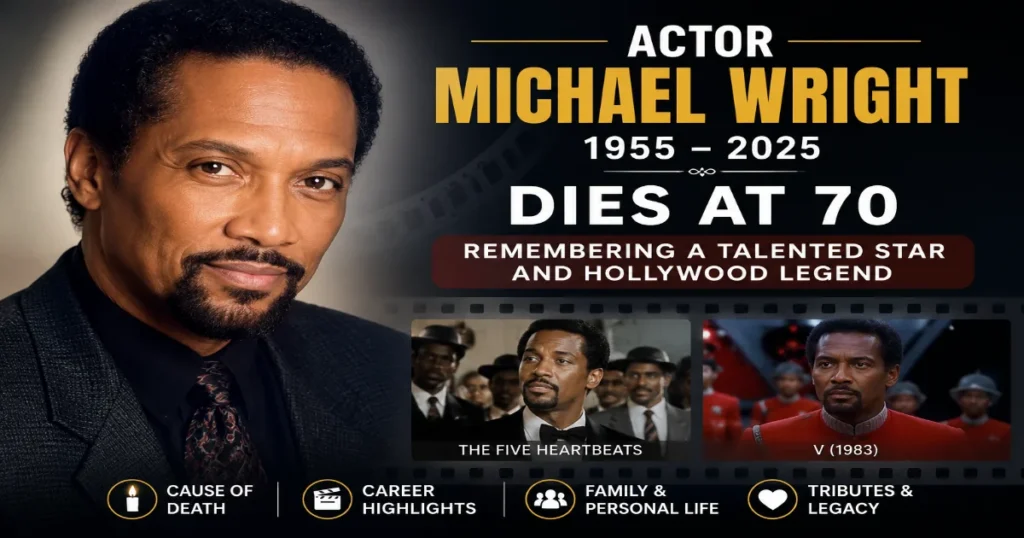
Michael Wright, the gifted and deeply committed actor whose portrayal of the self-destructive singer Eddie King Jr. in the 1991 musical drama The Five Heartbeats made him one of the most memorable screen presences of his generation, has died. He was 70.
Wright passed away on Wednesday, August 19, 2026, in Los Angeles after suffering heart failure coupled with complications from Marchiafava-Bignami disease — an uncommon and severe degenerative neurological condition. His family confirmed the cause of death through a statement released to the media. His wife, Susan Wright, announced his passing publicly on Friday evening, August 21, 2026, through an emotional tribute posted on Instagram.
The news sent waves of grief through Hollywood, the broader entertainment industry, and the generations of fans who had grown up watching his work on screen.
Who Was Michael Wright?
Born on April 30, 1956, in New York City, Michael Wright was drawn to the craft of acting from an early age with an intensity that would define both his personal philosophy and the quality of work he produced across a career spanning nearly five decades.
He appeared in more than 50 films and television productions over the course of his professional life. While his range was impressively wide — from science fiction to crime drama to musical film to period ensemble pieces — it was always the emotional depth and psychological complexity he brought to his characters that left audiences riveted.
In a 2021 interview, Wright offered a revealing glimpse into his artistic philosophy, saying: “The greatest sin an actor can commit is to fail to be interesting. I always try to make my characters interesting. I want you to be riveted.” That commitment — to never wasting a moment on screen, to always finding the truth beneath the surface of a role — is precisely what made his finest performances so enduring.
Wright was not an actor who played it safe. He consistently gravitated toward difficult, layered characters, and he brought to each of them a fearless authenticity that set him apart from his peers.
The Early Career — From The Wanderers to Streamers
Wright launched his professional acting career in 1979 with his debut in The Wanderers, a coming-of-age drama set in the Bronx of the early 1960s. The film followed a group of young men navigating gang life, neighbourhood loyalty, and the turbulence of adolescence in a rapidly changing America. It was a natural starting point for an actor with Wright’s New York roots and his instinctive feel for street-level realism and character truth.
Just four years later came the role that first earned him genuine international recognition. In 1983, he appeared in Robert Altman’s Streamers, a searing and claustrophobic drama about young soldiers awaiting deployment during the Vietnam War era. The film was a chamber piece — tight, intense, unrelenting — and it demanded raw, unsparing performances from every member of its cast.
Wright delivered exactly that, and the result was extraordinary. He and his fellow cast members were awarded the prestigious Volpi Cup for Best Actor at the Venice Film Festival — one of the world’s oldest and most respected film awards. Winning this honour before the age of 30 placed Wright in elite company and confirmed what those who had seen him work already knew: this was an actor of uncommon power and range.
The Five Heartbeats — The Role That Defined a Generation
If one performance stands above all others in Michael Wright’s career, it is his unforgettable portrayal of Eddie King Jr. in Robert Townsend’s 1991 musical drama The Five Heartbeats.
Directed by Townsend from a screenplay he co-wrote with Keenan Ivory Wayans, The Five Heartbeats told the story of a fictional R&B vocal group navigating the music industry from their neighbourhood roots in the 1960s through national stardom, personal betrayal, and the price of fame. The film was a love letter to Black musical history and American soul music, blending joyful performance sequences with genuinely painful human drama.
Wright played Eddie King Jr., the group’s extraordinarily talented but deeply troubled lead singer. Eddie’s alcohol and drug addiction gradually consume him, forcing him out of the group he helped build and into a spiral of self-destruction that is painful to watch precisely because Wright played it with such startling authenticity. He brought to the character not just the charisma of a natural-born performer but the vulnerability, denial, rationalisation, and slow-burning ruin of a man unable to reconcile his demons with his gifts.
What made Wright’s performance so powerful was its refusal to make Eddie simply sympathetic or simply villainous. He was both, simultaneously — the most gifted person in the room and the most destructive force in his own life. Wright held that contradiction without flinching, and the result was one of the most emotionally honest performances in American musical cinema.
The Five Heartbeats became a cultural landmark, particularly within African-American communities. It was a film that told the truth about the music industry, about brotherhood, about addiction, and about the cost of ambition in a world that rewards talent selectively. Among its ensemble cast, Wright’s Eddie King Jr. was consistently recognised as the emotional centrepiece — the character whose arc gave the film its deepest dramatic charge.
Decades after its release, the film remained beloved and widely watched. Wright’s performance within it continued to be discussed, studied, and celebrated as one of the genuine achievements of 1990s American cinema.
Television Career — V, Miami Vice, Oz, and Beyond
Alongside his film work, Wright built an equally impressive body of television work that demonstrated his ability to move comfortably across genres, networks, and formats.
His most prominent television role came in V, the NBC science fiction franchise that began as a miniseries in 1983 before expanding into a full series in 1984. Wright played Elias Taylor, one of the key leaders of the human Resistance fighting against an alien occupation of Earth by beings known as the Visitors. The role gave him a wide mainstream audience and showed his capability to anchor a large-scale, action-driven ensemble drama with the same intensity he brought to intimate dramatic work.
His television appearances also included Miami Vice, the iconic crime series that defined 1980s American television, and New York Undercover, the acclaimed crime drama that broke ground as one of the first American primetime series to feature two non-white leads. He later appeared in Black Lightning, the superhero drama series on The CW.
His work on HBO’s Oz stands as another career highlight. Oz was a groundbreaking and unflinching prison drama that demanded fearless, morally complex performances from its cast — and Wright was entirely in his element. The show’s uncompromising approach to its subject matter required actors willing to go to uncomfortable places, and Wright brought that willingness without hesitation.
From network television to prestige cable, from science fiction to crime drama to superhero narratives, Wright moved across the full range of American television with a consistent artistic commitment that never wavered.
Film Career at a Glance
| Film | Year | Notes |
|---|---|---|
| The Wanderers | 1979 | Feature film debut |
| Streamers | 1983 | Volpi Cup for Best Actor, Venice Film Festival |
| The Principal | 1987 | With Jim Belushi and Louis Gossett Jr. |
| The Five Heartbeats | 1991 | Career-defining role as Eddie King Jr. |
| Sugar Hill | 1993 | Dramatic crime film |
| Money Talks | 1997 | Supporting role |
| Point Blank | 1998 | Feature film |
| The Interpreter | 2005 | Supporting role |
What Is Marchiafava-Bignami Disease?
Wright’s death was caused by heart failure coupled with complications from Marchiafava-Bignami disease — a condition unfamiliar to most people outside the medical community, precisely because of how rarely it occurs.
Marchiafava-Bignami disease (MBD) is an extremely rare and severe neurological disorder characterised by progressive deterioration of the corpus callosum — the broad band of nerve fibres that connects the left and right hemispheres of the brain and allows them to communicate. First identified and documented in 1903 by two Italian pathologists, Ettore Marchiafava and Amico Bignami, the disease was historically associated with chronic and heavy alcohol consumption, though it has since been documented in patients without any history of alcoholism.
Symptoms of Marchiafava-Bignami disease can include acute confusion, severely altered states of consciousness, seizures, progressive dementia, loss of muscle coordination, difficulty walking, and in advanced stages, coma. Because the corpus callosum is central to how the brain integrates information across its two hemispheres, its deterioration produces wide-ranging and devastating neurological effects.
The disease is extraordinarily rare, and there is no established cure. Treatment is primarily supportive — managing symptoms, addressing contributing health factors, and slowing progression where possible. Many physicians go through entire careers without encountering a confirmed case.
Its extreme rarity means that awareness of the condition outside specialist neurology circles is minimal, making Wright’s death one of very few high-profile cases to bring it to broader public attention.
Family, Personal Life, and Tributes
Michael Wright is survived by his wife, Susan Wright, and five children: Manon Wright, Byron Barr, Brittney Briggs, Brianna Barr, and Sir Barr. He is also survived by a grandchild named Yoko. Prior to his marriage to Susan, he was previously married to Mitzie Lau from 1996 to 2000.
In her Instagram tribute announcing his passing, Susan Wright described her husband with words that captured both the scale of his professional achievement and the humanity of the man behind the performances:
“It is with profound sadness and an unimaginable heaviness in my heart that I share the passing of my beloved husband, Michael Wright. Michael was a husband, a father, a grandfather, loved one, a friend, and an extraordinary artist whose work touched generations. His talent, presence, and contributions to film and television will live on, but to those of us who loved him personally, he was so much more than the roles the world knew him for. Our family is grieving an enormous and deeply personal loss.”
Susan also wrote: “In the coming days, when we are ready, we will share additional information regarding Michael’s life, legacy, and how we intend to honour and celebrate him.”
Fellow actor and The Five Heartbeats co-star Leon paid tribute on Instagram with words that spoke to the bond shared by the film’s cast and the significance of what they created together: “We made history together, we were honoured together, you made your mark and for that you will be remembered, my friend.”
Tributes also poured in from fans, critics, filmmakers, and fellow artists across social media, with many reflecting on the particular impact of The Five Heartbeats on their lives and on Wright’s irreplaceable role within it.
Key Facts About Michael Wright
| Detail | Information |
|---|---|
| Full Name | Michael Wright |
| Date of Birth | April 30, 1956 |
| Place of Birth | New York City, USA |
| Date of Death | August 19, 2026 |
| Place of Death | Los Angeles, California |
| Age at Death | 70 |
| Cause of Death | Heart failure and Marchiafava-Bignami disease complications |
| Best Known For | Eddie King Jr. in The Five Heartbeats (1991) |
| Major Award | Volpi Cup for Best Actor, Venice Film Festival (1983) |
| Career Span | 1979 – 2026 (nearly 5 decades) |
| Total Credits | 50+ films and TV shows |
| Survivors | Wife Susan Wright; children Manon Wright, Byron Barr, Brittney Briggs, Brianna Barr, Sir Barr; grandchild Yoko |
Frequently Asked Questions (FAQs)
1. How did Michael Wright die?
Michael Wright died on August 19, 2026, in Los Angeles, California. His family confirmed that the cause of death was heart failure combined with complications arising from Marchiafava-Bignami disease, a rare degenerative neurological condition affecting the brain’s corpus callosum.
2. What is Michael Wright best known for?
Michael Wright is best known for his role as Eddie King Jr. in the 1991 Robert Townsend musical drama The Five Heartbeats. He is also widely recognised for his role as Elias Taylor in the NBC science fiction series V and for his early career performance in Robert Altman’s Streamers (1983), for which he won the Volpi Cup for Best Actor at the Venice Film Festival.
3. What is Marchiafava-Bignami disease?
Marchiafava-Bignami disease is an extremely rare neurological disorder involving the progressive deterioration of the corpus callosum — the nerve fibres connecting the brain’s two hemispheres. First identified in 1903, the condition causes symptoms including confusion, seizures, loss of coordination, and dementia-like decline. There is no known cure, and the disease is considered one of the rarest neurological conditions in medical literature.
4. Who are Michael Wright’s children?
Michael Wright is survived by five children: Manon Wright, Byron Barr, Brittney Briggs, Brianna Barr, and Sir Barr. He also had a grandchild named Yoko.
5. What was Michael Wright’s role in The Five Heartbeats?
In The Five Heartbeats, Michael Wright played Eddie King Jr. — the charismatic but deeply troubled lead singer of a fictional R&B group. The character’s struggle with alcohol and drug addiction, which ultimately forces him out of the group, gave Wright the opportunity to deliver one of the most emotionally powerful performances of his career.
6. Did Michael Wright win any awards?
Yes. Michael Wright won the Volpi Cup for Best Actor at the Venice Film Festival in 1983 for his work in Robert Altman’s Streamers, sharing the award with his fellow cast members. The Venice Film Festival Volpi Cup is one of the most prestigious acting awards in world cinema.
7. What other TV shows did Michael Wright appear in?
Beyond his film career, Michael Wright had prominent television roles in V (NBC), Miami Vice, New York Undercover, Oz (HBO), and Black Lightning, among others. He appeared in television productions spanning more than four decades.
8. Who confirmed Michael Wright’s death?
Michael Wright’s death was confirmed publicly by his wife, Susan Wright, in an Instagram post published on the evening of Friday, August 21, 2026. The family also released a statement through media outlets providing details about the cause of death.
Legacy — What Michael Wright Leaves Behind
Michael Wright worked in Hollywood during an era when Black actors were frequently limited by the industry to a narrow and often stereotyped range of roles. That he managed — within those constraints — to build a career defined by psychological complexity, artistic risk-taking, and authentic emotional power is a testament to both his exceptional talent and his refusal to settle for anything less than full commitment to his craft.
He was not a loud or self-promoting presence in the entertainment world. He did not court controversy for its own sake or seek celebrity beyond what his work naturally produced. He was, above all else, an actor — someone who believed that the job was to be interesting, to be truthful, and to make audiences feel something real.
His performance as Eddie King Jr. in The Five Heartbeats will endure as a permanent landmark in American cinema — a portrayal of addiction, pride, self-destruction, and the particular tragedy of a person whose talent exceeds their capacity to protect themselves. It is the kind of performance that does not age, because the human truth it captures is timeless.
He leaves behind a body of work spread across five decades, a family who loved him deeply, colleagues who respected him profoundly, and audiences whose lives were genuinely touched by the characters he brought to life.
Michael Wright was 70 years old. He will not be forgotten.