
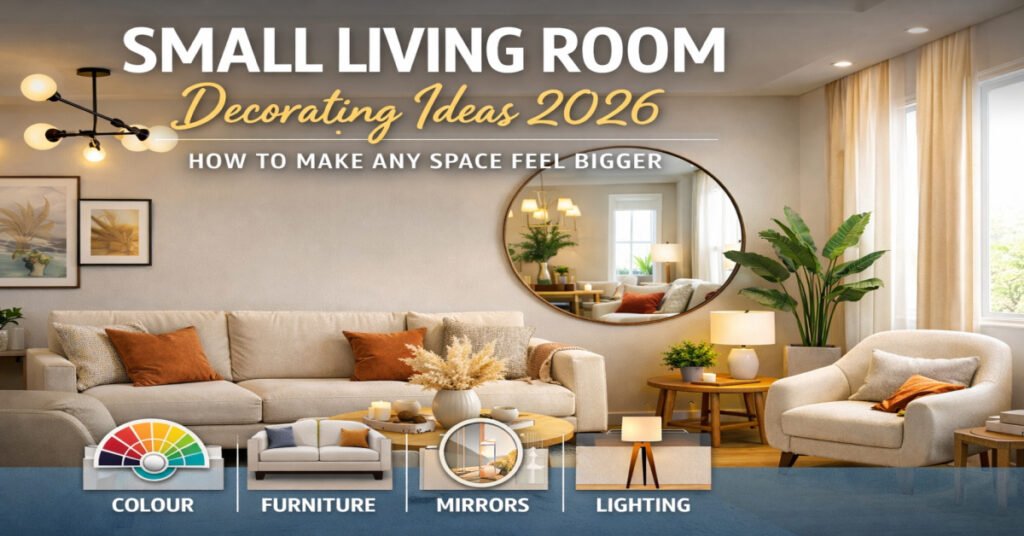
A small living room is one of the most common decorating challenges in modern homes — and one of the most solvable. Whether you are working with a compact apartment, a studio flat, a narrow terraced house sitting room, or simply a room that feels too tight for the furniture you love, the right combination of design choices can completely transform how the space looks and feels.
The good news for 2026 is that interior designers have moved well beyond the old formula of painting everything white and keeping things minimal. This year’s approach to small living rooms is bolder, smarter, and far more personal than that. The focus has shifted to using space with genuine intention — choosing furniture, colour, lighting, and layout in ways that create real visual depth and breathing room without sacrificing style or personality.
This guide covers the most effective small living room decorating ideas for 2026, organized so you can apply them one by one or use them together for a full transformation.
Start With the Floor: It Sets the Tone for the Entire Room
Your floor is the single largest uninterrupted surface in any room, and the choices you make there have a bigger impact on perceived space than almost anything else.
Light-coloured flooring — pale wood, light oak, blonde LVP (luxury vinyl plank), or warm cream tile — visually expands a small living room by reflecting light back upward and creating a continuous, open surface that draws the eye across the room rather than stopping it. In 2026, warm blonde and natural wood tones are the leading flooring choice for small spaces, offering the light-reflecting benefit without the clinical coldness that white or grey floors can carry.
Laying floorboards or tiles on a diagonal is an underused trick that reliably makes a room feel wider. The diagonal line tricks the eye into following a longer visual path across the space, which creates an impression of greater depth. It costs nothing extra to install boards this way and the effect is immediate.
Rugs deserve careful thought in a small living room because the wrong choice is worse than no rug at all. In a compact room, a rug that is too small chops the space into disconnected fragments and makes everything feel more cramped. Choose a rug large enough to sit under at least the front legs of all your seating — ideally under the entire furniture arrangement. A single, well-proportioned rug that anchors the whole seating area reads as one unified zone and makes the room feel significantly larger. Avoid layering two rugs in a small space: it breaks up the visual flow and reduces the openness that one well-chosen rug creates.
Colour in 2026: Forget White, Think Intentionally
The long-standing advice to paint small rooms white is well-meaning but outdated. White can brighten a room, but in a space that lacks strong natural light or has architectural imperfections, it can also make walls feel flat and rooms feel cold and unresolved. In 2026, designers are working with colour in more sophisticated and counterintuitive ways.
Colour drenching is one of the strongest small room trends of the year, and it works exactly opposite to how most people expect. Rather than keeping a small room light and airy with pale tones, colour drenching involves painting the walls, ceiling, and sometimes the woodwork all in the same rich, saturated tone. The effect is cocooning — it removes the visible edges and corners of the room from perception, so instead of seeing a box with defined boundaries, you see an enveloping, immersive space that feels larger precisely because its limits are harder to locate.
Deep jewel tones — forest greens, plum, deep terracotta, navy, and dark chocolate — are the leading choices for colour drenching in small living rooms right now. The critical step is taking the paint all the way to the ceiling. A designer tip that makes an immediate difference: when the ceiling colour matches the walls, the room suddenly feels taller and more expansive because there is no visible line where the wall ends and the ceiling begins.
For those who prefer a lighter approach, a monochromatic palette using varying tones of a single neutral colour — soft warm whites, taupes, creams, or warm greiges — creates a seamless, continuous look that removes the visual interruptions that make a room feel smaller. The key is consistency: when walls, furniture, and soft furnishings all speak a similar colour language, the eye glides through the space rather than stopping and starting at contrast points.
Mirrors: Still the Most Powerful Space-Expanding Tool Available
Mirrors have been used to expand small spaces for centuries because they work. A well-placed mirror literally doubles what the eye perceives by reflecting the room back at itself, creating genuine visual depth and amplifying every light source in the space.
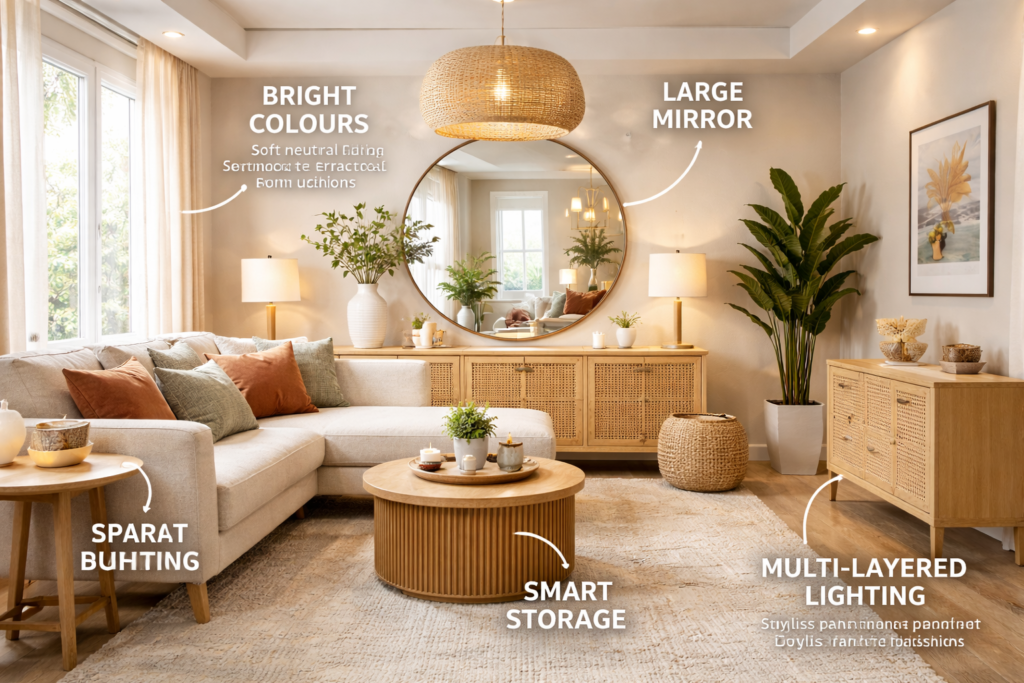
In 2026, the most popular mirror styles for small living rooms are large sculptural arch mirrors, organic-shaped frames, and oversized sunburst designs that function simultaneously as wall art and space expanders. Position a large mirror on the wall opposite or adjacent to your main window to maximise reflected natural light — this makes the room feel not just bigger but brighter and more alive, particularly during daylight hours.
A full-height floor mirror leaning against a wall is one of the most immediate and commitment-free ways to add depth to a small living room. It requires no drilling, no permanent decision, and can be repositioned to find the angle that works best for your specific layout. It is also one of the strongest 2026 design trends for casual, relaxed interiors that feel layered and lived-in rather than formally decorated.
One placement note: avoid positioning a mirror directly opposite the main seating area, as it can feel uncomfortable to see yourself every time you look up. Angled placement or adjacent-wall positioning works better for both comfort and visual effect.
Furniture Choices That Make or Break a Small Room
The furniture decisions you make in a small living room have more impact than any decorative detail. Getting these choices right is the foundation of every other improvement.
Choose furniture with visible legs. Sofas, chairs, and coffee tables that sit directly on the floor create a visual block that reads as solid, heavy mass. The same pieces with exposed legs — even just a few inches of clearance — allow light to pass underneath, which creates the impression that the furniture is floating rather than anchored. This small change makes a living room feel noticeably more spacious without changing the footprint at all.
Scale furniture to the room, not to your wishlist. The temptation to fit a large sectional into a small living room is understandable — sectionals are comfortable and generous. But oversized furniture disrupts movement through the space, eliminates negative space, and makes the room feel dominated by a single piece. In a small room, choose a compact two-seater or apartment-sized sofa, and add individual armchairs for flexible extra seating that can be moved when not needed. Two smaller pieces will almost always work better than one oversized one.
Embrace multipurpose and storage furniture. In 2026, smart storage that disappears into the design is one of the top priorities for small living rooms. Coffee tables with hidden storage, ottomans that open to store throws and magazines, media units with closed cabinet fronts, and floating shelves that keep the floor clear all reduce visible clutter without reducing function. Clutter is the single fastest way to make a small room feel cramped, and built-in or integrated storage is the most effective solution.
Keep the centre of the room clear. The instinct in a small living room is often to fill every corner and push furniture against the walls. In practice, leaving the central floor area as open as possible — and pulling furniture slightly away from the walls to create a loose floating arrangement — makes the room feel more spacious and intentionally designed. Furniture pushed flat against every wall tends to feel defensive and cramped rather than inviting.
Lighting: The Most Underrated Space Trick
Lighting transforms the perceived size and mood of a small living room more dramatically than most people realise — and it costs far less than a renovation.
Natural light is the most valuable asset in any small room. Maximise it by keeping window treatments light and open during the day. In 2026, sheer linen curtains in natural or warm-white tones are the leading choice for small living rooms — they allow daylight to filter through while maintaining softness and privacy. Avoid heavy drapes that block the window frame and absorb light.
Hang curtains as high as possible — ideally close to the ceiling rather than at the window frame — and let them fall to the floor. This visual trick makes the ceiling appear taller, the windows appear larger, and the room proportionally more generous. The difference between a curtain hung at frame height and the same curtain hung near the ceiling is remarkable, and it costs nothing extra.
Artificial lighting in layers creates depth and atmosphere in a small room. Avoid relying on a single overhead ceiling light, which flattens the space and casts unflattering shadows. Instead, layer a ceiling fixture with floor lamps, table lamps, and accent lighting. Multiple light sources at different heights create visual warmth and the impression of a larger, more interesting space — the same effect that gives hotels and restaurants their welcoming feel.
Wall sconces are an excellent choice for small living rooms because they provide warm directional light without occupying any floor space. In 2026, plug-in wall sconces make this option accessible without requiring any electrical work.
Vertical Space: Stop Ignoring Your Walls and Ceiling
In a small living room, the floor area is fixed. The vertical space above your furniture is not — and most people leave it almost entirely unused.
Drawing the eye upward is one of the most effective ways to make a small room feel larger. Tall, slender floor lamps with a vertical profile direct attention upward and add height to any corner. Floor-to-ceiling curtains — as discussed above — amplify this effect on every wall that has a window. Built-in shelving that runs from floor to ceiling turns an entire wall into storage and display space while eliminating the need for multiple standalone units that take up floor area.
Vertical wall panelling and shiplap are trending strongly in small living rooms in 2026 for exactly this reason. Vertical lines naturally direct the eye upward along the wall, creating the impression of greater ceiling height. Peel-and-stick panelling options make this achievable on a modest budget without permanent installation.
When hanging artwork, resist the instinct to hang multiple pieces low at eye level, which emphasises the wall’s width and draws attention downward. Instead, hang a single large piece higher than feels natural — or create a tall, vertical gallery arrangement — to pull the eye upward and add perceived height to the room.
The Power of Negative Space: Edit Ruthlessly
One of the most consistent findings when designers talk about what makes small living rooms feel cramped is simple overloading. Too many decorative objects, too many competing colours, too many small pieces of furniture, and too many patterns all collide to create visual noise that reads as chaos and makes the room feel smaller and more stressful than its actual dimensions.
In 2026, the approach that works best in small living rooms is intentional editing — choosing fewer pieces and allowing each one to genuinely earn its place. Rather than filling every surface and corner, leave deliberate negative space. The pause between objects, the empty stretch of wall, the clear section of floor — these are not emptiness to be filled. They are breathing room that makes everything else in the room feel more considered and the space itself feel more open.
One bold, well-chosen statement piece does more for a small room than five mediocre decorative objects arranged together. A single large piece of art, one well-placed architectural mirror, or one striking lamp creates visual interest without adding visual noise. The most stylish small living rooms of 2026 are the ones where it is clear that every item was chosen deliberately rather than accumulated by default.
Layout Principles That Work for Any Small Living Room
Before spending a penny on furniture or decoration, consider the layout. The arrangement of your existing furniture can make more difference than any purchase.
Float furniture away from walls rather than pushing every piece flush against them. A sofa pulled even 30 centimetres off the wall creates a sense of space behind it that reads as depth rather than tightness. Placing furniture at slight angles can break the boxy feeling of a small rectangular room and create a more dynamic, layered arrangement.
In a narrow or long room, create zones rather than lining everything up along the walls. A console table placed behind the sofa acts as a subtle room divider between the seating area and another function — reading corner, workspace, or entry zone — without physically separating the space. Clear zoning makes a small open-plan room feel intentional and multi-functional rather than cramped.
Keep circulation routes clear. The ability to move through a room freely — without squeezing past furniture or navigating obstacles — is one of the most significant factors in whether a room feels comfortable or stressful to use. If your current layout forces awkward movement, rearranging for better flow will transform how the room feels to live in.
Quick Wins: Small Changes With Big Impact
Not every improvement requires a full room rethink. These individual changes can make a noticeable difference immediately.
Replacing solid cabinet fronts with glass panels makes storage furniture feel lighter and less visually heavy in a small room. Swapping dark, heavy window treatments for lighter sheer fabrics instantly brightens and opens the space. Removing one or two pieces of surplus furniture — a side table that serves no real purpose, a chair nobody sits in — to restore breathing room is often the single most effective step. Adding a large mirror, raising curtain rods closer to the ceiling, and replacing a small rug with a properly proportioned one are all straightforward changes that consistently deliver dramatic results.
The through-line in every effective small living room transformation in 2026 is the same: intention over accumulation, light over heaviness, and confidence in making fewer, better choices.
Frequently Asked Questions About Small Living Room Decorating
Q: Should I always paint a small living room a light colour?
A: Not necessarily. While light colours do reflect more natural light, colour drenching — using one rich, saturated tone on walls, ceiling, and woodwork — can actually make a small room feel more expansive by removing the visible edges and corners. In 2026, deep greens, plums, and warm dark tones are proving just as effective as pale colours when used consistently.
Q: What size rug should I use in a small living room?
A: Larger than you think. A rug should be big enough to anchor the entire seating arrangement, with at least the front legs of all furniture sitting on it. A rug that is too small fragments the room and makes it feel more cramped. When in doubt, go up a size.
Q: Does a large sofa work in a small living room?
A: A large sectional or oversized sofa generally does more harm than good in a compact room because it disrupts traffic flow and dominates the space. A well-proportioned two-seater sofa with exposed legs, paired with one or two individual chairs, will always feel more open and flexible.
Q: How do I make a small living room feel taller?
A: Hang curtains close to the ceiling rather than at the window frame. Use tall, vertical floor lamps. Install floor-to-ceiling shelving or panelling. Hang artwork higher than feels natural. All of these draw the eye upward and make the ceiling feel further away.
Q: Is a mirror useful in every small living room?
A: Yes, almost universally. A large mirror positioned to reflect natural light from a window is the single most reliable space-expanding tool available. Position it on the wall opposite or adjacent to your main window for maximum effect.