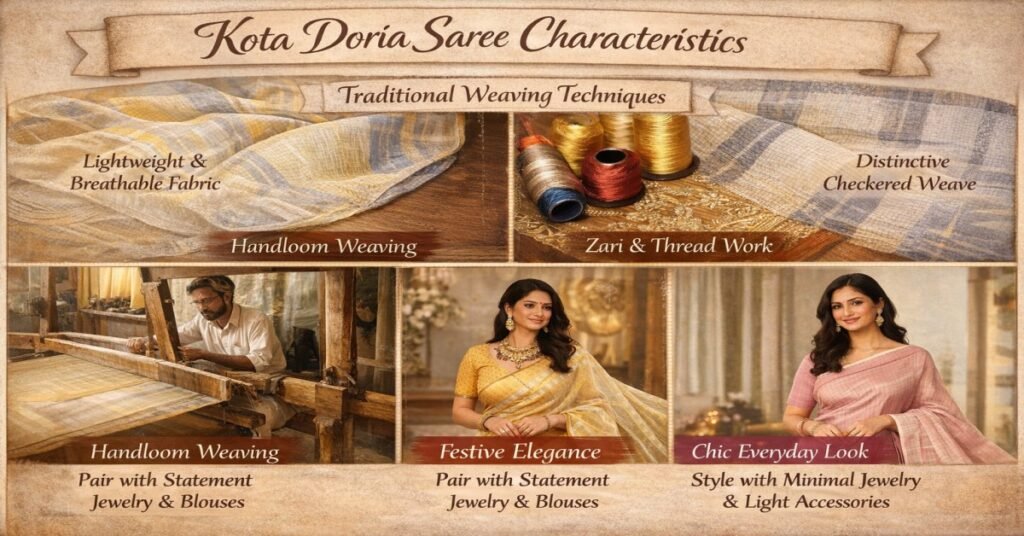
There are fabrics that merely clothe the body — and then there are fabrics that tell a story. The Kota Doria saree belongs emphatically to the second category. Woven in the historic town of Kaithoon near Kota in Rajasthan, this extraordinary textile carries within its delicate threads a legacy of craftsmanship stretching back over three centuries — a story of Mughal patronage, skilled weaver communities, and a unique technical innovation that produced one of India’s most distinctive and beloved fabrics.
The Kota Doria saree is immediately recognizable to those who know it — its characteristic square check pattern (called the khats or khanas), its extraordinary lightness, its translucent quality, and the distinctive crisp yet fluid drape that makes it unlike any other Indian textile. It is a fabric that has been worn by Rajasthani royalty, celebrated by textile connoisseurs, and awarded the Geographical Indication (GI) tag by the Government of India — a recognition that protects its authenticity and acknowledges its irreplaceable cultural significance.
In an era when handloom textiles face intense competition from machine-made imitations, the Kota Doria saree stands as a living testament to what human skill, patience, and centuries of refined technique can produce — a fabric so distinctive that no machine has yet been able to fully replicate its characteristic texture and drape.
This comprehensive guide explores everything you need to know about Kota Doria sarees — their fascinating history and origin, their unique technical characteristics, the intricate weaving process that creates them, how to identify genuine Kota Doria from imitations, and most importantly, how to style them beautifully for every occasion in your wardrobe.
History and Origin of Kota Doria
The Mughal Connection
The story of Kota Doria begins in the Mughal era — specifically during the reign of Emperor Aurangzeb in the seventeenth century. Historical accounts suggest that a skilled weaver community from Mysore in Karnataka — the Masuria weavers, named after the Masuria fabric they traditionally produced — was brought to the Kota region of Rajasthan by a Mughal general named Deccani Khan. These weavers settled in Kaithoon, a village near Kota, and began adapting their weaving techniques to the local conditions and royal court requirements.
The fusion of South Indian weaving traditions with Rajasthani aesthetic sensibilities and Mughal court tastes produced something entirely new — a fabric that combined the lightness of South Indian muslin traditions with the distinctive square check pattern that would become Kota Doria’s defining characteristic. This cross-cultural textile genesis gives Kota Doria a uniquely composite heritage that reflects the rich cultural exchanges of the Mughal period.
Royal Patronage and Evolution
The Kota royal court became enthusiastic patrons of this new fabric — and under their patronage, the weaving tradition flourished and refined over generations. The fabric was originally called Masuria — after the community of weavers who created it — but became known as Kota Doria over time, combining the city name with the word “doria” which refers to the thread or stripe that characterizes the weave structure.
For centuries, Kota Doria remained an exclusively royal and elite fabric — the extreme skill required to produce it, combined with its extraordinary delicacy, made it a luxury available only to those of the highest social standing. The weaving tradition was closely guarded within specific weaver families and communities, passed from generation to generation as both craft knowledge and cultural identity.
Geographical Indication Recognition
In 2005, the Government of India granted Kota Doria a Geographical Indication (GI) tag — a legal recognition that protects the fabric’s name and ensures that only sarees genuinely produced in the Kota-Kaithoon region using traditional techniques can be marketed under the Kota Doria name. This protection was a critical acknowledgment of both the fabric’s cultural significance and the economic rights of the skilled artisan communities who produce it.
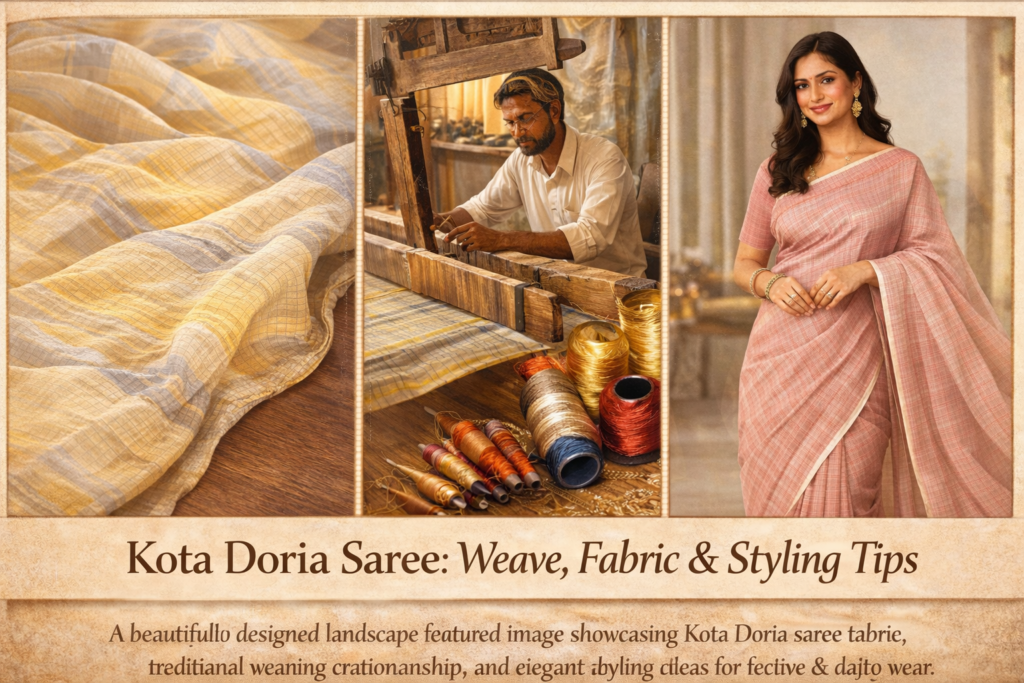
Unique Characteristics of Kota Doria Fabric
What makes Kota Doria immediately recognizable — and genuinely different from any other Indian textile — is a combination of characteristics that emerge directly from its unique construction method.
The Khats (Square Check Pattern)
The most visually distinctive characteristic of authentic Kota Doria is its square check pattern — called khats or khanas. These squares are formed by the alternating arrangement of cotton and silk threads in both the warp and weft of the weave — creating a transparent, window-like pattern across the fabric surface. Each khat is perfectly square — a precision that requires extraordinary skill to maintain consistently across the full width of the fabric.
The khats are not simply a decorative pattern — they are an inherent structural feature of the weave. The transparent quality of each square is created by the specific interlacement of threads that leaves regular openings in the fabric structure — giving Kota Doria its characteristic see-through quality and the airy lightness that distinguishes it from all other Indian textiles.
Extraordinary Lightness
Kota Doria is among the lightest woven fabrics in the world. A full six-yard saree — approximately five and a half meters of fabric — can weigh as little as 100 to 150 grams. This extraordinary lightness is a direct consequence of the open weave structure created by the khats — large proportions of the fabric surface are effectively open space rather than solid thread, reducing weight dramatically while maintaining structural integrity.
This lightness makes Kota Doria one of the most comfortable fabrics imaginable for India’s warm and humid climate — wearing a Kota Doria saree feels genuinely like being wrapped in air rather than fabric.
Translucency and Sheen
The combination of silk and cotton threads in Kota Doria’s construction gives the fabric a distinctive dual quality — the cotton provides breathability and matte softness while the silk introduces a subtle, refined sheen that catches light beautifully. This interplay between matte and lustrous creates a visual depth that is one of Kota Doria’s most celebrated aesthetic qualities.
The translucency of the fabric — visible through the open khat squares — gives Kota Doria a delicate, ethereal quality that photographs exceptionally well and creates a beautiful layering effect when worn over a contrasting petticoat.
The Distinctive Drape
Kota Doria drapes with a quality that is entirely its own — neither the flowing liquid drape of silk nor the structured fall of cotton, but something between — a crisp yet fluid quality that holds pleats beautifully while moving gracefully with the body. Experienced saree wearers consistently cite Kota Doria’s drape as one of its most pleasurable qualities — it creates elegant, defined pleats that maintain their shape throughout wear without feeling stiff or restrictive.
Natural Breathability
The open weave structure that creates the khat pattern simultaneously creates exceptional breathability — air circulates freely through the fabric, making Kota Doria one of the most comfortable sarees to wear during Rajasthan’s famously intense summer heat. This natural climate adaptation — a textile perfectly suited to the environment of its origin — is one of the most elegant functional characteristics of traditional Indian textiles.
The Weaving Process: How Kota Doria Is Made
Understanding how Kota Doria is made deepens appreciation for every saree — the extraordinary complexity of the process explains both the fabric’s unique characteristics and its premium price relative to machine-made alternatives.
The Raw Materials
Authentic Kota Doria is woven from two primary materials — fine cotton thread and silk thread — used in specific proportions and arrangements that create the characteristic khat pattern. The cotton used is fine, high-quality thread that provides the fabric’s breathable, absorbent base. The silk — originally Mysore silk but now incorporating various silk sources — provides the subtle sheen and the structural strength that allows the fabric to maintain its open weave without losing integrity.
Some contemporary Kota Doria sarees incorporate zari (gold or silver metallic thread) into the weave — creating the Kota Doria Zari variant that is particularly popular for festive and wedding occasions. The zari adds richness and sparkle to the characteristic khat pattern without compromising the fabric’s essential lightness.
The Handloom Setup
Kota Doria is woven on a traditional pit loom — a loom where the weaver sits above a pit that accommodates the foot pedals (treadles) used to control the warp thread separation. The loom setup for Kota Doria is particularly complex — the precise arrangement of warp threads in the specific sequence required to create the khat pattern demands meticulous attention and expertise. Setting up a loom for a new Kota Doria saree can take an experienced weaver a full day or more before a single weft thread is passed.
Thread Preparation
Before weaving begins, threads must be carefully prepared — wound onto bobbins for the weft (horizontal threads) and stretched and sized onto the warp beam for the vertical threads. The sizing process — applying a thin starch solution to the cotton warp threads — gives them the stiffness required to withstand the tension of weaving without breaking.
Silk threads used in Kota Doria require a different preparation — they are degummed (sericin removed) and wound carefully to prevent tangling. The combination of cotton and silk in the same weave requires managing two very different thread types simultaneously — one of the technical challenges that makes Kota Doria weaving particularly demanding.
The Weaving Technique
The actual weaving of Kota Doria proceeds with painstaking precision. The weaver passes the weft shuttle through the shed (the opening created between upper and lower warp threads) created by pressing specific treadles — each treadle press creating the particular warp thread arrangement required at that point in the khat pattern.
The alternating arrangement of cotton and silk threads in both warp and weft — and the specific interlacement pattern that creates the open khat squares — requires constant attention to thread sequence and tension. Any deviation from the precise thread sequence disrupts the khat pattern and requires the weave to be partially undone and corrected.
An experienced Kota Doria weaver can produce approximately one to one and a half meters of fabric per day under normal working conditions — meaning a full six-yard saree requires five to six days of continuous skilled work at minimum. More complex designs with intricate motifs or dense zari work can take weeks or even months for a single saree.
Dyeing and Finishing
Kota Doria sarees are available in both yarn-dyed and piece-dyed forms. Yarn-dyed sarees — where threads are dyed before weaving — allow for complex multicolor designs and the precise color separation that defines the most beautiful Kota Doria patterns. Piece-dyed sarees — where the woven fabric is dyed as a whole — produce the solid color sarees that remain extremely popular.
After weaving and dyeing, Kota Doria sarees are finished by hand — borders are carefully examined, loose threads are secured, and the saree is gently pressed to enhance its natural sheen and drape quality.
How to Identify Genuine Kota Doria
With the market flooded with machine-made imitations, knowing how to identify authentic handwoven Kota Doria protects your investment.
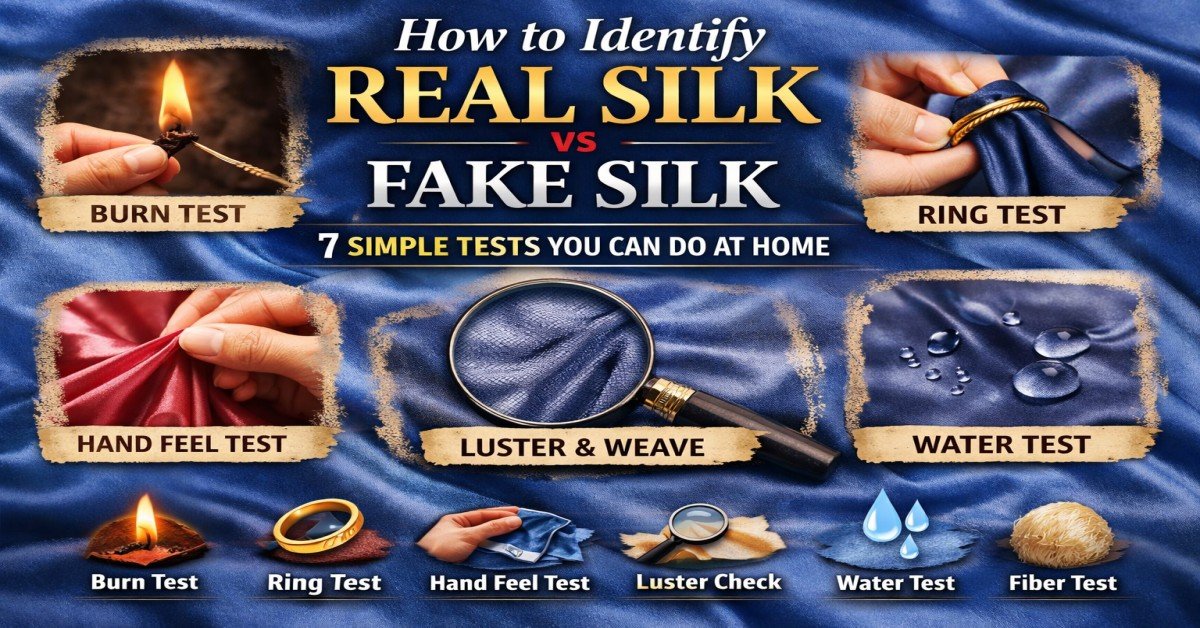
The khat test: Hold the fabric up to light and examine the square check pattern. In genuine handwoven Kota Doria, the khat squares are perfectly formed and the threads surrounding them are clearly individually distinguishable. Machine-made imitations often have irregular khat patterns with thread bunching at intersections.
The weight test: A genuine Kota Doria saree is extraordinarily light — almost weightless in the hand. Machine-made copies tend to be heavier due to denser weave structures.
The thread examination: Genuine Kota Doria shows the alternating cotton and silk threads clearly when examined closely — you can typically feel the difference in texture between the two thread types. Machine copies use uniform synthetic threads throughout.
GI certification: Purchase from certified handloom retailers or government emporiums that carry GI-tagged Kota Doria with certification documentation. The Rajasthan government’s handloom department and the Weavers Service Centre provide certification support.
Price reality check: Authentic handwoven Kota Doria sarees start at approximately ₹1,500 to ₹3,000 for basic cotton varieties and can reach ₹15,000 and above for fine silk-cotton with zari work. Prices significantly below these thresholds almost certainly indicate machine-made imitations.
How to Style Kota Doria Sarees
Kota Doria’s extraordinary versatility is one of its most celebrated qualities — it transitions effortlessly from casual daywear to elegant festive dressing, making it one of the most wearable saree varieties in any wardrobe.
For Everyday and Office Wear
The lightweight, breathable quality of Kota Doria makes it ideal for daily wear — particularly in warm climates. Choose solid color or simple block-printed Kota Doria sarees in muted, professional tones — dusty rose, sage green, soft ivory, warm terracotta, or classic navy. Pair with a simple cotton or silk blouse in a contrasting or matching tone. Drape in the classic Nivi style for an elegant, understated look appropriate for professional settings.
Accessorize minimally for office wear — simple stud earrings, a delicate chain, and clean pointed-toe flats or block heels complete the look without visual overwhelm.
For Festive and Wedding Occasions
Kota Doria Zari sarees — incorporating gold or silver metallic thread in the weave — are spectacular choices for festive occasions, weddings, and religious celebrations. The combination of the fabric’s characteristic lightness with the richness of zari work creates a festive aesthetic that is both celebratory and refined.
For wedding functions, choose rich jewel tones — deep teal, royal purple, festive orange, or classic red — in Kota Doria Zari. Pair with a heavily embellished blouse in contrast fabric — raw silk, brocade, or velvet — to create visual contrast that elevates the delicate Kota Doria base.
Accessorize with traditional Rajasthani jewelry — Kundan sets, Meenakari pieces, or Polki jewelry — that honors the saree’s regional heritage while adding appropriate festive richness.
For Summer and Outdoor Events
Kota Doria’s breathability makes it the perfect choice for outdoor summer events — garden parties, daytime weddings, cultural festivals, and outdoor celebrations where comfort in heat is essential alongside elegant appearance.
Choose light, airy colors — pastel yellow, soft mint, powder blue, or printed floral Kota Doria — that enhance the summer aesthetic. Pair with light cotton blouses in complementary tones. Minimal jewelry — a simple necklace and small earrings — keeps the look fresh and appropriate for warm weather.
Blouse Pairing Guide
The blouse choice profoundly influences the overall aesthetic of a Kota Doria saree. For the saree’s delicate, transparent quality:
Plain silk or cotton blouses in contrast colors create clean, contemporary pairings. Embroidered blouses add texture contrast against the fabric’s open weave. Bandhani (tie-dye) blouses honor Kota Doria’s Rajasthani heritage in a beautifully cohesive regional pairing. Off-shoulder or boat-neck contemporary blouse cuts pair beautifully with Kota Doria for modern fusion looks.
Draping Styles
While the classic Nivi drape works beautifully with Kota Doria, the fabric’s lightness and crisp drape quality make it particularly suited to:
The Bengali drape — where the pallu is brought from the back over the right shoulder — showcases the fabric’s translucency and delicate pattern beautifully. The Gujarati front pallu style — where the pallu is draped over the front — displays Kota Doria’s pattern and any zari work to maximum visual effect. The seedha pallu draping creates particularly elegant, structured pleats that Kota Doria’s characteristic drape quality maintains effortlessly throughout wear.
Caring for Your Kota Doria Saree
Proper care preserves Kota Doria’s distinctive characteristics for years of wear.
Hand wash only in cool water with a pH-neutral detergent — never machine wash. Wash separately as the delicate open weave structure can snag on other garments. Never wring — press gently between clean towels to remove excess water. Dry flat in shade — never hang wet Kota Doria as the weight of water will stretch and distort the fabric. Iron on the reverse side at low heat while slightly damp. Store in breathable muslin with acid-free tissue between folds.
Frequently Asked Questions (FAQs)
FAQ 1: What does Kota Doria mean and where is it made? Kota Doria takes its name from Kota city in Rajasthan combined with “doria” meaning thread. It is woven primarily in Kaithoon village near Kota — the only region where authentic GI-tagged Kota Doria is produced using traditional handloom techniques passed through generations of skilled weaver communities.
FAQ 2: What is the difference between Kota Doria and Kota Masuria? Kota Masuria and Kota Doria refer to the same fabric — Masuria is the original name derived from the Mysore weaver community that created the fabric while Kota Doria became the more widely used contemporary name. Both terms describe the same distinctive square-check handwoven silk-cotton textile from the Kota region of Rajasthan.
FAQ 3: Is Kota Doria suitable for all body types? Yes. Kota Doria’s lightweight, fluid drape is universally flattering. Its lightness prevents the heavy, dragging appearance that denser fabrics can create on petite frames. For fuller figures the crisp drape creates clean lines and elegant silhouettes. The fabric’s natural transparency over a contrasting petticoat creates a visually slimming layered effect.
FAQ 4: How do I distinguish between cotton and silk Kota Doria? Pure cotton Kota Doria uses only cotton threads — it has a matte appearance and slightly rougher hand feel. Silk-cotton Kota Doria incorporates silk threads in the weave — producing the characteristic subtle sheen and slightly smoother texture. Pure silk Kota Doria uses silk throughout — producing maximum sheen and lightness. Price increases progressively from cotton through silk-cotton to pure silk varieties.
FAQ 5: Can Kota Doria sarees be worn in winter? Kota Doria is primarily a warm-weather fabric due to its open weave and lightweight construction. For winter wear, layer a Kota Doria saree over a warm petticoat and pair with a full-sleeved blouse and a light shawl or jacket. The fabric’s crispness actually works particularly well with structured winter layering pieces — creating an elegant season-transitional look.