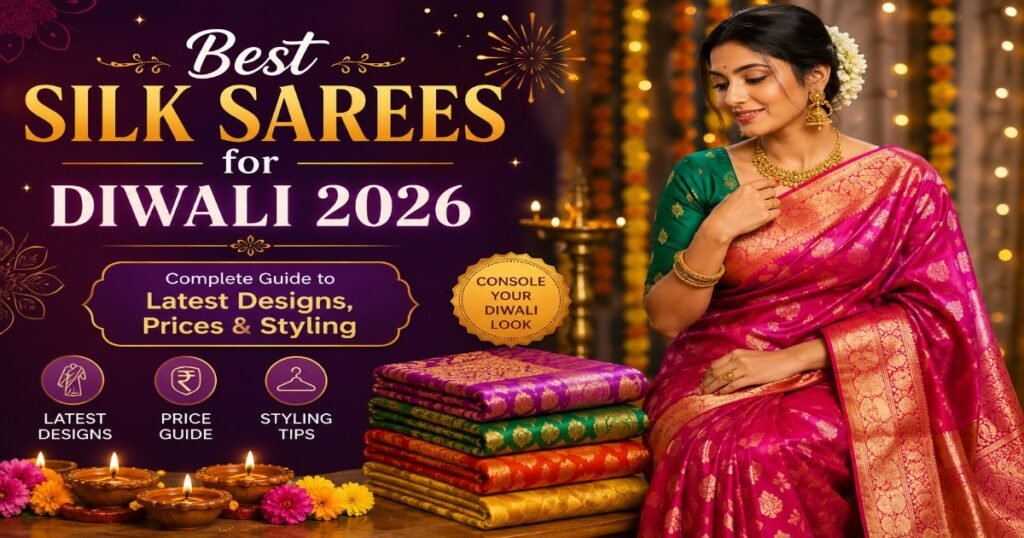
Diwali shopping for silk sarees can get overwhelming fast — every store claims “pure silk,” every seller has a different price for what looks like the same weave, and Instagram trends change every season. This guide cuts through that noise. It covers every major silk saree type worth considering for Diwali 2026, honest price expectations, how to actually judge quality in-store, region-by-region buying tips, draping and pairing advice, and a full FAQ section so you can shop with confidence instead of guesswork.
Why Silk Remains Diwali’s Signature Fabric
- Light reflection: Silk’s natural sheen catches diya flames and string lights in a way cotton or synthetic fabrics simply can’t replicate.
- Longevity: A well-maintained silk saree can last 15-20+ years and often becomes a mother-to-daughter heirloom.
- Cultural significance: Silk is considered auspicious for pujas and festivals in nearly every Indian regional tradition.
- Investment value: Unlike fast-fashion festive wear, silk sarees hold resale and sentimental value over decades.
- Photographic quality: With Diwali being one of the most photographed festivals of the year, silk’s texture and color depth simply looks better on camera and in low light.
Complete Silk Saree Directory for Diwali 2026
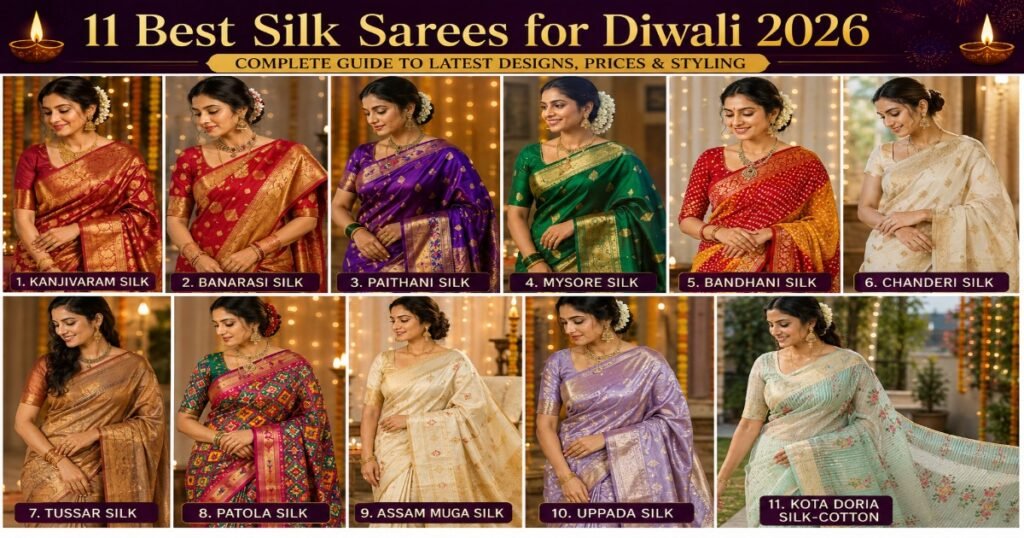
| Saree Type | Origin | Weight | Best For | Price Range (INR) |
|---|---|---|---|---|
| Kanjivaram Silk | Tamil Nadu | Heavy | Puja, formal family gatherings | ₹8,000 – ₹45,000+ |
| Banarasi Silk | Varanasi, UP | Heavy | Evening parties, receptions | ₹6,000 – ₹40,000+ |
| Paithani Silk | Maharashtra | Heavy | Statement occasions, peacock-motif lovers | ₹7,000 – ₹35,000+ |
| Mysore Silk | Karnataka | Light-Medium | All-day wear, comfort-first buyers | ₹3,500 – ₹15,000 |
| Bandhani Silk | Gujarat/Rajasthan | Light | Daytime celebrations, mehendi-style events | ₹2,500 – ₹12,000 |
| Chanderi Silk | Madhya Pradesh | Light | Semi-formal, breathable festive wear | ₹2,000 – ₹10,000 |
| Tussar Silk | Bihar/Jharkhand/WB | Medium | Earthy-tone understated looks | ₹2,500 – ₹9,000 |
| Patola Silk | Gujarat | Heavy | Collector-grade, geometric double-ikat designs | ₹15,000 – ₹1,00,000+ |
| Assam Muga Silk | Assam | Medium | Natural golden sheen, understated luxury | ₹6,000 – ₹30,000 |
| c | Andhra Pradesh | Light | Lightweight Kanjivaram alternative | ₹4,000 – ₹18,000 |
| Kota Doria Silk-Cotton | Rajasthan | Very Light | Sheer, breathable, day events | ₹1,500 – ₹6,000 |
Prices depend heavily on zari (gold/silver thread) purity, weave density, whether the piece is handloom or power-loom, and seller markup in tourist-heavy or metro markets vs. source-region prices.
Latest Design Trends for Diwali 2026
- Pastel base + heavy gold zari border — a clear shift away from all-red/maroon palettes toward blush, sage, and champagne tones.
- Dual-tone shot-silk weaves — fabric that shifts color under different lighting, especially strong in Kanjivaram and Banarasi this season.
- Minimal-pallu, heavy-border styling — a cleaner silhouette favored by younger buyers who still want festive richness.
- Temple border motifs making a strong comeback across Kanjivaram, Mysore, and Uppada weaves.
- Digital-print silk blends for buyers wanting a festive look without committing to heavier handloom pricing.
- Contrast-blouse pairing — bold or embroidered blouses worn against a muted, solid-tone saree body.
- Pre-draped and ready-to-wear silk sarees gaining popularity among first-time saree wearers and working women short on time.
- Sustainable/organic silk (Ahimsa or peace silk) seeing rising demand among eco-conscious buyers.
How to Choose Based on Skin Tone
| Skin Tone | Flattering Colors | Colors to Approach Carefully |
|---|---|---|
| Warm/Deep | Gold, maroon, mustard, rust, emerald green | Pale pastels can wash out contrast |
| Cool/Fair | Jewel blue, purple, silver, rose pink | Very dark browns can flatten features |
| Medium/Olive | Teal, coral, deep red, bronze | Neon shades can clash with undertone |
| Any tone (safe bets) | Off-white with gold zari, deep maroon, navy blue | — |
How to Choose Based on Body Type
- Petite frames: Smaller repeating prints, vertical zari lines, and lighter fabrics like Chanderi or Uppada help elongate the frame.
- Tall frames: Can carry broader borders, heavy pallus, and bold horizontal design elements well.
- Curvier frames: A well-fitted blouse paired with a saree that has a defined but not overly stiff border tends to flatter most.
- Athletic/broad-shoulder frames: Soft, flowy silks like Mysore or Tussar balance structure better than very stiff Kanjivaram weaves.
Region-Wise Buying Guide: Where Prices Are Actually Better
| Saree Type | Best Source Location | Why Buy There |
|---|---|---|
| Kanjivaram | Kanchipuram, Tamil Nadu | Direct from weavers/cooperatives, 20-30% cheaper than metro retail |
| Banarasi | Varanasi, UP | Wholesale markets like Chowk offer authentic handloom at source price |
| Paithani | Paithan/Yeola, Maharashtra | Government emporiums (like Maharashtra’s handloom outlets) verify authenticity |
| Patola | Patan, Gujarat | Only a handful of certified weaver families still produce authentic double-ikat |
| Muga Silk | Sualkuchi, Assam | Known as the “Manchester of Assam” for silk weaving, direct-from-loom pricing |
| Metro cities (Delhi, Mumbai, Bangalore) | Branded retail stores | Convenient, but expect 30-50% markup over source-region prices |
How to Spot Real Silk vs. Fake/Blended Silk
- Burn test (on a loose thread): Real silk burns slowly and smells like burnt hair, leaving fine ash; synthetic fabric melts and smells like burning plastic.
- Rubbing sound: Genuine silk produces a distinct “silk scroop” — a soft rustling sound when rubbed together.
- Feel test: Pure silk feels warm and slightly rough initially, then smooths out; synthetic blends often feel uniformly slippery.
- Zari check: Real zari (gold/silver thread) doesn’t tarnish or turn black quickly; cheap imitation zari darkens within months.
- Price sanity check: If a “pure Kanjivaram” is priced dramatically below ₹6,000-8,000, it’s very likely a blend or power-loom imitation.
- Ask for a silk mark or GI tag: Many authentic silk sarees (like Kanjivaram, Muga, Patola) carry Geographical Indication tags — always ask retailers for this.
Price Comparison: What You’re Actually Paying For
| Price Bracket | What to Expect |
|---|---|
| Under ₹3,000 | Silk-blend or art silk; machine-woven; good for one-time festive wear |
| ₹3,000 – ₹10,000 | Pure silk, moderate zari work, often power-loom with handloom finishing touches |
| ₹10,000 – ₹25,000 | Handloom pure silk, denser zari, recognizable regional weave pattern |
| ₹25,000 – ₹50,000 | Master-weaver pieces, real gold/silver zari, intricate motifs, longer weaving time (weeks to months) |
| ₹50,000+ | Heirloom-grade, GI-tagged, collector pieces (especially Patola, vintage Kanjivaram) |
Styling & Draping Ideas for Diwali
- Classic Nivi drape: The safest, most universally flattering style — works for pujas and formal family events.
- Bengali drape (with pallu pleats on both shoulders): A striking alternative for those wanting to stand out at parties.
- Belted saree look: A thin metallic or fabric belt over the waist gives a modern silhouette, popular for evening Diwali parties.
- Pre-pleated/stitched saree: A practical choice if you’re hosting and need to move around all evening without adjusting pleats.
- Contrast blouse with full sleeves: Balances a heavy silk saree body and works well for cooler autumn Diwali evenings in North India.
Jewelry & Accessory Pairing Guide
- With Kanjivaram/Banarasi (heavy zari): Keep jewelry moderate — a statement necklace OR earrings, not both, to avoid visual overload.
- With lighter silks (Chanderi, Tussar, Mysore): You can layer more — multiple bangles, jhumkas, and a maang tikka work well.
- Footwear: Traditional juttis or kolhapuris for daytime pujas; embellished heels for evening events.
- Bag: A small potli or clutch in a metallic tone that matches your blouse, not the saree body.
Budget Planning Table: Complete Diwali Look
| Budget Level | Saree | Blouse Stitching | Jewelry (Imitation) | Total Estimate |
|---|---|---|---|---|
| Economical | ₹3,000 – ₹6,000 | ₹800 – ₹1,500 | ₹1,000 – ₹2,500 | ₹4,800 – ₹10,000 |
| Mid-Range | ₹8,000 – ₹15,000 | ₹1,500 – ₹3,000 | ₹2,500 – ₹6,000 | ₹12,000 – ₹24,000 |
| Premium | ₹20,000 – ₹40,000 | ₹3,000 – ₹6,000 | ₹6,000 – ₹15,000 | ₹29,000 – ₹61,000 |
Care Tips to Protect Your Diwali Saree
- Always dry clean pure silk sarees with heavy zari — home washing can damage metallic threads and cause color bleeding.
- Store wrapped in muslin or cotton cloth, never plastic, to let the fabric breathe and avoid yellowing.
- Refold along different lines every few months to prevent permanent crease lines and fabric weakening at fold points.
- Keep sarees away from direct sunlight during storage — UV exposure fades silk noticeably faster than other fabrics.
- Add a few neem leaves, cloves, or silica gel packets in storage to prevent silverfish and moisture damage.
- Iron on low heat with a thin cotton cloth barrier between the iron and the silk to avoid scorch marks.
- Get zari-heavy sarees professionally re-set or lightly re-starched every few years if worn frequently, to maintain drape quality.
Common Mistakes to Avoid While Buying
- Buying based on brand name alone without checking weave quality or zari authenticity in person.
- Ignoring blouse fabric matching — many buyers focus only on the saree and end up with a mismatched blouse piece.
- Not checking return/exchange policy — especially important for online silk saree purchases where color can look different on screen.
- Overspending on a “trending” print that may look dated within a season or two, instead of choosing timeless colors and motifs.
- Skipping the burn/feel test when buying loose-thread samples from unfamiliar sellers, especially in tourist markets.
Frequently Asked Questions
Q: Which silk saree is best for a Diwali puja at home?
A: Kanjivaram or Mysore silk in traditional colors like red, maroon, or gold work particularly well for puja settings — they’re considered auspicious and photograph beautifully in diya light.
Q: Is it worth buying a saree above ₹25,000 for one festival?
A: If you plan to reuse it across weddings and future festivals for years, yes — the cost-per-wear drops significantly over time, and quality handloom pieces often appreciate in sentimental and resale value.
Q: What’s the real difference between handloom and power-loom silk?
A: Handloom is hand-woven on traditional looms, has slight natural irregularities in the weave, and takes longer to produce — hence the higher price. Power-loom is machine-woven, more uniform, faster to produce, and considerably cheaper.
Q: Can I wear a lighter silk like Chanderi or Tussar instead of a heavy Kanjivaram for Diwali?
A: Absolutely. Lighter silks are increasingly popular for daytime celebrations, are far more comfortable for long hours of wear, and still carry festive elegance without the weight.
Q: How do I know if I’m being overcharged for a silk saree?
A: Compare against the price ranges in this guide, ask for a GI tag or certificate of authenticity where applicable, and if possible, price-check against source-region rates (e.g., Kanchipuram for Kanjivaram) before buying in a metro retail store.
Q: What’s the most practical silk saree for someone hosting guests all evening?
A: A pre-pleated or stitched Mysore or Chanderi silk saree — lightweight, easy to move in, and doesn’t require constant pleat adjustment.