
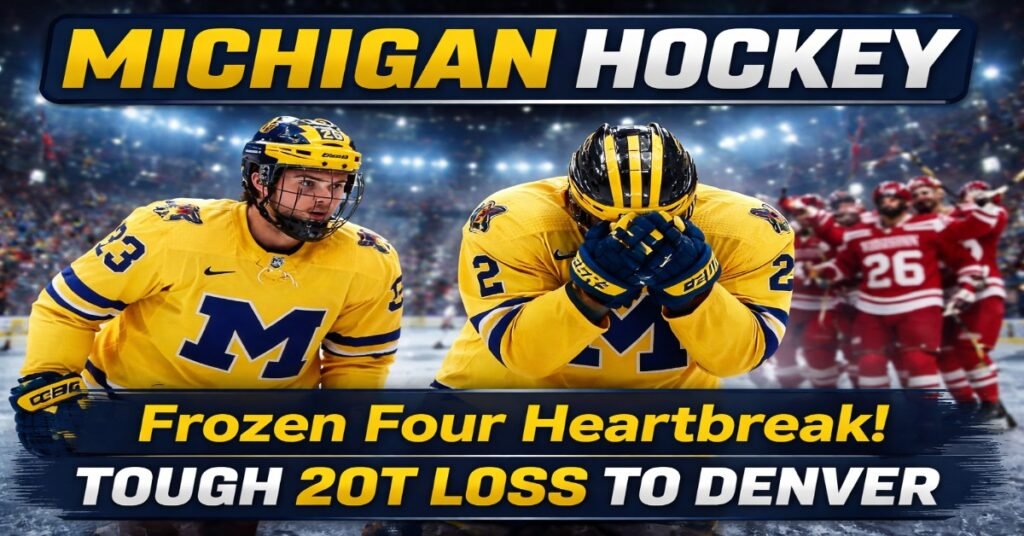
A game that lasted 92 minutes and 35 seconds, featured 77 combined shots, swung through five lead changes, and ended well past midnight Las Vegas time will take a long, long time to process in Ann Arbor. But the result is now permanent, written into the long and painful ledger of Michigan hockey heartbreak that keeps growing longer with each passing season.
Denver defeated Michigan 4-3 in double overtime Thursday night in the 2026 Frozen Four semifinal at T-Mobile Arena, delivering one of the most gut-wrenching exits in the program’s recent history. The Wolverines arrived in Las Vegas as the overwhelming No. 1 overall seed and the betting favorite to finally end a 28-year national championship drought. Instead, they went home again — outplaying their opponent for the majority of the game, dominating shots, creating chances repeatedly in overtime, and still losing.
It is a Michigan hockey story as old as the drought itself.
The Setup: A Season That Demanded a Title
To understand how much this loss hurts, you have to understand what Michigan brought to Las Vegas.
This was not a team hoping to make noise in the tournament. This was a program that spent the entire 2025-26 season building a case for the national championship. The Wolverines finished the regular season with a 32-7-1 record, claimed the Big Ten Tournament Championship on home ice at Yost Ice Arena, and locked up the No. 1 overall seed in the NCAA Tournament for the third time since 2008. They arrived in Las Vegas having won six straight games, carrying the nation’s top-ranked power play at a 31.6% conversion rate, and deploying one of the deepest offensive rosters in college hockey history.
The roster was loaded with NHL-caliber talent. Senior captain T.J. Hughes was one of the most dynamic forwards in the country, finishing second in Division I scoring with 56 points on the season, earning Big Ten Player of the Year honors, and becoming a Hobey Baker Award Hat Trick finalist. Jayden Perron had blossomed into a consistent scorer. Will Horcoff and Malcolm Spence gave the Wolverines speed and skill throughout the lineup. Michael Hage, the prolific sophomore playmaker, pushed the pace with his vision and skating ability. Defensemen Luca Fantilli and Tyler Duke had developed into reliable top-pairing contributors after years of working their way up the depth chart. Behind all of them stood goaltender Jack Ivankovic, who had been exceptional throughout the season, earning the MVP award at the Albany Regional after making 54 saves across two tournament wins.
This was also a record-setting trip to the Frozen Four. Michigan’s appearance in Las Vegas was the program’s 29th all-time — the most in NCAA history, extending a record no other school comes close to matching. Coach Brandon Naurato had now taken three of his four teams to the Frozen Four. Three senior leaders — Hughes, Kienan Draper, and Luca Fantilli — were making their third Frozen Four appearance, having also been to Tampa in 2023 and Minneapolis in 2024. The experience was there. The talent was there. The motivation was undeniable.
Michigan had not won a national championship since 1998. Nine Frozen Four appearances in those 28 years had produced a single championship game appearance, in 2011, and nothing more. This team — this specific group, in this specific year — was supposed to be the one that finally broke through.
The First Period: Michigan’s Resilience on Full Display
Denver struck first. The Pioneers controlled the opening minutes of the game, dictating possession and forcing Michigan into extended defensive shifts. Their aggressive forecheck created a turnover in the Michigan zone, and Kyle Chyzowski converted the opportunity at 9:49 of the first period, slipping a bouncing puck through traffic and past Ivankovic for a 1-0 Denver lead.
Michigan had looked uncomfortable through the opening stretch. The crowd at T-Mobile Arena, split roughly evenly between Wolverine and Pioneer supporters, felt the tension shift toward the Denver faithful.
And then Michigan did what great teams do. They flipped the game in 59 seconds.
With 3:42 left in the first period, Josh Eernisse won an offensive-zone faceoff and blasted a shot past a partially screened Johnny Hicks to tie the game at one. The T-Mobile Arena building barely had a moment to process the shift before Michigan struck again. Adam Valentini fired a shot that sailed high and caromed off the back glass, bouncing out directly in front of Hicks. T.J. Hughes was perfectly positioned, buried the rebound, and gave Michigan a 2-1 lead heading into the first intermission.
Two goals in 59 seconds. The top-ranked offense in the country doing exactly what it had done all season long — striking in flurries and swinging momentum in an instant.
Michigan carried the better of play into the break with a 2-1 lead, a territorial advantage, and every reason to feel confident about the 40 minutes ahead.
The Second Period: Denver Refuses to Go Away
Denver, a program that does not rattle regardless of circumstance, answered almost immediately in the second period. Cale Ashcroft collected the puck at the point and snapped a shot over Ivankovic’s blocker — a clean strike from the blue line that knotted the score at 2-2 just two and a half minutes into the period. Ivankovic had been partially screened on the play, but it was a quality shot executed at exactly the right moment.
What followed was a grind. Both goaltenders took over. Hicks continued to be a wall, flashing his glove, controlling his crease, and making the kind of calm, assured saves that a freshman netminder simply should not be making in a Frozen Four game. Ivankovic matched him at the other end, moving laterally and handling traffic in front with composure. The second period ended 2-2, with neither team able to break through despite sustained offensive zone time for both sides.
Through two periods, Michigan had outshot Denver and generated the more dangerous looks. But Hicks remained unbeatable. It was the same story that had defined Denver’s second half of the season — a team that leaned heavily on its freshman goalie and won because he refused to lose.
The Third Period: So Close, So Familiar
Michigan’s power play — the best in the nation at 31.6% — finally made its voice heard in the third period. With 8:58 remaining in regulation, Jayden Perron received a pass from Will Horcoff and Malcolm Spence, stepped into a shot, and ripped it past Hicks to give Michigan a 3-2 lead. The Wolverines were 11 minutes from the national championship game.
What happened next was heartbreak dressed up as a hockey play.
With just 2:46 remaining in regulation and Michigan protecting the one-goal lead, Denver defenseman Clarke Caswell positioned himself in front of the net, received a pass from Garrett Brown, and deflected the puck off his stick over Ivankovic’s glove shoulder to tie the game at 3-3. It was Caswell’s eighth goal of the season. It was the kind of goal that ends dreams.
Michigan had held that lead for nearly nine minutes. They were nine minutes and 14 seconds from returning to the national championship game for the first time since 2011. One bounce of fortune went against them, and just like that, the game was headed to overtime.
The numbers at the end of regulation were staggering in Michigan’s favor. The Wolverines held a 31-18 shot advantage through 60 minutes. They had generated the better chances, carried more offensive zone time, and were the clearly superior team in possession. But in a sport where pucks bounce off glass and deflect off sticks at impossible angles, statistics do not guarantee outcomes.
Overtime: A Marathon, A Masterpiece, and a Broken Heart
What followed was 32 minutes and 35 seconds of overtime hockey that those who watched it will not forget.
Michigan came out of the intermission and immediately took control of the overtime period. Coach Brandon Naurato called a timeout early in the first overtime after Denver’s strong opening shift, and the Wolverines responded by dominating the possession game. They were outshooting Denver 7-4 in the first overtime, then 11-1 early in the second overtime. At one point in the second extra period, Michigan was outshooting Denver 13-2. Garrett Schifsky nearly poked home a rebound right in front of Hicks. Caswell’s shot rang off the crossbar. The net seemed to be shrinking in real time.
Hicks was extraordinary. He made saves with his glove, his blocker, his pads, and at one point with his helmet. He sprawled across his crease to stop a Cole McKinney redirected shot that seemed destined for the net. He tracked cross-ice passes through traffic and positioned himself on the short side before shooters even thought about releasing. For a freshman making his 15th start of the season, in front of nearly 18,000 people at T-Mobile Arena with a trip to the national championship on the line, his composure was remarkable. He finished the game with 49 saves — a career high and one of the most dominant single-game goaltending performances in recent Frozen Four memory.
T.J. Hughes briefly left the ice in the first overtime after taking contact and appeared to favor his right arm. He returned to the game and continued competing, a detail that captures everything about what Michigan’s seniors brought to this season.
Then, with 7:25 remaining in the second overtime period, it ended. Denver defenseman Eric Jamieson spun behind the Michigan net, worked along the boards, and found Kent Anderson waiting for a pass in the slot. Anderson — a senior defenseman who had scored just once all season — received the pass from Kristian Epperson, sneaked down from his point position, found himself with a brief opening, and wristed a shot past Ivankovic to the glove side.
Denver 4, Michigan 3. Double overtime. Michigan hockey season over.
Anderson’s goal was his sixth of his entire four-year career. He had scored once all season before that moment. The least likely possible person on the ice had ended Michigan’s championship run.
The Numbers Tell the Full Story
The box score from this game reads like a list of Michigan accomplishments with exactly one item missing: the win.
Michigan outshot Denver 52-25 for the game. The Wolverines outshot the Pioneers 13-2 at one point in the second overtime period. Michigan was the more dangerous team in every offensive zone situation across both overtime periods. Jack Ivankovic made 22 saves against 25 shots, solid numbers for a game of this magnitude. The Wolverines’ power play went 1-for-4, which includes the Perron goal that gave them the 3-2 lead in the third period.
Denver went 0-for-5 on the power play. The Pioneers’ offense was largely neutralized all night. They survived on Hicks, on clutch plays at critical moments, and on the kind of resilient, never-panicking team identity that David Carle has instilled in his program over his tenure in Denver.
This was not a game Michigan lost because they played poorly. They played extremely well. They dominated large portions of the contest and created a volume of quality scoring opportunities that should, by any conventional probability, have produced a win. But the puck went in the net only three times. And Denver’s freshman goalie — undefeated in 15 starts since taking over the starting role in late January — kept it that way.
A Rivalry Defined by Overtime Pain
This was not the first time Denver has ended Michigan’s season in overtime at the Frozen Four. In 2022, in Boston, Denver defeated Michigan 3-2 in overtime in the national semifinals on their way to winning the national championship. That loss still clearly resonates in Ann Arbor. When asked about it before this year’s Frozen Four game, Coach Naurato acknowledged that he rewatched the 2022 loss the morning of March 31. His words were simple: “It still hurts.”
Michigan and Denver are the two programs with the most national championships in college hockey history. Denver’s win Thursday keeps them at 10 titles while they chase their 11th against Wisconsin on Saturday. Michigan remains at nine, their last coming in 1998. The rivalry between these two programs — elite, historic, and bitterly competitive — keeps producing moments that define both programs’ identities. For Michigan, that identity increasingly includes the weight of unfulfilled expectations and overtime elimination.
David Carle, for his part, acknowledged the magnitude of what both teams delivered Thursday night. “They look like a completely different team this year than they did four years ago,” he said after the game, a respectful acknowledgment of how far Michigan had come under Naurato’s rebuilding of the program. Then he added what every coach feels walking into a one-goal game in sudden-death overtime at the Frozen Four: “It’s sports. It’s either pure elation or utter heartbreak. It’s the beauty of it.”
For Michigan, it was heartbreak. Again.
What This Loss Means for the Program
Michigan hockey is not a program in decline. The Wolverines have now appeared in the Frozen Four four times in five seasons under Brandon Naurato. They finished the 2026 season with a 32-7-1 record as the nation’s top seed. They won the Big Ten Tournament. They reached an NCAA record 29th Frozen Four. By every reasonable measure, Michigan hockey is operating at the elite level of the sport.
But the championship window is real, and it does not stay open forever. T.J. Hughes will sign an NHL contract when the season ends. The senior class — Hughes, Kienan Draper, Josh Eernisse, Luca Fantilli, Tyler Duke, and others — will not return. Some of those faces have been here before, to Tampa and Minneapolis and now Las Vegas, and they will leave without the title their talent and commitment deserved.
The incoming group has talent. Jack Ivankovic returns. Michael Hage returns. Jayden Perron returns. Naurato has proven he can recruit, develop, and coach to this level consistently. The pipeline is not broken.
But in the short term, on this night, what happened in Las Vegas is simply painful. Michigan dominated a game, outshot their opponent by more than two to one across 92 minutes of hockey, and lost in double overtime to a freshman goalie who has never lost a college hockey game. In a sport where puck luck and goaltending can override talent and possession in a single elimination game, sometimes that is just what happens.
It does not make it easier to accept. It rarely does when you are the best team that did not win.
Final Score
Denver 4, Michigan 3 (2OT)
Goals: Michigan — Eernisse (1st, 16:18), Hughes (1st, 17:17), Perron (3rd, 11:02) | Denver — Chyzowski (1st, 9:49), Ashcroft (2nd, 2:33), Caswell (3rd, 17:14), Anderson (2OT, 12:35)
Shots on Goal: Michigan 52 — Denver 25
Saves: Ivankovic (Michigan) 22 saves | Hicks (Denver) 49 saves
Attendance: 17,942 — T-Mobile Arena, Las Vegas, Nevada
What Comes Next
Denver advances to face Wisconsin in the national championship game on Saturday, April 11, at T-Mobile Arena with a 5:30 p.m. ET start on ESPN. The Badgers defeated North Dakota 2-1 in the first Frozen Four semifinal Thursday evening, ending the Fighting Hawks’ season. Wisconsin is seeking their seventh national title, their most recent having come 20 years ago.
For Michigan, the 2026 season is over. The flight back to Ann Arbor will be a quiet one. The weight of another Frozen Four without a national championship will settle into the program and carry into the offseason recruiting and roster decisions that will shape whether the Wolverines can return to this stage next year and, finally, finish the job.
The championship drought now stands at 28 years and counting. Ann Arbor will be waiting.