Social Security scams in 2026 have reached crisis levels across the United States. You worked for decades, paid into Social Security every single paycheck, and planned carefully for retirement. Now a sophisticated criminal industry — operating around the clock and armed with artificial intelligence — is specifically targeting Social Security recipients like you. Understanding how these Social Security scams work is no longer optional. It is essential for protecting everything you have built.
You worked for decades. You paid into Social Security every single paycheck. You planned carefully for retirement. And now, a sophisticated criminal industry — operating around the clock, armed with artificial intelligence and psychological manipulation tactics — is specifically, deliberately, and systematically targeting you.
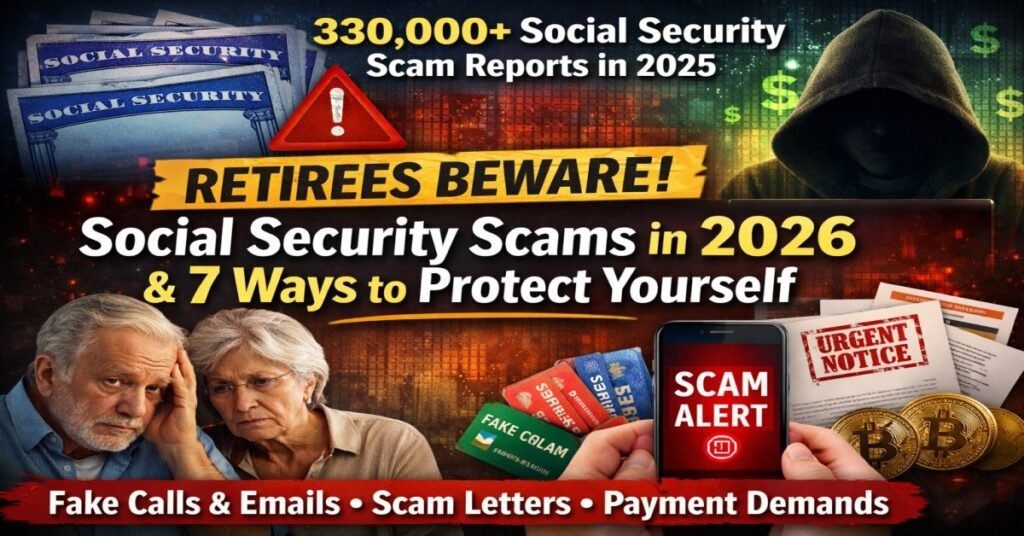
This is not a warning to brush aside. In 2025, the Federal Trade Commission received more than 330,000 complaints involving government impersonation scams — a 25% jump over the year before. The Social Security Administration remains one of the most frequently impersonated agencies in the entire country. Financial losses among seniors aged 60 and older who lost $100,000 or more to these schemes jumped from $55 million to $445 million between 2020 and 2024 — an eightfold increase in just four years.
The scams have also evolved dramatically. In 2026, the criminals behind these schemes are no longer just cold-calling from a script. They are using AI-generated voices, deepfake video calls, fake government letterhead, spoofed caller ID numbers, fraudulent Supreme Court citations, and years of stolen personal data to craft attacks so convincing that they fool even sharp, educated, experienced adults every single day.
This guide will tell you exactly who is targeting retirees, what every major Social Security scam looks like in 2026, what the real Social Security Administration will and will never do, and seven concrete, actionable steps you can take to protect yourself and the people you love.
Why Social Security Scams Are the Fastest-Growing Financial Crime in the US
Social Security fraud is not random. Criminals target this program deliberately and strategically, and there are very specific reasons why retirees are their preferred victims.
Social Security touches almost every American retiree’s financial life. Because the program is so universal, scammers can craft messages that feel personally relevant to virtually any older adult in the country. There is no need to know a target’s specific bank or brokerage — nearly every retiree has a relationship with the SSA.
Retirement savings represent a concentrated pool of wealth. Decades of savings, pension income, and investment accounts often sit in relatively accessible accounts during the retirement years. Scammers know that a successful attack on a retiree can yield far more money than the same effort spent targeting a younger, still-working individual.
Technology has created a trust gap. Many older adults grew up in an era when caller ID was reliable, official-looking documents were trustworthy, and phone calls from government agencies were taken at face value. Scammers exploit exactly this trust. They understand that a generation of Americans who spent their lives following the rule “answer the phone, respect authority, comply with official requests” is uniquely vulnerable to manufactured authority and urgency.
Social Security numbers are irreplaceable. Unlike a credit card that can be cancelled and replaced, your Social Security number is yours for life. Once a criminal obtains it, they can use it for years — opening fraudulent accounts, filing false tax returns, stealing benefits, and building synthetic identities. This makes Social Security-related fraud uniquely long-lasting in its damage.
The scam industry has industrialized. What was once a crime of opportunity — individual criminals making phone calls from their homes — has evolved into a sophisticated, technology-powered criminal enterprise. Organized fraud networks now use AI tools to identify the most vulnerable targets, generate personalized messaging at scale, clone voices, and deploy automated systems that operate continuously across time zones.
The Complete 2026 Social Security Scam Playbook: Every Scheme You Need to Know
Modern Social Security scammers follow predictable patterns. The SSA’s own guidance identifies four core tactics they use consistently, described as the four Ps: Pretend, Problem or Prize, Pressure, and Payment. Understanding each scam type in detail is your most powerful defense.
Scam #1: The Suspended Social Security Number Call
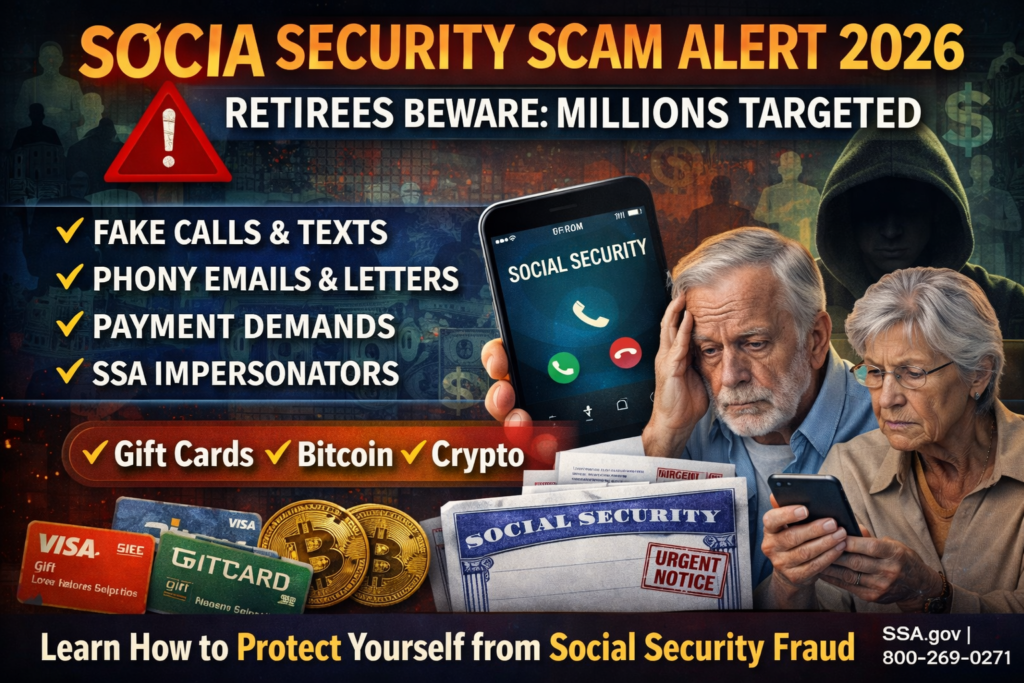
This is the most common Social Security scam and accounts for approximately 31% of all SSA fraud reports according to OIG quarterly data. The phone rings. The caller identifies themselves as an SSA agent, often providing a name and badge number. They tell you that your Social Security number has been “suspended” or “compromised” due to suspicious activity — often referencing drug trafficking, money laundering, or criminal investigation — and that you must verify your identity or make an immediate payment to restore your benefits.
The urgency is intense. They may tell you that if you hang up, a warrant for your arrest will be issued within the hour. They may already know your name, address, and partial Social Security number — obtained from data breaches — which makes the call feel frighteningly legitimate.
The truth: The Social Security Administration does not suspend Social Security numbers. It does not threaten arrest over the phone. It does not demand immediate payment of any kind to restore benefits. This call is a scam, every single time.
Scam #2: The Fraudulent Warning Letter
In 2026, scammers have moved beyond phone calls alone. A wave of official-looking letters is being mailed directly to retirees’ homes. These letters carry SSA logos, government-style formatting, fabricated case numbers, and even the names of real Social Security officials. Their purpose is identical to the phone scam: frighten the recipient into revealing personal information or sending money.
Some of these letters have gone so far as to cite fabricated Supreme Court cases to make legal threats appear credible. Others threaten the suspension of Social Security cards or the seizure of benefits unless the recipient calls a number or visits a website immediately.
Red flags to watch for in any letter claiming to be from the SSA: threats of any kind, demands for immediate action, requests for payment via unusual methods, a phone number or website address that does not end in .ssa.gov or .gov, and any demand for secrecy about the contents of the communication.
Scam #3: The COLA “Activation” Scam
Every autumn, the Social Security Administration announces the annual cost-of-living adjustment — the percentage by which benefits increase to account for inflation. Scammers time their attacks to coincide exactly with this announcement.
They contact retirees by phone, email, or text claiming that the COLA increase requires “identity verification” or a small processing fee before it can be applied to the beneficiary’s account. They may even quote the correct COLA percentage to appear credible.
The truth: The SSA never requires payment, personal verification calls, or any action from recipients to activate a COLA increase. Adjustments are applied automatically to every eligible beneficiary’s account. Any communication suggesting otherwise is a scam.
Scam #4: The Fraudulent Social Security Statement Email
The SSA’s Office of the Inspector General issued a direct public warning in February 2026 about a sharp increase in scam emails impersonating official SSA communications. These emails are designed to look identical to legitimate Social Security correspondence, including official logos, color schemes, formatting, and language. They claim to provide access to the recipient’s Social Security statement and instruct the reader to click a link or download an attachment.
Clicking the link typically leads to either a credential-harvesting fake website designed to steal your SSA login, or malware that gives criminals remote access to your computer. Official SSA email communications come only from addresses ending in .gov. Any Social Security email from a Gmail, Yahoo, Hotmail, or non-government domain address is fraudulent.
Scam #5: The AI-Powered Grandparent Scam
This scam has undergone a terrifying technological upgrade in 2026. Using publicly available audio scraped from social media, YouTube videos, voicemails, or TikTok posts, criminals can now clone a real person’s voice with as little as three seconds of audio. They then use that cloned voice to call a grandparent, impersonating their grandchild in distress.
The script is consistent: the “grandchild” has been in an accident, was arrested, is in trouble abroad, or needs emergency money — and they beg the grandparent not to tell anyone else in the family out of embarrassment. A “lawyer” or “police officer” then takes over the call and provides payment instructions.
In a documented Philadelphia case, an 86-year-old grandmother handed over $6,000 in cash to scammers who had perfectly replicated her granddaughter’s voice. She had no reason to doubt what she was hearing. The voice was indistinguishable from real.
Deepfake video technology takes this even further. AI-generated videos of Social Security officials, law enforcement officers, or even family members are now being used in video calls to add a visual layer of false credibility that is increasingly difficult to detect.
Scam #6: The “Safe Account” Money Transfer Scam
In this scheme, a caller posing as an SSA or law enforcement official tells the victim that their bank account has been flagged in a criminal investigation and their funds are at risk of being seized. To “protect” the money, the victim is instructed to transfer funds immediately to a “safe” government-controlled account — which is, of course, the scammer’s account.
Variations of this scam have instructed victims to withdraw cash and hand it to a courier, purchase gold bars for a government agent to collect in person, or buy gift cards and read the numbers over the phone. None of these instructions would ever come from any legitimate government agency.
Scam #7: The Social Security Social Media Impersonation
Scammers now create fraudulent social media pages on Facebook, Instagram, and X (formerly Twitter) that closely mimic the appearance of official SSA accounts. They use these fake pages to reach out to older adults via direct message, claiming there is a problem with their account or that they have won a benefit enhancement. They then collect personal information or direct victims to fake SSA websites.
The SSA does not initiate contact with beneficiaries through social media direct messages. If you receive a DM from what appears to be an SSA account, treat it as fraudulent regardless of how legitimate the page appears.
Scam #8: The Recovery Scam — A Second Hit After the First
This particularly predatory scheme targets people who have already been victimized by a scam. Criminals contact previous fraud victims — whose information is often sold on criminal networks — claiming to be from a law enforcement agency, consumer protection bureau, or private recovery firm that can help retrieve the money that was stolen.
They charge upfront fees, demand personal information, or request cryptocurrency payments to initiate the “recovery process” — which never happens. The victim is scammed a second time, often for more money than they lost originally. If someone contacts you unsolicited claiming to recover your lost funds, it is a scam.
What the Real SSA Will NEVER Do: The Master Reference List
One of the most effective defenses against Social Security scams is understanding exactly how the real SSA operates — because the agency’s genuine contact policies make it very easy to identify impostors once you know the rules.
The Social Security Administration will NEVER:
- Threaten to arrest you, suspend your Social Security number, or sue you over the phone
- Demand immediate payment of any amount to restore, unlock, or verify your benefits
- Ask you to pay using gift cards, wire transfers, cryptocurrency, prepaid debit cards, cash, or gold bars
- Request that you move money to a “protected” or “safe” government account
- Send someone to your home to collect cash or other assets in person
- Require payment or personal verification to activate a COLA increase
- Contact you through social media with account problems or payment requests
- Send emails with attachments or links asking you to log in to your SSA account
- Ask you to keep any communication from the SSA secret from family members
- Use threatening, aggressive, or urgent language designed to make you act immediately without thinking
- Claim that your Social Security number has been “suspended” or “cancelled”
How the real SSA does contact people:
The primary method the SSA uses to contact beneficiaries is first-class mail. When the agency needs to reach you, it sends a letter with a return address and specific instructions for responding through official channels. When you call the SSA yourself, the number is 1-800-772-1213. If the SSA calls you, you always have the right to hang up, look up the official number independently, and call back to verify that the contact was real.
7 Proven Ways to Stay Safe From Social Security Scams in 2026
Protection Method #1: Create Your My Social Security Account Before a Scammer Does
This is one of the most important — and most overlooked — steps any retiree can take. By creating a free account at ssa.gov/myaccount, you establish yourself as the verified owner of your Social Security record online. This means a scammer cannot fraudulently create an account in your name and redirect your direct deposit, change your mailing address, or access your benefits information.
Once your account is active, you receive automatic alerts any time someone attempts to change your address or direct deposit information. You are in control. You have a direct line of sight into your own benefit record. Every retiree in America should have this account active regardless of whether they are concerned about scams.
Protection Method #2: Freeze Your Credit at All Three Bureaus
A credit freeze — also called a security freeze — prevents anyone from opening new credit accounts, loans, or financial products in your name, even if they have your Social Security number. It is free to place and free to lift temporarily whenever you need to apply for something yourself. You must freeze your credit at all three major bureaus separately: Equifax, Experian, and TransUnion.
A credit freeze does not affect your existing accounts, your credit score, or your ability to use current credit cards. It simply locks new creditors from accessing your report. For retirees who are not actively seeking new credit, a permanent freeze is one of the strongest identity theft protections available.
Protection Method #3: Set Up a Personal Code Word With Trusted Family
Establish a private, memorable code word that only you and your immediate trusted family members know. If you ever receive a call claiming to be from a grandchild, family member, or anyone asking for emergency money, require them to say the code word before you take any action. No real family member in genuine distress will object to this. A scammer using a cloned voice will not know it.
This simple, zero-cost strategy directly defeats AI voice cloning attacks — the fastest-growing and most convincing category of elder fraud in 2026.
Protection Method #4: Never Act on Urgency — Always Hang Up and Verify Independently
The single most powerful psychological tool scammers use is manufactured urgency. Every Social Security scam is built around pressure: act now, pay immediately, do not hang up, do not call anyone else, your arrest warrant is being issued as we speak. This urgency is not accidental — it is specifically designed to short-circuit your rational thinking and prevent you from pausing long enough to realize something is wrong.
The counter to urgency is a standing personal rule: you will never take financial action or share personal information during an unexpected inbound contact of any kind. Always hang up. Always look up the official number yourself — from the SSA’s official website at ssa.gov, not from any number given to you by the caller. Then call back and verify independently.
No legitimate government agency will punish you for taking a few minutes to verify their identity. Scammers, however, will become more aggressive or simply hang up when you say you plan to call back.
Protection Method #5: Add Fraud Alerts to Your Financial Accounts
Contact your bank, credit union, and any investment institutions where you hold accounts and ask about available fraud alert options. Many financial institutions now allow you to set up real-time alerts for every transaction, transfer, or login attempt on your account. Some offer the ability to require a verbal confirmation before wire transfers or large withdrawals are processed.
Additionally, place a fraud alert with the three credit bureaus. A fraud alert is different from a credit freeze — it instructs creditors to take extra steps to verify identity before extending credit in your name. While less comprehensive than a freeze, it provides an additional layer of protection and remains active for one year, renewable at any time.
Protection Method #6: Protect Your Digital Footprint Aggressively
AI voice cloning requires only seconds of publicly available audio to produce a convincing clone of your voice. Deepfake technology can generate realistic video from a handful of photos. The raw material for these attacks is collected from public social media profiles, YouTube videos, TikTok posts, Facebook timelines, and voicemail greetings.
Review and tighten the privacy settings on every social media platform you use. Limit who can see your posts, videos, and personal information to confirmed friends and family only. Consider whether your public voicemail greeting includes enough of your voice to be used for cloning — and consider changing it to a brief, generic message. The less public audio and video of you that exists, the harder it is for criminals to build a convincing impersonation.
Protection Method #7: Talk About Scams Openly and Regularly With Family
Shame and embarrassment are among the most significant reasons Social Security fraud goes unreported. Many victims — particularly older adults — feel humiliated that they were deceived and choose not to tell family members or report the crime. Scammers count on this silence. They actively cultivate it by instructing victims to keep the “investigation” secret.
The most powerful antidote to this isolation is open, regular, shame-free conversation about scams within families. When retirees and their adult children or grandchildren routinely discuss the latest fraud tactics, share warnings, and check in with each other, the information network becomes a real defensive barrier. A family member who heard about the COLA activation scam last week is far more likely to recognize it when it targets their parent.
Make scam awareness a normal topic of conversation — not a crisis conversation to have after something goes wrong.
What to Do If You Have Already Been Targeted or Victimized
If you believe you have been contacted by a Social Security scammer — whether or not you shared information or sent money — the steps below are important to take as quickly as possible.
If you shared personal information (Social Security number, Medicare number, bank details):
First, contact your bank and any financial institutions immediately to report the potential compromise. Ask them to flag your account for unusual activity and review recent transactions. Then place a credit freeze at all three bureaus (Equifax, Experian, TransUnion) right away. Visit IdentityTheft.gov to report identity theft and receive a personalized recovery plan from the FTC. Finally, monitor your credit report carefully for weeks and months after the incident — stolen data is often used long after the initial theft.
If you sent money:
Contact your bank or payment provider immediately and ask whether the transaction can be reversed or stopped. Speed matters enormously here — the faster you call, the greater the chance of recovery. If you sent gift cards, call the customer service number on the back of each card and report the fraud. Report the incident to the SSA Office of the Inspector General at oig.ssa.gov/report or by calling 1-800-269-0271. File a report with the FTC at reportfraud.ftc.gov. If the financial loss was significant, also contact your local law enforcement.
If you received a suspicious contact but did not engage:
Report it to the SSA OIG regardless. Your report helps authorities identify patterns, track criminal operations, and warn other potential victims. Every report matters even when no money was lost.
Resources for ongoing support:
- SSA Office of the Inspector General: oig.ssa.gov/report | 1-800-269-0271
- Federal Trade Commission fraud reporting: reportfraud.ftc.gov
- FTC identity theft recovery: IdentityTheft.gov
- FTC multilingual assistance: (877) 382-4357
- Department of Justice National Elder Fraud Hotline: 1-833-FRAUD-11 (1-833-372-8311)
- AARP Fraud Watch Network Helpline: 1-877-908-3360
- BBB Scam Survival Toolkit: bbb.org/scam-survival-toolkit
Frequently Asked Questions
Q: How did the scammer already know my name and address?
A: Your personal information is likely available from one or more of the hundreds of data breaches that have occurred over the past decade at retailers, healthcare providers, credit bureaus, and government agencies. Criminals purchase this data on underground markets for very little money. The fact that a caller knows your name, partial SSN, or address is not proof that they are legitimate — it is proof that your data has already been exposed, which is true for the vast majority of American adults.
Q: Can caller ID really be faked to show the SSA’s actual number?
A: Yes, completely. Caller ID spoofing technology allows anyone to make a call appear to come from any phone number they choose — including official SSA numbers, law enforcement agencies, and government offices. Never trust caller ID as proof of identity. If you want to confirm whether a call was real, hang up and call the official SSA number (1-800-772-1213) directly.
Q: The scammer sent me an official-looking badge photo and government letterhead. Does that mean they are real?
A: No. Official-looking documents and badge images are trivially easy to fake and are a standard part of the scammer’s toolkit. The SSA OIG has specifically warned the public that scammers use fraudulent badges and letterhead as psychological props to increase credibility. It is actually illegal under federal law to reproduce federal employee credentials — but scammers break laws. A badge photo proves nothing.
Q: I am embarrassed that I was targeted. Should I still report it?
A: Absolutely, and please understand: these scams are engineered by professional criminal organizations with deep expertise in human psychology. Being deceived by them is not a reflection of your intelligence or competence. It is a reflection of how sophisticated and well-resourced these criminal networks have become. Reporting protects others. It helps law enforcement track and shut down these operations. You have nothing to be ashamed of and everything to gain by reporting.
Q: My grandchild’s voice sounded exactly like them on the phone. How is that possible?
A: AI voice cloning technology can replicate a person’s voice from just a few seconds of audio available publicly online. The result is indistinguishable from the real voice to most listeners, even family members who know the person well. This is exactly why the family code word strategy described in this article is so important — it creates a verification layer that technology cannot defeat.
Q: What if I froze my credit but need to apply for something?
A: You can temporarily lift a credit freeze at any bureau online or by phone, typically within minutes. The lift can be made permanent or set for a specific time window after which the freeze automatically re-activates. This flexibility means a credit freeze is almost never a meaningful inconvenience for normal financial activity.
The Bottom Line: Awareness Is Your Most Powerful Defense
Social Security scammers in 2026 are more sophisticated, more organized, better funded, and more technologically capable than at any point in history. They are using artificial intelligence to clone voices and generate fake videos. They are combining years of stolen personal data with psychological expertise to craft attacks that are nearly impossible to dismiss instinctively.
But every single Social Security scam — no matter how technically sophisticated — ultimately depends on one thing: your response. Your payment. Your fear. Your urgency.
When you hang up, refuse to engage, verify independently, and refuse to be pressured into acting without thinking, the scam fails. Every time. The most effective defense against the most advanced fraud operation in the world is still a calm, informed person who knows that the real SSA sends letters — not threatening phone calls — and who refuses to make any financial decision under artificial urgency.
Share this article with every retiree you know. Talk about it with your parents, your grandparents, your neighbors. The more people who know these tactics, the fewer victims there will be.