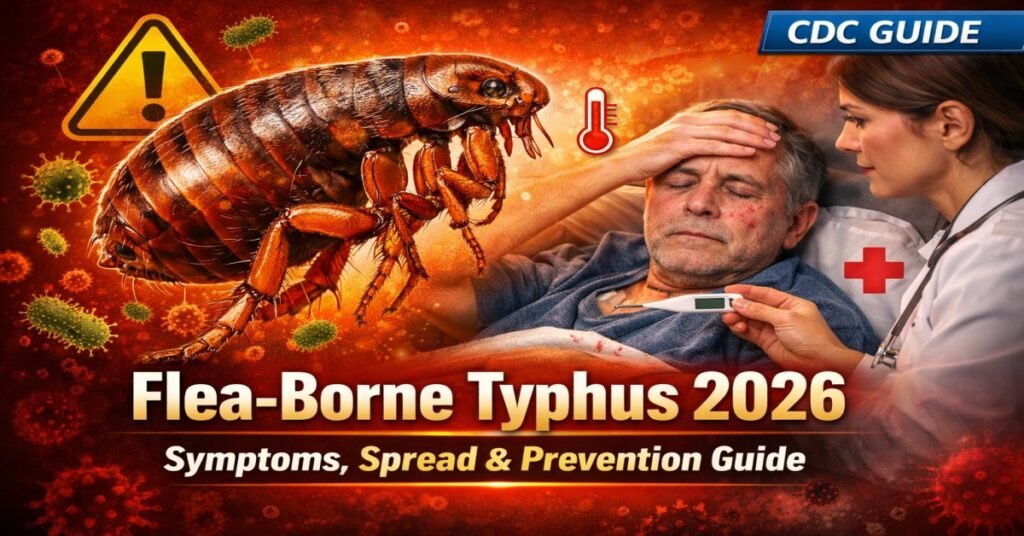
Most Americans have never heard of flea-borne typhus. Yet this bacterial infection — carried by the same tiny insects that bother your pets — has been quietly spreading across the United States for nearly two decades, with case numbers hitting all-time highs in 2025. Unlike diseases that travel by cough or handshake, flea-borne typhus arrives invisibly, through an insect bite so small most people never notice it.
Understanding what flea-borne typhus actually is, how it gets into the human body, what it does once it is there, and how to treat and prevent it — could be the difference between catching it early and ending up in a hospital bed.
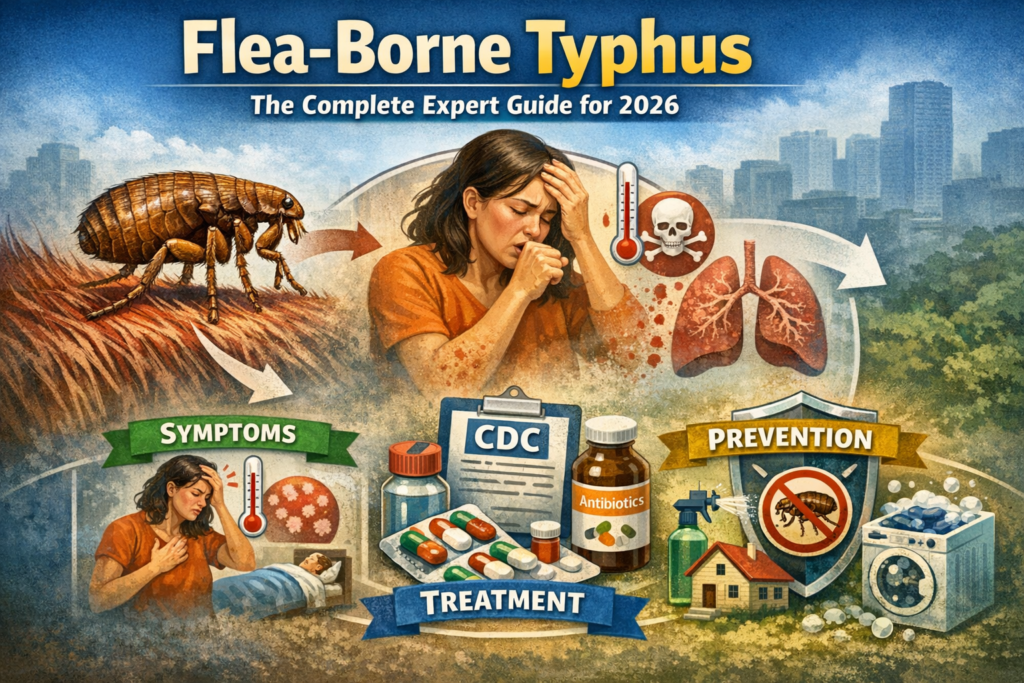
This guide covers everything: the science behind the disease, a full breakdown of symptoms from mild to severe, the latest US case data, clinical diagnosis and treatment, and a practical prevention checklist you can act on today.
What Is Flea-Borne Typhus?
Flea-borne typhus is a bacterial infection caused by a microscopic organism called Rickettsia typhi. It belongs to a family of bacteria called Rickettsiaceae — obligate intracellular pathogens, meaning they can only survive and reproduce inside the living cells of a host. They cannot be grown in a standard laboratory dish the way most common bacteria can, which is part of what makes them difficult to detect and study.
The disease goes by several names that are all used interchangeably in medical and public health literature:
- Flea-borne typhus — the most accurate descriptor of how it spreads
- Murine typhus — from the Latin word murinus, meaning “of mice,” reflecting the rodent connection
- Endemic typhus — because it circulates persistently within certain geographic regions rather than exploding in epidemics
It is critically important to understand that flea-borne typhus is a completely distinct disease from epidemic typhus, which is caused by a different bacterium (Rickettsia prowazekii) and spreads through body lice. Epidemic typhus was responsible for millions of deaths throughout history, particularly during war and famine. Flea-borne typhus is considerably milder by comparison, but it is still a serious illness capable of causing organ damage, prolonged hospitalization, and in rare cases, death — especially when treatment is delayed.
There is a second flea-borne Rickettsia species worth knowing: Rickettsia felis, which causes a related condition sometimes called flea-borne spotted fever. It is transmitted by the same cat fleas and produces overlapping symptoms, though it is less well understood than R. typhi.
The Science Behind the Bacteria
Rickettsia typhi is a tiny, rod-shaped, gram-negative bacterium. Once it enters the human body, it targets the cells that line blood vessel walls — called endothelial cells. By invading and replicating inside these cells, the bacteria trigger a process of widespread vascular inflammation throughout the body.
This endothelial injury is the central mechanism behind almost every symptom of flea-borne typhus. As blood vessel walls become inflamed and damaged, fluid leaks from the circulatory system into surrounding tissues, organ perfusion can drop, and in severe or untreated cases, systems including the lungs, kidneys, liver, and brain begin to fail. This is why flea-borne typhus is never truly a mild nuisance — even in cases that seem manageable at first, the underlying biological process is fundamentally serious.
The bacterium is classified at biosafety level 2/3, meaning it requires special laboratory handling due to its infectious potential. Infected flea feces can remain viable and infectious for up to 100 days under the right temperature and humidity conditions.
How Does Flea-Borne Typhus Spread? The Complete Transmission Chain
To understand how people get flea-borne typhus, you need to understand the transmission cycle — and it is more complex than a simple flea bite.
The Classic Urban Cycle: Rats and Rat Fleas
The primary transmission chain involves rats and the Oriental rat flea (Xenopsylla cheopis). Rats are the natural reservoir for Rickettsia typhi, meaning the bacteria circulate within rat populations without making the rats visibly sick. When an uninfected rat flea feeds on a rickettsemic rat, it picks up the bacteria. From that moment onward, the flea remains infected for its entire lifespan — and can continuously shed infectious bacteria in its feces.
This urban rat-flea cycle is most common in densely populated city areas where rat populations are high and human-rodent contact is frequent.
The Suburban Cycle: Opossums and Cat Fleas
In the United States, particularly in Southern California and Texas, a second transmission pathway has emerged. This involves opossums (Didelphis virginiana) and cat fleas (Ctenocephalides felis) rather than rats and rat fleas. Opossums carry Rickettsia typhi without showing any signs of illness, and the ubiquitous cat flea readily feeds on opossums, picks up the bacteria, and then moves to domestic animals — or directly to humans.
This suburban cycle is particularly concerning because it puts the disease squarely in residential neighborhoods, backyards, and homes. It no longer requires contact with an obviously rat-infested environment.
How the Bacteria Actually Enters the Human Body
The mechanism of infection is not the flea bite itself in most cases — it is the flea’s feces. When a flea feeds on a person, it simultaneously defecates on the skin. The bacteria are concentrated in that fecal matter. When the person scratches the itchy bite, they break the skin slightly and rub the infectious material into the wound. The bacteria then enter the bloodstream.
Two additional — though less common — routes of infection exist. A person can introduce the bacteria by touching flea feces and then rubbing their eyes or mouth, exposing mucous membranes. And in rare cases, dried flea feces can be inhaled when disturbed, delivering the bacteria directly to the respiratory tract.
Key facts about transmission:
- Flea-borne typhus absolutely does not spread from person to person — not through touch, breathing, or any form of human contact
- Infected animals — including your own pets — carry infected fleas without showing any symptoms themselves
- Most people who get infected never notice a flea bite or know they were exposed
- Infected fleas remain infectious for life, meaning a single flea can infect multiple hosts over an extended period
Where in the United States Is Flea-Borne Typhus Found?
Flea-borne typhus is not uniformly distributed across the country. Three states consistently account for the vast majority of reported cases.
California
California — specifically Los Angeles County and surrounding Southern California communities — has become the current national epicenter of flea-borne typhus. Los Angeles County recorded 220 confirmed cases in 2025, breaking the previous record of 187 set in 2024, and nearly 90% of those patients required hospitalization. Localized outbreaks were identified in three areas: Central Los Angeles, Santa Monica, and the Willowbrook community in South LA County. Cases affected patients ranging from 1 year old to 85 years old. The connection to urban rodent populations and growing encampments has been explicitly noted by county public health officials.
Texas
Texas has historically reported the highest annual caseload in the nation. Between 2008 and 2023, over 6,700 cases were recorded in the state — with a peak of 835 cases in a single year. The disease is most concentrated in South Texas, from Nueces County southward into the Rio Grande Valley, but over the past 15 years has expanded significantly into the Dallas-Fort Worth metroplex, greater Houston, and other metro areas. Approximately 70% of Texas cases result in hospitalization, and 14 fatalities were recorded over that 15-year period.
Hawaii
Hawaii’s year-round tropical climate sustains thriving flea and rodent populations, creating consistent transmission risk across the islands. Cases are reported regularly and contribute meaningfully to the national count.
Other States
Because flea-borne typhus was removed from the national notifiable disease list in 1987, comprehensive national data does not exist. Many states likely have cases that go undetected, misdiagnosed, or unreported. Public health experts widely believe that the true national burden of flea-borne typhus is considerably higher than official figures capture.
Flea-Borne Typhus Symptoms: From First Signs to Severe Complications
Incubation Period
After exposure to infected fleas or flea feces, symptoms typically appear within 6 to 14 days. Because most people do not realize they were bitten by a flea, the connection between an outdoor experience, a pet encounter, or a neighborhood outing and subsequent illness is rarely made. This delay in recognizing the exposure source contributes significantly to delayed diagnosis and treatment.
Early Symptoms (Days 1 to 5)
The earliest symptoms of flea-borne typhus are entirely non-specific and resemble influenza or a range of common viral illnesses. This is the window during which most cases are misidentified.
- Sudden onset of high fever — often the first and most prominent symptom
- Severe, persistent headache
- Chills
- Intense muscle aches and body pain
- Deep fatigue and weakness
- Loss of appetite
- Nausea and sometimes vomiting
- Abdominal pain and discomfort
- Dry, persistent cough in some patients
At this early stage, nothing about these symptoms specifically points to flea-borne typhus. This is exactly why a history of possible flea exposure — or living in an endemic area — is such a critical piece of information for any physician evaluating a febrile patient.
The Rash (Typically Days 5 to 8)
A rash develops in the majority of flea-borne typhus patients, though not in all of them. When it does appear, it usually emerges at the end of the first week of illness. It begins as a flat, spotted eruption — medically described as maculopapular — on the trunk of the body. Over the following days, it spreads outward toward the arms and legs.
Importantly, the rash in flea-borne typhus consistently spares the palms of the hands and the soles of the feet. The rash is typically non-itchy, lasts roughly 1 to 4 days, and can be very subtle or easy to overlook, especially in patients with darker skin tones. Its appearance can vary considerably between patients.
Crucially: the absence of a rash does not rule out flea-borne typhus. Physicians are specifically instructed not to rely on the rash as a diagnostic criterion, because it may appear late, be transient, or be absent altogether.
Severe and Advanced Symptoms
When flea-borne typhus is not treated promptly, the bacterial damage to blood vessel walls progresses throughout the body. The resulting complications can affect multiple organ systems simultaneously.
Pulmonary (lung) involvement occurs in roughly 27% of murine typhus cases, typically manifesting as a dry cough. In a smaller subset of patients, chest imaging reveals infiltrates, and a very small percentage progress to acute respiratory distress syndrome — a life-threatening condition requiring intensive care.
Kidney injury results from reduced blood flow to the kidneys as the vascular system is compromised. If prolonged, this can progress to acute tubular necrosis — permanent kidney cell damage.
Liver injury is common and often shows up on routine blood tests as elevated liver enzymes. Jaundice can occur in some cases.
Neurological manifestations are among the most alarming potential complications. In hospitalized patients, confusion has been reported in approximately 8% of cases, seizures in 4%, stupor in 4%, and loss of coordination in 1%. In elderly patients or those with pre-existing neurological conditions, flea-borne typhus can mimic or worsen dementia symptoms, sometimes leading to complex and challenging diagnostic situations.
Cardiac involvement in the form of myocarditis — inflammation of the heart muscle — has been documented in severe cases.
Pregnancy complications have also been associated with typhus infection, including increased risk of miscarriage, preterm birth, and low birth weight when infection occurs during early pregnancy.
The case fatality rate for flea-borne typhus is approximately 0.4% overall. While this is low, it is not zero — and the risk of death increases substantially when diagnosis is delayed and the disease is allowed to progress without treatment.
Who Is Most at Risk?
Flea-borne typhus can affect anyone of any age. However, several groups carry significantly elevated risk:
Older adults face greater risk of severe outcomes and complications. The disease tends to be more aggressive in elderly individuals, and its neurological manifestations are harder to distinguish from existing age-related cognitive conditions.
People with weakened immune systems — including those receiving immunosuppressive therapy, living with HIV, or managing chronic illnesses — are more susceptible to severe disease progression.
Pet owners whose dogs or cats have outdoor access are consistently at higher risk, as pets serve as the primary bridge that brings infected fleas from wildlife into the home.
Outdoor workers — including landscapers, agricultural workers, pest control professionals, and sanitation workers — face elevated occupational exposure.
Residents of endemic areas in Southern California, South Texas, and Hawaii carry ongoing ambient risk simply by living where the disease circulates.
People who interact with stray animals or wildlife, including those who feed feral cats, work with rescue animals, or spend time in areas with high wildlife activity.
People experiencing homelessness face disproportionate risk due to exposure to rodent-heavy environments, limited access to pest control, and barriers to early medical care.
How Is Flea-Borne Typhus Diagnosed?
Diagnosing flea-borne typhus is one of its greatest clinical challenges. The symptoms overlap with dozens of other conditions, there is no reliable rapid test, and the most accurate laboratory methods cannot deliver results fast enough to guide initial treatment decisions.
Clinical Diagnosis: The Foundation
Physicians are trained to consider flea-borne typhus in any patient presenting with persistent fever, headache, and body aches who has any of the following risk factors:
- Known or possible flea exposure
- Contact with rats, opossums, cats, or other animals that carry fleas
- Residence in or recent travel to Southern California, South Texas, or Hawaii
- Outdoor activities in areas with high wildlife or rodent activity
Because the disease mimics so many other conditions — including flu, COVID-19, mononucleosis, leptospirosis, Rocky Mountain spotted fever, dengue fever, and many others — clinical suspicion is the single most important diagnostic tool available to a physician in the first days of illness.
Laboratory Testing
Indirect Fluorescent Antibody (IFA) Test is the primary confirmatory diagnostic method. It detects antibodies to Rickettsia typhi in the patient’s blood. However, antibodies typically do not appear until at least 7 days after illness begins — and fewer than 20% of patients have detectable antibodies at the 7-day mark. A confirmed serological diagnosis requires two blood samples collected at least 3 weeks apart, with the second showing a significant rise in antibody levels.
PCR (Polymerase Chain Reaction) Testing is the best option for early acute infection. Whole blood collected within the first few days of illness onset can be tested by PCR to detect the DNA of Rickettsia bacteria. This is more rapid and definitive than serology for acute cases and is available through state laboratories including the California and Texas departments of public health.
Standard blood work in flea-borne typhus patients often shows low platelet counts (thrombocytopenia), low sodium levels (hyponatremia), and elevated liver enzymes — none of which are specific to typhus, but which together create a pattern that raises clinical suspicion.
The most critical diagnostic principle: Treatment must never wait for laboratory confirmation. If flea-borne typhus is clinically suspected, antibiotics should be started immediately.
Treatment: How Flea-Borne Typhus Is Treated
The encouraging reality of flea-borne typhus is that it responds very well to antibiotic treatment — but only when that treatment is started early enough.
First-Line Treatment: Doxycycline
Doxycycline is the antibiotic of choice for flea-borne typhus in all patients, including children of all ages and pregnant women, according to current CDC clinical guidelines. This recommendation applies universally — the benefit of treating a confirmed or suspected typhus infection with doxycycline always outweighs the risks associated with the antibiotic itself.
Standard treatment protocol:
- Doxycycline is taken twice daily for adults, with dosing adjusted by weight for children
- Treatment continues for at least 3 full days after the patient’s fever resolves completely
- Total treatment duration is typically 7 to 10 days depending on how quickly the patient responds
- Most patients notice significant improvement within 24 to 72 hours of starting doxycycline
What Happens When Treatment Is Delayed
Without timely antibiotic therapy, fever can persist for 2 to 3 full weeks. During this extended illness window, the risk of organ damage compounds steadily. Hospitalization becomes increasingly likely. In severe cases, patients may require intensive care for respiratory failure, renal failure, or neurological complications. Approximately 70% of Texas cases and nearly 90% of 2025 Los Angeles County cases required hospital admission — figures that reflect how commonly people seek care after the disease has already progressed beyond its earliest stages.
Recovery Outlook
When treated appropriately and early, the prognosis for flea-borne typhus is excellent. Almost all patients recover completely. The CDC notes that there is no evidence of persistent or chronic flea-borne typhus infection — meaning that once the disease is treated and resolved, it does not linger in the body in a dormant form the way some other infections can.
After recovery, patients typically develop a robust immune response. However, whether this provides lifelong protection against reinfection remains unknown, so ongoing prevention is still recommended.
There is currently no approved vaccine for flea-borne typhus anywhere in the world.
Prevention: A Complete Practical Guide
The best news about flea-borne typhus is that it is largely preventable through consistent, practical steps. You do not need to avoid the outdoors, give up your pets, or live in fear of wildlife. You simply need to create consistent barriers between yourself, your household, and the fleas that carry this disease.
Protect Your Pets Year-Round
Your pets are the most likely bridge between infected wildlife and your home. This makes year-round flea prevention on all pets the single highest-impact prevention step you can take.
- Ask your veterinarian for a flea prevention product appropriate for each pet. Options include oral monthly medications, topical spot-on treatments, and flea collars. All have different profiles and some are more effective than others — your vet can recommend based on your pet’s lifestyle and health.
- Keep pets indoors as much as possible, particularly at night when opossums, raccoons, and other wildlife are most active outdoors.
- Never use permethrin-based flea products on cats — permethrin is highly toxic to felines even at low concentrations, despite being safe for dogs.
- Check pets for fleas after any outdoor time, especially during late summer and early fall when flea populations peak.
Secure Your Home and Yard
- Trim grass and vegetation regularly and remove leaf piles, brush heaps, wood debris, and any organic material where rodents and wildlife can shelter and nest.
- Store firewood elevated off the ground and at least a few feet from the house.
- Seal every gap, crack, and opening in your home’s foundation, attic, crawl space, garage, and outdoor storage structures. Rats can enter through openings as small as a quarter. Opossums need only a few inches.
- Use trash cans with securely fitting lids at all times — unsecured garbage is one of the most powerful attractants for urban rodents.
- Never leave pet food or water bowls outside after dark. Even small amounts of accessible food attract rats, opossums, and stray cats to your property.
Protect Yourself Outdoors
- Use EPA-registered insect repellents that specifically list protection against fleas on the label. DEET-based repellents are effective against fleas. Apply to exposed skin and clothing before outdoor activities in known risk areas.
- When working in areas with known rodent or wildlife activity, wear long socks and tuck the cuffs of your pants into your socks to reduce skin exposure.
- After spending time in high-risk outdoor environments, change clothes and shower promptly.
Avoid Wildlife Contact
- Do not attempt to feed, pet, or handle any stray cats, opossums, raccoons, squirrels, or other wildlife — regardless of how healthy or friendly they appear.
- If you find injured wildlife, contact your local animal control agency rather than handling the animal yourself.
- Wildlife rehabilitation volunteers should use appropriate personal protective equipment including gloves when handling any wild animals.
A Critical Note on Rodent Control Sequencing
If you discover a rodent infestation in your home or yard, do not begin trapping or killing rodents before treating for fleas. When rodents die or flee an area, their fleas immediately begin searching for new warm-blooded hosts. If fleas are not controlled first, you may inadvertently drive a wave of potentially infected fleas directly toward yourself and your family. Always treat for fleas simultaneously with — or ideally before — beginning rodent elimination.
Flea-Borne Typhus vs. Other Similar Diseases: Key Distinctions
Because flea-borne typhus shares symptoms with several other vector-borne and febrile illnesses, it is frequently misidentified. Understanding how it differs from related conditions can help both patients and clinicians arrive at the correct diagnosis faster.
Flea-Borne Typhus vs. Rocky Mountain Spotted Fever (RMSF)
Both are caused by Rickettsia bacteria and both are treated with doxycycline. However, RMSF is transmitted by tick bites — not fleas — and is significantly more dangerous. The RMSF rash classically begins at the wrists and ankles and moves inward toward the trunk, opposite to the outward trunk-to-limbs pattern of typhus. RMSF can kill within days if untreated, whereas flea-borne typhus, while serious, is generally slower to reach life-threatening severity.
Flea-Borne Typhus vs. Epidemic (Louse-Borne) Typhus
Epidemic typhus — caused by Rickettsia prowazekii — is spread by body lice and is associated with conditions of extreme poverty, displacement, and overcrowding. It is far more lethal than flea-borne typhus, with fatality rates of 10 to 30% when untreated. Flea-borne typhus does not spread from person to person, while epidemic typhus circulates through lice on people. The two diseases are clinically similar in presentation, which is why the transmission history is so important in distinguishing them.
Flea-Borne Typhus vs. Plague
Both involve fleas and rodents, but plague — caused by Yersinia pestis — is a very different and far more acutely dangerous disease, presenting with rapidly enlarging painful lymph nodes (buboes), and potentially progressing to septicemic or pneumonic forms within days. Plague is extraordinarily rare in modern America. Flea-borne typhus shares only the flea-and-rodent transmission pathway with plague, not its clinical presentation or mortality profile.
Flea-Borne Typhus vs. Influenza
Early flea-borne typhus is nearly indistinguishable from influenza based on symptoms alone. The key differentiating factors are: a history of possible flea or animal exposure; residence in or travel to Southern California, Texas, or Hawaii; and the eventual appearance of a trunk-centered rash that does not occur with flu. When a patient has “flu-like illness” that does not improve within the expected timeframe, especially during late summer and fall in endemic areas, flea-borne typhus should be considered.
Frequently Asked Questions
Q: Can my indoor-only cat give me flea-borne typhus?
A: If your cat is strictly indoors and has zero contact with other animals, wildlife, or outdoor environments, the risk is extremely low. However, if your cat occasionally goes outside, has contact with outdoor cats, or if fleas could enter your home via other means, the risk increases. Year-round flea prevention is the safest approach for all pet owners regardless of lifestyle.
Q: How do I know if I have been bitten by an infected flea?
A: You almost certainly will not know. Most people who develop flea-borne typhus never recall a flea bite. The bites are too small to reliably detect, and many infected fleas leave no visible mark. This is exactly why symptom awareness — not bite awareness — is your most important early warning signal.
Q: Can children safely take doxycycline for flea-borne typhus?
A: Yes. Although doxycycline was historically avoided in young children due to concerns about effects on developing teeth, the CDC and infectious disease specialists now recommend it as the treatment of choice for flea-borne typhus in patients of all ages, including children. In the context of a serious rickettsial infection, the benefit of treatment decisively outweighs the risk.
Q: Is flea-borne typhus the same as the typhoid fever you get from contaminated water?
A: No. These are completely different diseases caused by completely different bacteria. Typhoid fever is caused by Salmonella typhi and spreads through contaminated food and water. Flea-borne typhus is caused by Rickettsia typhi and spreads through fleas. They share a name historically but have nothing else in common clinically or microbiologically.
Q: How long does it take to fully recover from flea-borne typhus?
A: Most patients who receive early doxycycline treatment recover within 1 to 2 weeks. Those who develop complications or who are treated late may require a longer hospital stay and extended recovery. The CDC confirms there is no evidence of chronic persistent infection — once treated and resolved, the disease does not relapse.
Q: Does flea prevention for pets also protect humans?
A: Yes — significantly. Pets are the primary pathway through which infected fleas enter domestic environments. When pets are kept on consistent, effective flea prevention year-round, the risk to all household members drops substantially.
Q: Is there any seasonal pattern to flea-borne typhus?
A: Yes. Cases peak during late summer and early fall, when flea populations are at their highest. However, in warm-climate states like Texas and Hawaii, flea activity continues year-round, meaning transmission risk never fully disappears even in winter.
Q: Can I get flea-borne typhus more than once?
A: After recovery, the immune response to Rickettsia typhi is generally robust. However, whether it provides lifelong immunity is currently unknown. Reinfection has not been widely documented, but ongoing prevention remains the recommended approach.
Summary: The 7 Things Everyone Should Know About Flea-Borne Typhus
1. It is real and rising. Flea-borne typhus is a re-emerging infectious disease in the United States, with record cases recorded in 2025 in Los Angeles County and continued high caseloads in Texas.
2. Fleas — not people — spread it. You cannot catch flea-borne typhus from another person. It requires contact with infected fleas, usually carried by rats, opossums, or stray and outdoor cats.
3. You probably will not know you were bitten. Most patients have no memory of a flea bite. Symptom awareness is more valuable than looking for a bite mark.
4. Early symptoms look like the flu. Fever, headache, body aches, and nausea in the first few days give no clear indication that this is typhus rather than dozens of other common illnesses.
5. Early treatment is critical. Doxycycline works quickly and effectively when started early. Waiting allows the bacteria to damage blood vessels throughout the body, raising the risk of organ failure and hospitalization dramatically.
6. Your pets are your biggest risk factor. Keeping pets on year-round, veterinarian-recommended flea prevention is the most effective single action you can take to protect your entire household.
7. It is preventable. With consistent flea control on pets, secured yards, reduced wildlife attractants, and EPA-approved repellents outdoors, the risk of flea-borne typhus can be substantially reduced for most households.