Menstruation, commonly known as a period, is a natural biological process that billions of women, girls, and people with female reproductive organs experience every month. Despite being such a normal function of the human body, menstruation is often surrounded by confusion, myths, stigma, and even shame in many parts of the world. For some, it is simply seen as “monthly bleeding,” but in reality, it is a complex cycle involving hormones, reproductive health, emotions, and cultural significance.
This comprehensive guide offers menstruation explained in detail, covering every aspect you need to know. From the science behind the cycle to the symptoms, hygiene, nutrition, myths, cultural perspectives, and health conditions, this article dives deep into menstruation in a way that is both scientifically accurate and easy to read.
Menstruation is not just a health topic—it is also a social and emotional subject. Understanding it helps in breaking taboos, empowering women, and ensuring better reproductive health education. Whether you’re a teenager experiencing your first periods, a parent guiding your child, or someone simply curious about this natural process, this guide will give you clarity, knowledge, and confidence.
So let’s begin our journey of menstruation explained—from the basics to the most advanced insights.
🩸 What is Menstruation? Definition & Meaning
Menstruation is the monthly shedding of the uterine lining (endometrium) through the vagina. This process occurs when the body prepares for a potential pregnancy but no fertilized egg implants in the uterus. The discarded lining, blood, and mucus flow out of the body, which is what we commonly call a period.
- 📍 First menstruation (Menarche): Typically occurs between ages 10–15.
- 📍 Last menstruation (Menopause): Usually between ages 45–55.
- 📍 Cycle length: On average 28 days, but normal cycles range from 21–35 days.
- 📍 Bleeding duration: Typically lasts 3–7 days.
- 📍 Blood loss: Usually 30–80 ml (about 2–6 tablespoons).
Menstruation is more than a monthly event—it is an indicator of hormonal balance, fertility, and overall reproductive health.
Interestingly, menstruation is not universal across all species. Humans, some primates, and a few other mammals like bats and elephant shrews menstruate, while most mammals reabsorb the uterine lining instead of shedding it. This makes human menstruation unique and evolutionarily significant.
👉 In short, menstruation explained: It is your body’s way of resetting the reproductive system every month to prepare for the possibility of creating life.
🧠 The Science of Menstruation – Hormonal Regulation
Menstruation is orchestrated by a delicate interplay of hormones involving the hypothalamus, pituitary gland, ovaries, and uterus. This connection is called the Hypothalamic-Pituitary-Ovarian (HPO) axis.
🔬 Step-by-Step Process:
- Hypothalamus (brain center): Releases GnRH (Gonadotropin-Releasing Hormone).
- Pituitary gland: Responds by releasing two important hormones:
- FSH (Follicle-Stimulating Hormone): Stimulates egg follicle growth.
- LH (Luteinizing Hormone): Triggers ovulation (release of the egg).
- Ovaries: In response, release estrogen and progesterone, which prepare the uterine lining.
- If pregnancy occurs: Hormone levels stay high to support the pregnancy.
- If pregnancy does not occur: Hormone levels drop → uterine lining breaks down → menstruation.
💡 Why Hormones Matter
- Estrogen: Builds up the uterine lining, influences mood, skin, and bone health.
- Progesterone: Stabilizes the uterine lining, supports early pregnancy.
- FSH & LH: Regulate egg growth and release.
👉 When these hormones go out of balance, issues like irregular periods, infertility, PCOS, or excessive bleeding can occur.
So, when we say menstruation explained, we’re not just talking about bleeding—it’s a finely tuned hormonal dance that affects the entire body.
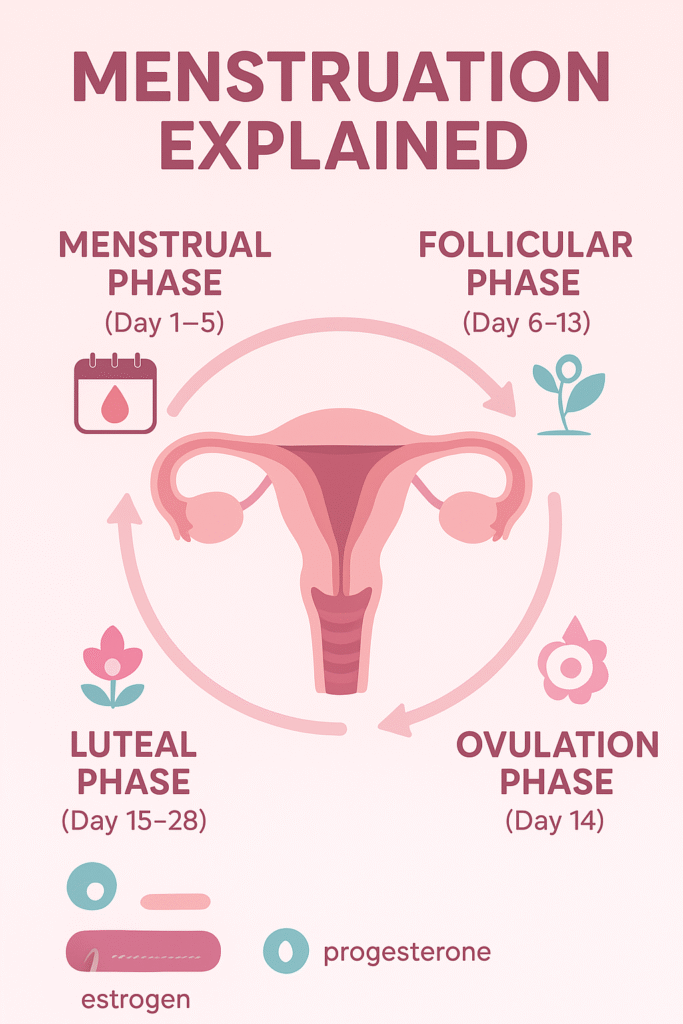
🔄 The Menstrual Cycle: 4 Phases in Detail
The menstrual cycle is divided into four phases, each with unique hormonal changes and physical effects.
1. 🌙 Menstrual Phase (Day 1–5)
- The uterine lining sheds → bleeding occurs.
- Low estrogen & progesterone → fatigue, mood swings, cramps.
- Self-care: rest, warm compress, gentle yoga.
2. 🌱 Follicular Phase (Day 1–13)
- FSH stimulates follicles in the ovaries.
- Estrogen rises → energy and mood improve.
- Skin glows, hair feels healthier.
- Brain is sharper → great for studying or creativity.
3. 🌟 Ovulation Phase (Day 14 in a 28-day cycle)
- LH surge → mature egg released.
- Most fertile window (ideal for conception).
- Cervical mucus becomes slippery (egg white texture).
- Libido may increase.
4. 🌺 Luteal Phase (Day 15–28)
- Progesterone rises → prepares uterus for pregnancy.
- If fertilization occurs → pregnancy continues.
- If not → hormone levels drop → PMS symptoms appear.
- Signs: bloating, breast tenderness, irritability, food cravings.
👉 Each phase affects not only reproductive health but also energy levels, skin, emotions, and metabolism.
⚡ Symptoms During Menstruation
Menstrual symptoms vary widely, but some common ones include:
- 🤕 Cramps (dysmenorrhea): Caused by uterine contractions.
- 🌊 Bloating & water retention.
- 😴 Fatigue & low energy.
- 😣 Mood swings, irritability, or sadness.
- 🍫 Food cravings (often sweets or salty snacks).
- 😵 Headaches, migraines, or dizziness.
Severe Symptoms (May Indicate Health Issues)
- Very heavy bleeding (changing pads every hour).
- Severe pain not relieved by medication.
- Irregular cycles or missed periods.
- Clots larger than a coin.
👉 These could signal conditions like PCOS, endometriosis, thyroid issues, or fibroids.
🧼 Menstrual Hygiene & Care Practices
Maintaining hygiene is crucial for comfort and infection prevention.
Products to Use:
- 🩲 Sanitary pads (most common).
- 🧴 Tampons (inserted into the vagina).
- 🥤 Menstrual cups (eco-friendly, reusable).
- 👙 Period underwear (comfortable and sustainable).
Hygiene Tips:
- Change pads/tampons every 4–6 hours.
- Wash genital area with mild soap & water.
- Use cotton underwear for breathability.
- Avoid scented products (can cause irritation).
Self-Care During Periods:
- Warm compresses for cramps.
- Gentle yoga or stretching.
- Eat iron-rich foods (to prevent anemia).
- Stay hydrated.
🥗 Nutrition, Lifestyle & Exercise
Periods affect energy and nutrition needs.
Eat More Of:
- 🥬 Iron-rich foods (spinach, lentils, nuts).
- 🐟 Omega-3 foods (salmon, walnuts).
- 🍊 Vitamin C (boosts iron absorption).
Avoid Excess Of:
- 🍟 Processed, salty foods (worsens bloating).
- 🍭 Sugary snacks (increase mood swings).
- ☕ Too much caffeine (can worsen cramps).
Exercise:
- 🚶 Walking & stretching ease cramps.
- 🧘 Yoga reduces stress.
- 🏃 Light cardio boosts circulation.
🚫 Myths vs ✅ Facts
- ❌ Myth: Periods are dirty.
✅ Fact: Menstrual blood is natural. - ❌ Myth: Exercise is harmful.
✅ Fact: It helps reduce cramps. - ❌ Myth: You can’t get pregnant on your period.
✅ Fact: Pregnancy is possible (rare but real). - ❌ Myth: Periods must always be 28 days.
✅ Fact: 21–35 days is normal.
🩺 Health Conditions Linked to Menstruation
- PCOS (Polycystic Ovary Syndrome): Irregular periods, acne, weight gain.
- Endometriosis: Severe pain, infertility risk.
- Fibroids: Heavy bleeding, pelvic pain.
- Amenorrhea: Absence of periods (not pregnancy).
- Menorrhagia: Extremely heavy bleeding.
🩺 When to Consult a Doctor
Seek medical advice if:
- Periods >7 days.
- Severe pelvic pain.
- Missed cycles for 3+ months.
- Unexplained sudden cycle changes.
🌍 Social, Cultural & Emotional Aspects
Menstruation is often stigmatized in many cultures, leading to silence, shame, and school/work absenteeism. Breaking this taboo ensures gender equality, menstrual equity, and empowerment.
🕊️ Breaking the Stigma & Promoting Equality
- Normalize talking about periods.
- Provide free/affordable menstrual products.
- Improve workplace & school menstrual support.
❓ FAQs on Menstruation Explained
- Can you get pregnant during periods? Rare, but possible.
- What is the normal age for menarche? Between 10–15 years.
- Is irregular cycle always a problem? Not always, but monitor.
- Why do cramps happen? Due to prostaglandins causing contractions.
✅ Conclusion
Menstruation is not just monthly bleeding—it is a vital biological cycle that reflects reproductive health, hormonal balance, and overall well-being. By understanding the science, symptoms, hygiene, nutrition, and social aspects, we can truly have menstruation explained in depth.
Breaking the stigma and spreading awareness empowers women and society alike to see menstruation as a sign of life and strength—not shame.



Sveiki, aš norėjau sužinoti jūsų kainą.
Contat on email