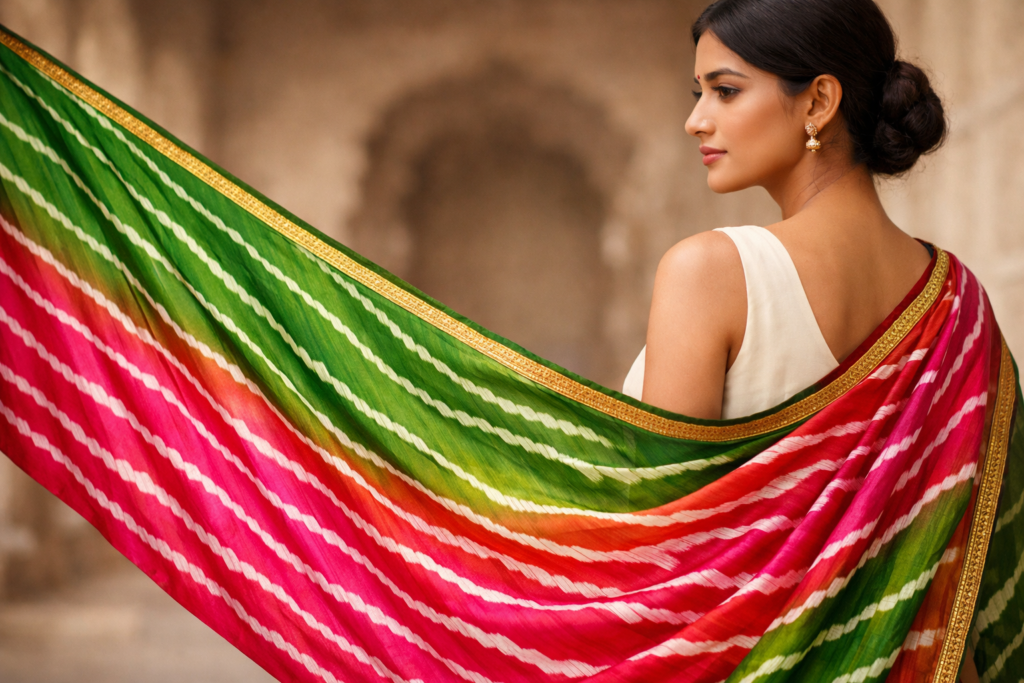
The Leheriya Silk Saree is not merely a colorful garment—it is a living expression of Rajasthan’s climate, culture, and craftsmanship. Characterized by rhythmic diagonal waves and luminous colors, Leheriya on silk represents a rare combination of technical precision, symbolic meaning, and regal elegance. Every saree tells a story shaped by monsoon winds, desert traditions, and centuries-old dyeing knowledge passed through generations of artisans.
Meaning of Leheriya: More Than a Pattern
The word Leheriya originates from “Leher” (wave), inspired by:
- Flowing desert winds
- Monsoon rain patterns
- Movement of water in arid landscapes
These waves symbolize prosperity, continuity, and positive energy, which is why Leheriya silk sarees are traditionally worn during auspicious occasions and festivals.
Historical Roots & Royal Patronage
Leheriya developed in medieval Rajasthan, especially in Jaipur, Jodhpur, and Udaipur, where royal families actively supported textile innovation. While cotton Leheriya was worn daily, silk Leheriya was reserved for nobility due to its cost and prestige.
Royal women favored silk Leheriya for:
- Court ceremonies
- Seasonal festivals
- Diplomatic gatherings
This patronage helped preserve the craft in its most refined form.
Why Silk Transforms Leheriya into a Luxury Saree
Silk is not just a base fabric—it amplifies the Leheriya technique.
Key Advantages of Silk in Leheriya:
- Exceptional dye penetration results in intense, lasting colors
- Natural luster enhances wave definition
- Fluid drape highlights diagonal movement
- Thermo-regulating nature makes it wearable across seasons
Common silk varieties used:
- Pure Mulberry Silk
- Satin Silk
- Silk Georgette
- Lightweight Silk Chiffon
Each variant offers a distinct look—from structured elegance to airy softness.
The Authentic Leheriya Dyeing Process (Artisan Method)
True Leheriya silk sarees follow a resist-dye technique, not printing.
Traditional Steps:
- Pre-treatment of Silk
Silk is washed and stretched to ensure uniform absorption. - Diagonal Rolling
Fabric is rolled tightly along a precise diagonal axis. - Thread Binding
Cotton threads are tied at measured intervals to resist dye. - Sequential Dye Baths
Multiple colors are applied from light to dark. - Sun Drying & Unbinding
Threads are removed to reveal wave patterns. - Finishing Enhancements
Zari borders, pallu detailing, or gota work may be added.
📌 Even a slight variation in tying pressure changes the final pattern—making every saree one-of-a-kind.
Types of Leheriya Silk Sarees (Buyer-Relevant Classification)
1. Single-Tone Leheriya Silk
Elegant and minimal; ideal for traditional ceremonies.
2. Dual & Multi-Color Leheriya
Bold contrasts created through layered dyeing.
3. Mothra Leheriya Silk
A more intricate version using cross-tying, producing chequered waves.
4. Zari-Bordered Leheriya Silk
Festive sarees with gold or silver woven borders.
5. Contemporary Leheriya Silk
Pastels, ombré shades, and fusion styling for modern wearers.
Color Psychology in Leheriya Silk Sarees
Colors in Leheriya are intentional—not random.
- Red & Yellow – Energy, fertility, celebration
- Green & Pink – Harmony, festivity, femininity
- Blue & White – Calmness, grace, daytime elegance
- Purple & Gold – Royalty, grandeur
- Pastels – Contemporary sophistication
Occasions Best Suited for Leheriya Silk Sarees
- Weddings & pre-wedding rituals
- Religious ceremonies & pujas
- Festive gatherings (Teej, Gangaur, Rakhi)
- Cultural events & exhibitions
- Elegant daytime celebrations
Leheriya silk adapts beautifully to both traditional and semi-formal settings.
Styling Leheriya Silk Sarees: Traditional to Modern
Blouse Styling
- Solid silk blouse for balance
- Brocade or Bandhani blouse for heritage look
- Boat-neck or sleeveless for fusion appeal
Jewelry Pairing
- Kundan or Polki for classic styling
- Meenakari earrings for regional authenticity
- Gold bangles or pearl accessories for refinement
Footwear
- Mojaris or juttis
- Minimal heels for contemporary outfits
Care & Longevity of Leheriya Silk Sarees
- Always dry clean
- Store in cotton or muslin cloth
- Avoid plastic covers
- Keep away from direct sunlight
- Refold periodically to protect silk fibers
With proper care, a Leheriya silk saree can retain its beauty for decades.
How to Identify a Genuine Leheriya Silk Saree
✔ Diagonal waves visible on both sides
✔ Slight irregularity in stripe width
✔ Deep color penetration (not surface print)
✔ Soft silk texture with natural sheen
✔ Minor handcrafted imperfections
⚠️ Printed zig-zag designs are not authentic Leheriya.
Why Leheriya Silk Sarees Hold Long-Term Value
- Handcrafted heritage textile
- Limited production by skilled artisans
- Cultural significance beyond fashion
- Increasing demand in luxury ethnic wear
- Timeless appeal across generations
A Leheriya Silk Saree is an artistic legacy woven in color, rhythm, and silk. It reflects Rajasthan’s soul—vibrant yet graceful, traditional yet evolving. Owning one is not just about fashion; it is about preserving a living craft that continues to inspire modern Indian elegance.
Leheriya Silk Saree – Frequently Asked Questions
What makes a Leheriya silk saree different from printed wave-pattern sarees?
Authentic Leheriya silk sarees are created using a traditional resist-dye technique where the fabric is rolled, tied, and dyed to form natural diagonal waves. Printed sarees only mimic the design on the surface, while true Leheriya patterns run through the fabric and are visible on both sides.
Is Leheriya silk suitable for weddings and formal occasions?
Yes, Leheriya silk sarees are considered auspicious and festive, making them ideal for weddings, pre-wedding rituals, and traditional ceremonies. Zari borders and rich color combinations enhance their formal appeal.
Which type of silk is best used for Leheriya sarees?
Pure mulberry silk is the most premium choice due to its excellent color absorption and natural sheen. Lightweight options like silk georgette and silk chiffon are also preferred for easier draping and comfort.
Do Leheriya silk sarees lose color over time?
When properly dyed and maintained, Leheriya silk sarees retain their vibrancy for many years. Color fading usually occurs due to improper washing, prolonged sunlight exposure, or incorrect storage.
How can I identify an original Leheriya silk saree?
Genuine Leheriya silk sarees show continuous diagonal waves on both sides, slight irregularities in pattern spacing, and deep color penetration into the fabric. Minor variations indicate authentic hand craftsmanship.
What is the difference between Leheriya and Mothra silk sarees?
Leheriya features flowing diagonal wave patterns, while Mothra uses a cross-tying technique that creates a denser, chequered wave effect. Mothra silk sarees are more intricate and often chosen for grand occasions.
Can Leheriya silk sarees be styled for a modern look?
Yes, Leheriya silk sarees can be styled with contemporary blouses, minimalist jewelry, and neutral footwear. Pastel shades and subtle borders are especially popular for modern and fusion styling.
Are Leheriya silk sarees comfortable for long hours of wear?
Silk is naturally breathable and temperature-regulating. Combined with the fluid drape of Leheriya patterns, these sarees remain comfortable for extended wear during festivals and special events.