
There is something undeniably luxurious about silk. The way it catches light with a soft, shifting luminescence. The way it feels against skin — cool, smooth, weightless, and impossibly refined. For thousands of years, silk has been the fabric of royalty, ceremony, and ultimate indulgence — a textile so prized that ancient trade routes stretching thousands of miles were named after it.
But here is the uncomfortable truth that every silk buyer needs to know: the silk market in 2026 is flooded with imitations.
From online marketplaces selling suspiciously affordable silk sarees to high-street boutiques offering silk scarves at prices that defy the economics of genuine silk production, fake silk — crafted from polyester, rayon, nylon, or blended synthetic fibers — is being marketed, sold, and purchased as the real thing every single day. And the financial stakes are significant. Genuine pure silk commands prices that reflect its extraordinary production process — a single silk saree can require the labor of thousands of silkworms over weeks of careful cultivation. Synthetic imitations that mimic silk’s visual appearance can be produced for a fraction of the cost.
The problem is compounded by how convincingly modern synthetic fabrics can replicate the surface appearance of real silk. To the untrained eye — and even to many experienced shoppers — high-quality polyester satin can look remarkably similar to genuine silk under casual inspection. The differences become apparent only when you know exactly what to look for and how to test for it.
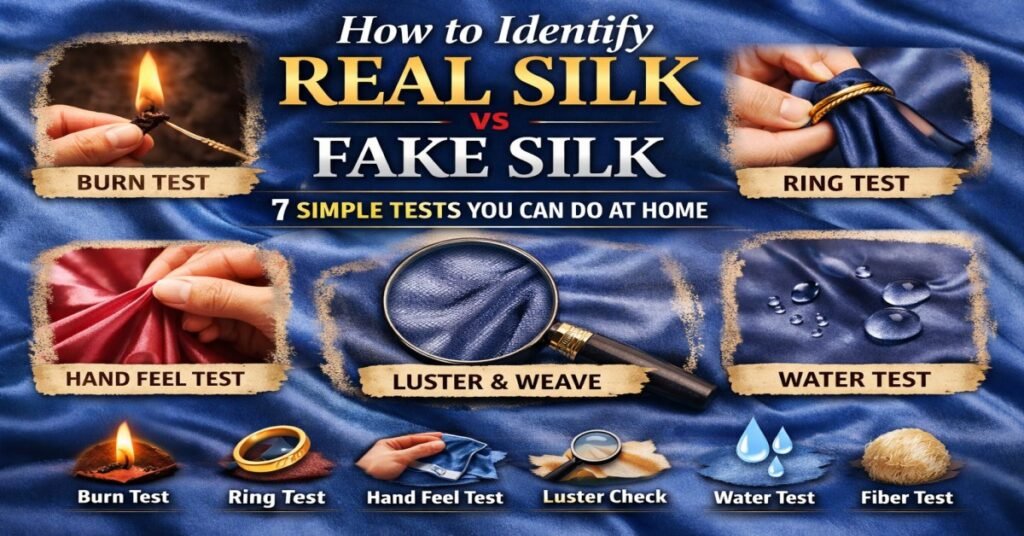
This comprehensive guide teaches you exactly that. Seven reliable, practical tests that you can perform at home — without any specialized equipment — to definitively distinguish real silk from synthetic imitations. Whether you are evaluating a saree purchase, assessing a secondhand find, or verifying the authenticity of a gifted silk garment, these tests will give you the knowledge and confidence to know exactly what you are holding.
Why the Real vs Fake Silk Question Matters
Before diving into the tests themselves, understanding why this distinction matters so profoundly helps motivate the due diligence that quality silk deserves.
The Financial Dimension
Pure silk is one of the most expensive natural fibers in the world. The production process — from silkworm cultivation through cocoon harvesting, thread reeling, weaving, and finishing — is extraordinarily labor-intensive and time-consuming. A single kilogram of raw silk requires approximately 5,000 silkworm cocoons. A premium Kanjivaram or Banarasi silk saree can require months of skilled weaving.
The price premium for genuine silk is therefore not arbitrary — it reflects real production costs. When you pay silk prices for synthetic fabric, you are simply being defrauded.
The Quality and Durability Dimension
Real silk and synthetic silk perform entirely differently in use. Genuine silk is naturally breathable, temperature-regulating, hypoallergenic, and exceptionally durable when cared for correctly — quality silk garments last decades with proper maintenance. Synthetic imitations trap heat, generate static, and degrade significantly faster — often showing wear within just a few years of regular use.
The Health Dimension
For individuals with sensitive skin, allergies, or skin conditions, the distinction matters physiologically. Real silk’s natural protein structure (fibroin) is remarkably compatible with human skin — it is hypoallergenic, moisture-wicking, and gentle on sensitive skin. Many synthetic fibers, by contrast, trap heat and moisture against skin, and some individuals experience allergic reactions to synthetic fiber coatings and treatments.
The Cultural and Ethical Dimension
In the Indian context specifically, silk carries profound cultural significance — particularly for weddings, religious ceremonies, and auspicious occasions. Wearing a silk saree at a wedding is not merely a fashion choice — it is a cultural statement with centuries of meaning behind it. Being sold synthetic fabric misrepresented as silk in this context constitutes not just financial fraud but a cultural disrespect that many buyers find particularly objectionable.
Understanding the Difference: What Makes Real Silk Unique
To understand why the tests work, it helps to understand what real silk actually is at a material level.
The Biology of Real Silk
Real silk is a natural protein fiber produced by the larvae of the mulberry silkworm Bombyx mori. Each silkworm produces a single continuous filament of silk — composed primarily of two proteins: fibroin (the structural core) and sericin (a gummy coating that binds the filament). This filament can extend to between 300 and 900 meters from a single cocoon.
The filaments from multiple cocoons are reeled together to form raw silk thread — a process called sericulture that requires extraordinary skill and care. This thread is then spun, dyed, and woven into the fabric we recognize as silk.
The protein composition of real silk is what gives it its distinctive properties — and what makes it respond differently from synthetic fibers in every one of the seven tests described below.
What Fake Silk Is Made Of
The most common silk impostors include:
Polyester satin: The most prevalent fake silk. Polyester is a petroleum-derived synthetic polymer that can be woven into a smooth, shiny fabric that superficially resembles silk. It is the most commonly used material in fake silk production because it is inexpensive, easy to manufacture, and capable of producing a convincing silk-like sheen.
Rayon (Viscose): A semi-synthetic fiber derived from cellulose (wood pulp). Rayon is softer and more breathable than polyester and feels closer to silk in hand — making it one of the more convincing silk imitations. However, it lacks silk’s strength, durability, and temperature-regulating properties.
Nylon: A fully synthetic polyamide fiber with a smooth surface that can mimic silk’s sheen. Less commonly used as a silk substitute than polyester or rayon but occasionally encountered.
Silk blends: Fabrics that contain some genuine silk mixed with synthetic fibers. These blends are particularly deceptive because they may genuinely contain silk — but at proportions far below what the price or labeling implies.
The 7 Simple Tests to Identify Real Silk at Home
Test 1: The Burn Test — The Most Definitive Home Test
What you need: A lighter or match, a pair of tweezers, a small sample of fabric (even a few threads pulled from a seam or hem)
Reliability rating: Extremely high — this is considered the most definitive home test for real vs fake silk
The burn test exploits the fundamental chemical difference between protein-based natural fibers and petroleum-derived synthetic fibers. Because silk is a protein — chemically similar to human hair — it burns in a manner characteristic of proteins. Synthetic fibers, being petroleum derivatives, burn in a completely different manner.
How to perform the test:
Pull two or three threads from an inconspicuous area of the fabric — ideally from the inside of a seam or from the raw edge of the hem. Hold the threads with tweezers and bring them to a flame slowly.
What to observe during burning:
Real silk burns slowly and is self-extinguishing — when you remove the flame, the burning stops almost immediately. It produces a small, controlled flame and emits a smell that is unmistakably similar to burning hair — this is because both silk and hair are composed of proteins, specifically keratin-related amino acid chains. After burning, real silk leaves a fine, crushable black ash that crumbles to powder when touched — there is no residue of melted material.
Fake silk (polyester) burns quickly and enthusiastically — often continuing to burn after the flame is removed. It melts as it burns — you will see the material shrinking, beading, and liquefying at the burning edge. The smell is synthetic and acrid — often described as resembling burning plastic. After burning, polyester leaves a hard, solid bead of melted plastic material that cannot be crushed between your fingers.
Rayon burns more slowly than polyester and closer to the way natural fibers burn — but it does not produce the characteristic protein smell of real silk. Its ash is softer than polyester residue but different in texture from real silk ash.
Interpreting your results:
If you observe slow burning, self-extinguishing behavior, a hair-like burning smell, and crushable black ash — you almost certainly have real silk. If you observe rapid burning, melting, a plastic smell, or a hard bead of residue — you have a synthetic fabric.
Important caveat: Only perform the burn test on a small sample of threads, not on the main fabric. Never hold the burning material near the garment itself. Exercise all appropriate fire safety precautions.
Test 2: The Ring Test — Testing Silk’s Unique Suppleness
What you need: A finger ring with an inner diameter of approximately 1.5 to 2 centimeters (a standard ring works perfectly)
Reliability rating: High for detecting pure silk vs stiff synthetic fabrics; less reliable for high-quality rayon blends
Real silk has a molecular structure that gives it extraordinary pliability and fluidity. A piece of genuine silk fabric — even a relatively large piece — can be pulled through the interior opening of a standard finger ring with minimal resistance, gathering smoothly and flowing through without bunching or snagging.
How to perform the test:
Take a section of the fabric — approximately 15 to 20 centimeters square — and attempt to draw it through the inside of a standard finger ring by pulling it gently through the opening.
What to observe:
Real silk gathers itself into smooth folds and slides through the ring with graceful ease. The fabric recovers its shape readily once through. The process feels fluid and effortless.
Fake silk — particularly stiffer polyester or nylon — resists the pulling. It bunches awkwardly, catches on the ring’s interior edge, and does not flow through with the same liquid ease. Lower-quality synthetic fabrics may not pass through the ring at all without significant force.
Interpreting your results:
This test is particularly useful for evaluating silk scarves, silk sarees, and lightweight silk fabrics. Pure silk passes through a ring with a smoothness that is immediately recognizable once you have felt genuine silk do so. However, high-quality rayon or very fine polyester can sometimes pass this test — which is why it should always be used in combination with other tests rather than in isolation.
Practical tip: If you have access to a piece of fabric you know to be genuine silk, test it first to calibrate your understanding of what real silk ring passage feels like. The comparison makes evaluating unknown fabrics significantly easier.
Test 3: The Hand Feel Test — Learning to Read Fabric with Your Hands
What you need: Your hands — specifically, both palms
Reliability rating: Moderate — highly effective for experienced handlers; less reliable for beginners without comparative reference
Real silk has a distinctive tactile quality that experienced textile handlers can identify almost instantly — but that takes some calibration to appreciate for those new to evaluating silk. The hand feel test requires rubbing the fabric between your palms and paying careful attention to what you feel and experience.
How to perform the test:
Place a section of the fabric between both palms and rub gently but with meaningful friction — back and forth for ten to fifteen seconds.
What to observe:
Real silk warms quickly under friction — almost immediately generating a warmth that is noticeably more rapid than what synthetic fabrics produce. This rapid warming is a consequence of silk’s protein structure and its thermal properties. Real silk feels warm, smooth, and almost alive under the palms.
Simultaneously, real silk produces a subtle, distinctive sound under friction — a soft rustling that experienced silk handlers call the scroop of silk. This is a gentle, papery whisper that is characteristic of genuine silk fiber.
Synthetic fabrics — particularly polyester — take longer to warm under friction and may generate a slight static charge during rubbing. The feel is smoother in a more uniform, almost artificial way — lacking the subtle texture variations that give real silk its characteristic hand feel.
Interpreting your results:
The rapid warming sensation is the most reliable indicator in this test. Real silk warms between your palms almost as quickly as body heat — a distinctive property that synthetic fabrics, despite their smooth surfaces, cannot replicate convincingly.
Important note: This test improves dramatically with comparative reference. If possible, hold a piece of fabric you know to be real silk and a piece of unknown fabric and perform the test on both in sequence — the difference in warming rate and hand feel becomes immediately apparent through comparison.
Test 4: The Sunlight Test — Observing Silk’s Unique Luminosity
What you need: Natural sunlight or a strong directional light source
Reliability rating: High for distinguishing silk’s characteristic light behavior from synthetic alternatives
One of real silk’s most celebrated properties is its luminosity — the way it catches and reflects light in a manner that is distinctly different from synthetic fibers. This difference in light behavior provides a reliable visual test that requires no equipment beyond good observation.
How to perform the test:
Take the fabric to natural sunlight or hold it under a strong directional lamp. Rotate and tilt the fabric at different angles relative to the light source, observing how the sheen changes as the angle of incidence changes.
What to observe:
Real silk exhibits a property known as iridescence or color shift. As you rotate silk in light, the sheen changes color — the highlights shift between white light and color, and the fabric appears to have depth and movement in its luminosity. This color-shifting quality occurs because silk filaments are triangular in cross-section — they reflect light differently depending on angle, creating the characteristic play of light that has made silk prized for millennia.
The color of real silk’s sheen corresponds to the silk’s dye color — if the fabric is red, the highlights will appear as a warm reddish-white. This color coherence between fabric and sheen is an important observation.
Fake silk — particularly polyester satin — produces a shinier, more uniform glare. The reflection is brighter and more mirror-like than genuine silk’s soft luminosity — and critically, the sheen of polyester often appears white or silver regardless of the fabric’s underlying color. This mismatch between fabric color and highlight color is a key indicator of synthetic material.
Interpreting your results:
The most reliable observation is the color of the sheen. If the highlights match the fabric’s color family — shifting between the fabric color and white — you are likely looking at real silk. If the highlights appear uniformly white or silver regardless of the fabric’s dyed color, you are most likely looking at polyester or another synthetic.
Test 5: The Price and Source Test — Using Market Intelligence
What you need: Knowledge of realistic silk pricing and source evaluation skills
Reliability rating: High as a preliminary filter — helps identify obvious frauds before physical testing
While not a physical test of the fabric itself, understanding the economics of genuine silk production is one of the most powerful preliminary filters available to any silk buyer.
The economics of real silk:
Genuine silk is expensive to produce — and no legitimate silk supplier can sell it below the cost of production without losing money. Understanding baseline price thresholds helps you immediately identify offers that are almost certainly too good to be true.
As of 2026, indicative price ranges for genuine silk products in the Indian market include:
Pure silk sarees (Kanjivaram, Banarasi): ₹8,000 to ₹1,00,000 and above depending on quality, weave complexity, and brand Pure silk dress fabric (per meter): ₹800 to ₹3,000 per meter for genuine mulberry silk Pure silk scarves: ₹1,500 to ₹10,000 depending on size, quality, and brand Pure silk bedding sets: ₹8,000 to ₹50,000 depending on momme weight and quality
Red flags that indicate potential fraud:
A silk saree offered at ₹500 to ₹2,000 is almost certainly synthetic — genuine silk sarees cannot be produced at these price points.
An online listing advertising “pure silk” with pricing that seems dramatically below market rates deserves intense skepticism.
Sellers who cannot or will not provide silk certification, mill certificates, or fabric composition documentation when asked are a significant red flag.
Marketplace listings with descriptions using vague language like “silk-like,” “silky smooth,” “art silk,” or “synthetic silk” — these are industry euphemisms for synthetic fabric and should be read as explicit admissions that the product is not genuine silk.
Evaluating sources:
Established silk merchants, certified government silk emporiums (such as those operated by the Silk Mark Organization of India), and reputable saree boutiques with verifiable track records provide significantly higher confidence than anonymous online sellers or street vendors offering implausibly low prices.
The Silk Mark — a quality assurance label administered by the Central Silk Board of India — is the most reliable certification of genuine Indian silk. Look for the Silk Mark hologram on labeled products when purchasing in India.
Test 6: The Cold Feel Test — Silk’s Distinctive Temperature Response
What you need: Clean, dry hands and attention to initial tactile sensation
Reliability rating: Moderate — most effective when performed as a first impression test before body heat warms the fabric
Real silk has remarkable thermal properties that are directly connected to its protein structure and the unique properties of silk fibroin. One of the most characteristic of these is the way silk feels when first touched with bare hands after the fabric has been at room temperature.
How to perform the test:
Allow the fabric to rest at room temperature — away from your body — for several minutes. Then touch it quickly with the back of your hand or your fingertips, paying careful attention to the immediate first impression of temperature.
What to observe:
Real silk feels distinctly cool to the initial touch — cooler than the ambient room temperature would suggest. This cooling sensation is characteristic of silk’s ability to conduct heat away from skin efficiently — one of the properties that makes genuine silk so comfortable to wear in warm weather. The cool sensation is immediate and unmistakable.
After this initial cool sensation, real silk then warms rapidly to body temperature — matching and adapting to your skin’s warmth within seconds. This temperature transition from initial cool to rapid warming is a distinctive silk characteristic.
Synthetic fabrics — particularly polyester — do not exhibit this marked initial coolness. They tend to feel closer to ambient temperature when first touched and warm more slowly and less responsively to body temperature than genuine silk.
Interpreting your results:
The immediate, distinctive coolness on first contact with real silk is a sensation that becomes easy to recognize with comparative experience. When evaluating an unknown fabric, touch it quickly — your first impression of temperature is more informative than the sensation after holding the fabric for an extended period, by which point body heat has equalized the temperature of any fabric.
Contextual note: This test is most reliable in moderate ambient temperatures. In very hot or very cold environments, the temperature differential may be less pronounced or easier to misinterpret.
Test 7: The Wedding Band or Scratch Test — Checking for Color Fastness and Fiber Response
What you need: A fingernail or a blunt metallic edge (such as the back of a ring)
Reliability rating: Moderate to high — particularly effective for identifying certain synthetic fabrics
This final test exploits a physical difference between real silk fibers and certain synthetic alternatives in their response to surface abrasion and friction.
How to perform the test:
Using your fingernail or the smooth back edge of a metal ring, apply firm but controlled pressure to the surface of the fabric and draw it across a small area — essentially scratching the fabric surface gently but deliberately.
What to observe:
Real silk responds to this scratch test in a characteristic way — the fibers may slightly separate or show a mild trace of the scratch path, but the fabric surface does not permanently mark or discolor. More importantly, when you examine real silk under this gentle abrasion, you will notice that the fabric’s color remains consistent and no residue appears on your fingernail or ring.
High-quality genuine silk that has been dyed properly shows excellent color fastness — the dye does not transfer to your fingernail or to a damp white cloth pressed against the fabric surface.
Certain synthetic fabrics — particularly lower-quality polyester with surface coatings or poorly finished rayon — may show the scratch trace more visibly, or may develop a slightly pilled surface appearance from the abrasion. Some poorly dyed synthetic fabrics may even transfer color to the scratching implement.
The damp cloth extension of this test:
Press a damp white cloth firmly against the fabric surface and hold it there for ten to fifteen seconds. Real silk that has been properly dyed will not bleed color onto the white cloth under normal conditions. Synthetic fabrics with surface dye treatments or poorly fixed dyes may transfer color more readily.
Important interpretation note: This test is less universally reliable than the burn test and should be used as a supporting evaluation rather than a definitive indicator. Poorly dyed genuine silk can bleed color, and well-finished synthetic fabrics may resist color transfer. Use this test in conjunction with others for the most reliable assessment.
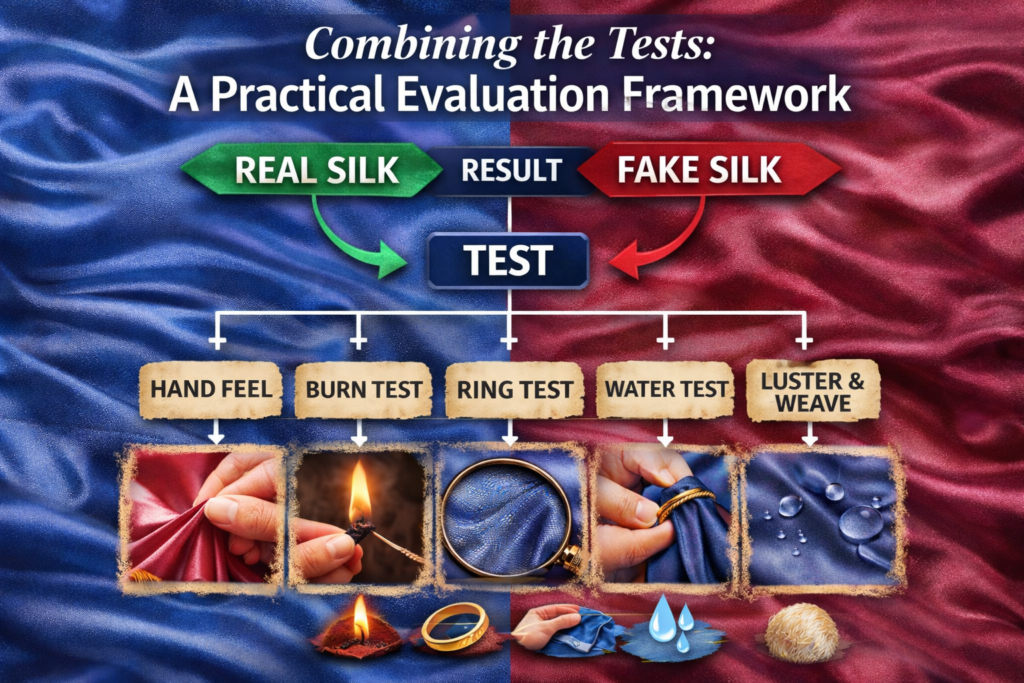
Combining the Tests: A Practical Evaluation Framework
No single test delivers absolute certainty in every situation — but combining multiple tests produces a highly reliable assessment. Here is a practical framework for evaluating unknown fabric:
Step 1 — Preliminary visual assessment: Examine the fabric under sunlight using the sunlight test. Observe the sheen color and its relationship to the fabric’s dyed color. Note whether the luminosity has depth and color shift or appears as a flat, uniformly white glare.
Step 2 — Price and source verification: Apply the price and source test. If the price is dramatically below market rates for genuine silk, treat every subsequent physical test with heightened skepticism.
Step 3 — Initial tactile assessment: Perform the cold feel test as your first physical contact with the fabric — before body heat equalizes the temperature. Note the immediate temperature impression.
Step 4 — Hand feel and ring test: Perform the hand feel test (rubbing between palms and noting warming rate) and the ring test (passing fabric through a finger ring). These two tests together provide strong tactile evidence of silk’s protein fiber characteristics.
Step 5 — Scratch test: Perform the scratch test on an inconspicuous area and note the fabric’s response to gentle abrasion and the color fastness result from the damp cloth variation.
Step 6 — Burn test (if practical and safe): If you have access to loose threads from the fabric — ideally pulled from an interior seam — perform the burn test for the most definitive confirmation. This test should always be your final step, as it requires obtaining a sample and exercising fire safety precautions.
Interpreting combined results:
If the majority of tests point toward genuine silk — color-coherent sheen, rapid palm warming, smooth ring passage, immediate coolness on contact, crushable black ash from burning with a protein smell — you can have high confidence in the fabric’s authenticity.
If multiple tests raise doubts — white glare regardless of fabric color, slow palm warming, resistance to ring passage, plastic burning smell, hard bead residue — you are almost certainly dealing with a synthetic fabric.
Special Considerations for Indian Silk Varieties
India produces some of the world’s most celebrated and distinctive silk varieties, each with characteristics that can affect how the tests above present:
Kanjivaram (Kanchipuram) Silk
Produced in Tamil Nadu, Kanjivaram silk is woven from pure mulberry silk with a characteristically heavy, substantial drape. Genuine Kanjivaram is distinguished by its distinctive temple border patterns, vibrant colors, and the weight that comes from high-quality pure silk construction. The burn test on Kanjivaram silk produces the characteristic protein smell and crushable ash. The hand feel is heavier and more substantial than lighter silk varieties.
Banarasi Silk
Varanasi-produced Banarasi silk features intricate zari (gold and silver thread) weaving on a silk base. Evaluating Banarasi silk requires attention to both the silk base fabric and the zari work. Genuine Banarasi silk has the characteristic silk warmth and ring-passing fluidity, though the zari sections add weight and some stiffness.
Mysore Silk
Produced under government supervision in Karnataka, Mysore silk is known for its lightweight, smooth texture and natural sheen. It is among the purest and most consistently genuine silk varieties available in India — the Karnataka Silk Industries Corporation provides certification that provides strong authenticity assurance.
Chanderi Silk
Chanderi fabric can be pure silk, silk-cotton blend, or pure cotton — making authentication particularly important when purchasing. The burn test on pure Chanderi silk produces the characteristic protein result, while cotton-silk blends produce a mixed result that smells of both protein and burning plant matter.
Assam Silk (Muga and Eri)
Muga silk — produced exclusively in Assam — has a naturally golden color and a distinctive warm luminosity that is different from mulberry silk’s cooler sheen. Its natural golden color can make the sunlight test slightly more complex to interpret, as the gold-toned sheen is inherent to the fiber rather than a result of dyeing.
Caring for Real Silk Once Authenticated
Having confirmed the authenticity of your silk, proper care ensures it retains its beauty and integrity for decades.
Washing: Hand wash in cool or lukewarm water using a gentle, pH-neutral soap or dedicated silk wash. Never use hot water — heat can damage and shrink silk fibers. Machine washing, even on delicate cycles, carries risk of fiber damage and is not recommended for valuable silk pieces.
Drying: Never wring or twist silk to remove water — gently press between clean towels and roll to absorb excess moisture. Dry flat in the shade away from direct sunlight, which can fade dyes and weaken fibers.
Ironing: Iron silk while slightly damp on the reverse side, using a low temperature setting. Never iron silk on the right side without a pressing cloth — direct iron contact can create shine marks and damage the fiber surface.
Storage: Store silk in breathable cotton muslin bags — never in plastic, which traps moisture and encourages mildew. Store away from direct light in a cool, dry environment. Refold periodically along different fold lines to prevent permanent crease marks.
Dry cleaning: For valuable or heavily embellished silk pieces, professional dry cleaning by a specialist with silk experience is the safest option. Always inform the dry cleaner of the fabric content and any embellishments before handing over the garment.
Frequently Asked Questions (FAQs)
FAQ 1: Is the burn test safe to perform at home and can I do it without damaging the garment?
The burn test can be performed safely at home provided you exercise appropriate fire safety precautions and use only a small sample of threads rather than burning the main fabric. The key is to pull two or three threads from an inconspicuous location — the inside of a seam allowance, the raw edge of a hem, or from any fabric fraying at edges — so that the garment itself is not damaged. Perform the test over a non-flammable surface such as a ceramic plate or in a metal bowl, have water nearby as a precaution, and use tweezers rather than your fingers to hold the threads during burning. Never bring the flame near the main garment. If you are evaluating a fabric before purchase and cannot obtain a thread sample without damaging the item, ask the seller for a small cutting from an inconspicuous area — any legitimate silk seller should be comfortable providing this for testing purposes.
FAQ 2: What is art silk and is it really silk?
Art silk — short for artificial silk — is a marketing term used to describe synthetic or semi-synthetic fabrics that are designed to look and feel like genuine silk. The most common art silk materials are rayon (viscose), polyester, and nylon. Despite the name, art silk contains no genuine silk fiber whatsoever. The term is a deliberate marketing construction designed to create an association with real silk while technically avoiding an outright false claim of silk content. When you encounter a product described as art silk, artificial silk, synthetic silk, or silky fabric — these are all explicit indications that the product is not genuine silk. In India, art silk sarees are sold legitimately at appropriate price points for the synthetic material they contain — the problem arises when art silk is sold at genuine silk prices without transparent disclosure of its composition.
FAQ 3: Can I trust silk certification labels and how do I verify them?
Silk certification labels provide meaningful assurance when they are issued by recognized authorities — but they can also be counterfeited, which means you should know how to verify them. In India, the most reliable certification is the Silk Mark — a quality assurance program administered by the Central Silk Board under the Ministry of Textiles. Genuine Silk Mark products carry a holographic label with a unique identification number that can be verified through the Silk Mark Organization of India’s official verification system. When purchasing certified silk, examine the hologram carefully — genuine holograms display multiple colors and depth effects under light that are difficult to counterfeit convincingly. You can also request the retailer’s Silk Mark license number and verify it directly with the Central Silk Board. International certifications such as OEKO-TEX Standard 100 certify that a fabric is free from harmful substances but do not independently verify silk content — they should not be used as sole silk authenticity certification.
FAQ 4: Why does some genuine silk feel rough or coarse rather than smooth?
The expectation that all genuine silk should feel uniformly smooth and sleek reflects familiarity with processed mulberry silk — the most common variety — but genuine silk actually spans a wide range of textures depending on the silk variety, weaving technique, and finishing process. Raw silk — silk that retains its natural sericin gummy coating — has a distinctly rougher texture than degummed silk, which has had the sericin removed to reveal the smooth fibroin core. Tussar silk, produced by wild silkworms feeding on non-mulberry trees, has a naturally coarser texture and a more textured hand feel than cultivated mulberry silk. Dupioni silk — woven from double cocoon filaments — has a characteristically slubbed texture with irregular raised threads that are entirely natural and authentic. If a silk fabric feels rough or coarse, this does not indicate it is fake — it may simply be a raw, wild, or textured variety of genuine silk. Apply the burn test and other diagnostic tests to evaluate authenticity regardless of initial texture expectations.
FAQ 5: Are there professional tests for silk authentication that provide more certainty than home tests?
Yes — several professional and laboratory-based authentication methods provide higher certainty than home testing, and these are worth pursuing for high-value purchases. Fiber analysis under polarized light microscopy can definitively identify the triangular cross-section of silk fibers — a structural characteristic unique to genuine silk that cannot be replicated by synthetic alternatives. X-ray fluorescence (XRF) analysis can identify the elemental composition of fabric and detect synthetic polymer signatures. Near-infrared spectroscopy (NIR) provides definitive chemical composition analysis of fabric samples. In India, the Central Silk Board maintains testing laboratories that can provide professional silk authentication services. Several textile testing institutes across major Indian cities including BTRA (Bombay Textile Research Association) in Mumbai and SITRA (South India Textile Research Association) in Coimbatore offer professional fabric composition analysis. For purchases above a certain value threshold — a high-value silk saree, a significant quantity of silk fabric, or any silk purchase where substantial money is at stake — professional laboratory authentication is a worthwhile investment that provides certainty no home test can fully match.