
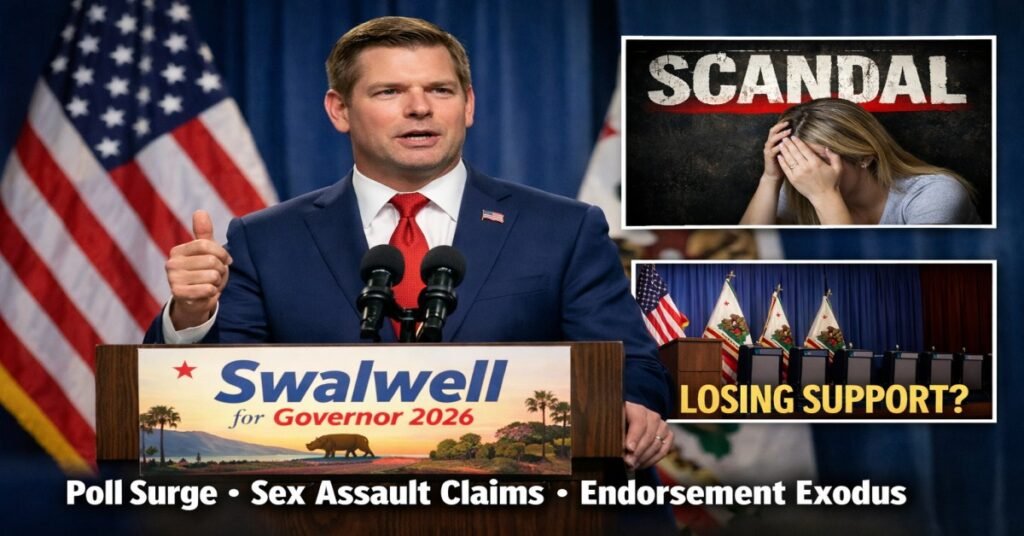

Few political stories in recent American history have moved as fast — or as dramatically — as Eric Swalwell’s campaign for California governor in 2026. What began as a high-energy, nationally watched bid to succeed term-limited Governor Gavin Newsom descended within months into one of the most turbulent political collapses the state has seen in decades. To fully understand the arc of this race, you need to understand the man, the campaign, the competition, the controversy, and the broader stakes for California’s political future.
Who Is Eric Swalwell? A Background on the Man Behind the Campaign
Eric Swalwell was born on November 16, 1980, in Sac City, Iowa, the oldest of four sons. His father served as police chief in Algona, Iowa, during his early childhood. After leaving Iowa, the family eventually settled in Dublin, California, where Swalwell graduated from Dublin High School in 1999. Wikipedia
Swalwell attended Campbell University in North Carolina, where he played soccer on a scholarship, before transferring to the University of Maryland, College Park, where he received a Bachelor of Arts in government and politics in 2003. Wikipedia He went on to earn a law degree and became a prosecutor for Alameda County, establishing himself in the East Bay legal community before pivoting to electoral politics.
In September 2011, Swalwell filed to run for Congress in California’s 15th district, challenging 20-term incumbent Democrat Pete Stark. Wikipedia Under California’s top-two primary system, Swalwell advanced to the general election and ultimately defeated Stark — a remarkable upset that launched one of the more visible congressional careers of his generation.
Since 2013, Swalwell has represented California’s 14th Congressional District, encompassing a large stretch of the East Bay. He served as one of the impeachment managers during President Trump’s second impeachment trial. In addition, there is an ongoing lawsuit filed by Swalwell against Trump that alleges his actions led to the January 6, 2021 assault on the U.S. Capitol. CBS News He became, by his own description, one of the most vocal critics of Donald Trump in the entire House of Representatives — a brand identity that would form the very core of his gubernatorial campaign.
The Campaign Launch: Jimmy Kimmel and a Standing Ovation
Swalwell announced his gubernatorial campaign on November 20, 2025, to succeed term-limited Democratic Governor Gavin Newsom, during an appearance on Jimmy Kimmel Live! Wikipedia
Swalwell got a standing ovation from the audience when he announced his run on Kimmel’s show. “Our state, this great state, needs a fighter and a protector,” Swalwell told Kimmel. “I’ve been in these fights as a City Council member up in Dublin, my hometown, as a prosecutor in Oakland and taking on the most corrupt president ever in the U.S. Congress, but I’m ready to bring this fight home.” CBS News
The choice of a late-night talk show as the venue for a major political announcement was deliberate and savvy. It generated enormous earned media coverage, positioned Swalwell as a culturally fluent, energetic alternative to the more conventional politicians in the field, and introduced him to millions of viewers beyond California’s political class in a single evening.
His campaign reported raising $3 million in just six weeks since that announcement. Ericswalwell The launch was, by almost every measure, a success.
The Case Swalwell Made to California Voters
Swalwell’s campaign rested on two central pillars: economic affordability and resistance to the Trump administration. He framed these not as separate issues but as interconnected crises demanding the same kind of fighter-prosecutor mentality he cultivated across a decade in Congress.
The Affordability Argument
Swalwell argued that his priorities as governor would be homes and jobs, noting that the average first-time homeowner in California is 40 years old and that the state has the highest unemployment rate in America. His promise: if you work hard, you should do better for yourself and dream bigger for your kids — what he called “the new California promise.” Ericswalwell
This was a pointed acknowledgment of a genuine crisis. California, despite being the fourth-largest economy in the world, has a housing affordability problem that ranks among the worst in the nation. Young working families are being priced out of homeownership entirely. Swalwell sought to harness frustration with that reality into a governing vision focused on expanding housing supply, growing wages, and restoring economic upward mobility for the middle class.
The Anti-Trump Identity
Swalwell argued that the next governor’s most important job would be to keep Donald Trump and ICE out of California’s streets and lives. He pointed to his January 6 lawsuit as one of the only lawsuits against Trump that survived the new presidency, and his role in leading the second impeachment as evidence of a proven track record. Ericswalwell
In a Democratic primary where opposition to the Trump administration functioned almost as a litmus test, this framing gave Swalwell a potent advantage. He was the only candidate in the field currently serving in Congress and actively engaged in federal resistance efforts — a distinction he pressed relentlessly.
He proposed the idea of a “mobile Congress,” with members casting votes remotely while spending more time in their districts — a modernization argument that underscored his generational appeal. Wikipedia
The Field: A Crowded and Fragmented Democratic Primary
Understanding Swalwell’s rise — and eventual fall — requires understanding just how chaotic the 2026 California governor’s race became.
The 2026 California gubernatorial election is scheduled to take place on November 3, 2026, to elect the governor of California, with the statewide nonpartisan top-two primary election set for June 2, 2026. Incumbent Democratic Governor Gavin Newsom is term-limited and cannot seek re-election to a third term. Over two dozen candidates have declared. Wikipedia
As California is heavily Democratic, Republicans have not won a statewide race in California since 2006 or held statewide office since 2011. However, the fragmented Democratic field in this year’s top-two primary could allow two Republicans to advance to the general election. The California Democratic Party urged low-polling candidates to drop out to prevent this outcome. Wikipedia
The major Democratic candidates included former Representative Katie Porter, billionaire climate activist Tom Steyer, former Los Angeles Mayor Antonio Villaraigosa, former HHS Secretary Xavier Becerra, California State Superintendent of Public Instruction Tony Thurmond, former State Controller Betty Yee, and San Jose Mayor Matt Mahan. Republican candidates include political pundit Steve Hilton and Riverside County Sheriff Chad Bianco. CBS News
The race’s peculiar dynamics were characterized by a fragmented Democratic vote atomized across more than a dozen candidates, with Swalwell, Porter, and Steyer routinely polling between 10% and 12%. That a candidate with Swalwell’s national profile and significant labor backing struggled to decisively break away from a crowded field spoke to the broader problem: there was no compelling Democratic figure commanding a dominant lead in the race. The San Francisco Standard
Polling: The Rise of Swalwell as Front-Runner
Despite the crowded field, Swalwell emerged early as the Democrat with the most momentum.
Two polls — from FM3 Research and Emerson College Polling — showed that Swalwell quickly emerged as a frontrunner for governor. According to Politico in December 2025, Democratic voters preferred Swalwell at 30% to Porter at 21% in an FM3 poll conducted among likely June 2026 voters. Ericswalwell
A March 2026 Emerson College survey found Swalwell leading the open primary at 17%, followed by Steve Hilton at 13%, Tom Steyer at 11%, and Chad Bianco at 11%. Among voters who want the next governor to stand up to the Trump administration, 25% supported Swalwell. Emerson Polling
Swalwell notably announced his campaign on Jimmy Kimmel Live in November. Political observers noted that it would take millions and millions of dollars to buy the kind of name recognition that launch generated. Swalwell surged to support at 17%, up from 12% in December, and held a 4-point lead ahead of his next-closest competitor. The Hill
Internal polling from EMC Research showed Swalwell with a double-digit lead among registered Democrats — one in three at 32% — while the next closest candidate, Katie Porter, trailed at 20%. He was also the most favorably rated candidate among Democrats, with a 67% favorable rating and a net favorable rating of +54. Ericswalwell
These numbers, had they held, pointed toward a credible path to the November general election.
Key Endorsements and Coalition Building
Swalwell built an impressive endorsement coalition in the early months of his campaign.
U.S. Representative Jimmy Gomez of Los Angeles served as the Campaign Chair, and Reps. Nanette Barragan, Adam Gray, Doris Matsui, Kevin Mullin, Jimmy Panetta, Dr. Raul Ruiz, and Mike Thompson endorsed Swalwell, in addition to local elected officials across the state. Ericswalwell
His supporters also included notable figures such as former U.S. Senator Barbara Boxer as campaign co-chair, and U.S. Senator Adam Schiff, who endorsed Swalwell. Wikipedia On the financial side, the political action committee supporting Swalwell’s campaign, Californians for a Fighter, counted Uber Technologies and businessman Stephen Cloobeck among its biggest backers. Bloomberg
Labor support was another pillar. Appearing before union caucuses at the California Democratic Party convention, Swalwell showcased his connections to working people and made the case that his working-class background — son of a cop, paper routes, construction jobs — set him apart from wealthier competitors in the field.
Challenges and Vulnerabilities Before the Allegations
Even before the explosive allegations that would eventually unravel his campaign, Swalwell faced legitimate scrutiny on several fronts.
The ICE Record Contradiction
As Swalwell made keeping federal agents out of California a key tenet of his campaign, he faced scrutiny for votes supporting Immigration and Customs Enforcement, as well as his endorsement of a former Republican Alameda County sheriff who had cooperated with ICE. All eight leading Democrats running to succeed Newsom sought to distinguish themselves in the crowded field as they questioned each other’s records on Trump’s intensifying immigration crackdown — with many of those attacks pointed toward Swalwell. The Press Democrat
Critics argued that Swalwell’s endorsement showed he continued to support the sheriff even after the sheriff’s connection with ICE was well known. A spokesperson for former Los Angeles Mayor Antonio Villaraigosa’s campaign said: “For years, Swalwell backed the very policies that empowered ICE, and now he’s running ads trying to condemn it to cover his tracks.” The Press Democrat
Residency Questions
Swalwell faced questions from Tom Steyer’s campaign about whether the congressman — who spends significant time in Washington D.C. — met California’s residency requirement to serve as governor. Political experts suggested these attacks were unlikely to stick legally, but they contributed to a narrative of a candidate whose California roots were thinner than his congressional career implied.
The Convention Picture
At the California Democratic Party convention in February 2026, nine Democrats and zero consensus emerged. The convention highlighted growing anxiety about a potential GOP lockout of the November general election, with no single candidate able to consolidate the Democratic base. CalMatters Even at peak momentum, the race reflected deep uncertainty about the Democratic Party’s direction in a post-Newsom California.
The Collapse: Sexual Assault Allegations Upend Everything
On April 10, 2026 — just weeks before the June primary — the entire trajectory of Swalwell’s campaign changed overnight.
The San Francisco Chronicle published allegations by an anonymous former staffer for Swalwell, claiming that her boss had twice sexually assaulted her at a time when she was too intoxicated to consent. The woman worked for Swalwell between 2019 and 2021. The report alleged that Swalwell, who is married and has three children, sent photos of his genitals to the younger staffer on Snapchat and pursued her sexually. The San Francisco Standard
A few hours later, CNN published a story in which four women alleged sexual misconduct by Swalwell, including a former staffer who said he raped her. Politico also reported that a former Swalwell employee signed a non-disclosure agreement pertaining to employment discrimination when they left his office. Although the agreement was not related to sexual harassment, it directly contradicted Swalwell’s previous claims that no one on his staff had signed an NDA. Wikipedia
Swalwell described the allegations as “lies” and claimed they were intended to damage his campaign for governor. His attorney sent a cease and desist letter to the staffer and threatened to sue for defamation. Wikipedia
The Exodus: Endorsers, Allies, and Donors Abandon Ship
The political fallout was immediate, severe, and accelerating.
U.S. Rep. Jimmy Gomez, the Los Angeles Democrat who had chaired Swalwell’s campaign, resigned from the role and called on Swalwell to drop out, calling the allegations “the ugliest and most serious accusations imaginable.” He said: “My involvement in any campaign begins and ends with trust. The congressman should leave the race now so there can be full accountability without doubt, distraction, or delay.” CalMatters
U.S. Senator Ruben Gallego of Arizona withdrew his support and said he regretted defending Swalwell earlier. CalMatters
On the same day, the California Teachers Association said it was suspending its support. Democratic U.S. Senator Adam Schiff withdrew his endorsement. Washington Times
The political action committee supporting Swalwell’s campaign, Californians for a Fighter, suspended its activities. Key financial backers including Uber Technologies and businessman Stephen Cloobeck withdrew support. House Minority Leader Hakeem Jeffries called on Swalwell to exit the race. Bloomberg
Betty Yee, Tony Thurmond, and San Jose Mayor Matt Mahan all called on Swalwell to withdraw from the race. Washington Times Even candidates who stopped short of demanding his exit, like Katie Porter and Tom Steyer, expressed solidarity with the woman who shared her account.
Swalwell’s Defiance: Refusing to Step Down
Despite the mounting pressure, Swalwell did not immediately withdraw from the race. He denied all allegations categorically, framing the accusations as politically motivated attacks designed to derail his campaign at its most critical juncture. His campaign team pointed to the timing — weeks before the primary — as suspicious.
This defiance divided opinion sharply. Some supporters argued that due process demanded he be allowed to defend himself before being driven from public life. Critics countered that the credibility of the accounts, the corroborating details reported by multiple outlets, and the NDA contradiction made continued candidacy untenable.
The political calculus for the broader race was complicated. Political analysts suggested that Porter and Steyer were in the strongest position to capitalize on any drop in support for Swalwell, since all three represent mainstream liberal progressive Democrat positions. However, one seasoned political strategist noted: “We’re in really crazy territory here. We know these stories aren’t coming organically.” The San Francisco Standard

What the Swalwell Saga Reveals About California’s 2026 Race
The Swalwell implosion has consequences far beyond one candidate’s political future. It reshapes the entire landscape of the June 2026 primary in several critical ways.
The Democratic Consolidation Problem Gets Worse
The California Democratic Party had already been pleading with lower-polling candidates to exit the race to prevent vote fragmentation from allowing two Republicans — Steve Hilton and Chad Bianco — to occupy both top-two primary spots. Swalwell’s departure from the top tier, voluntary or forced, removes the field’s only candidate polling above 15% among Democrats — worsening, not solving, the fragmentation problem.
The Vacuum Creates Opportunity
With Swalwell’s coalition suddenly in play, candidates like Katie Porter and Tom Steyer are positioned to absorb his labor endorsements, small-dollar donors, and moderate progressive voters. The question is whether either can consolidate that support quickly enough before June 2 and whether Swalwell’s absence clarifies or further muddles the race.
The Republican Threat Becomes More Real
Recent polling from the California Democratic Party showed two Republicans — Steve Hilton and Riverside County Sheriff Chad Bianco — in the lead, tied at 14%, while the Democratic vote was spread across more than a dozen candidates. The San Francisco Standard If Democrats cannot consolidate behind one or two candidates before the primary, the nightmare scenario of a Republican vs. Republican general election in California’s governorship — unthinkable even a year ago — becomes a genuine possibility.
The Broader Democratic Landscape in California
The 2026 governor’s race is unfolding against a dramatically changed political backdrop. Kamala Harris lost the 2024 presidential election to Donald Trump. Senator Alex Padilla chose not to run. The state’s most prominent Democrats either sat out or entered late, leaving a field that, as one analyst put it, struggled to generate excitement proportional to the stakes.
California remains structurally the most powerful Democratic state in the country — a population of 39 million people, the world’s fourth-largest economy, home to Silicon Valley, Hollywood, and the largest agricultural economy in the nation. Whoever becomes its next governor will immediately rank among the most significant elected officials in the Democratic Party, stepping into a role as de facto opposition leader to the Trump administration.
That enormous prize is what makes the fragmentation, the controversy, and the chaos of this primary so consequential. The next governor of California will be fighting federal immigration enforcement, defending climate policy, managing wildfires, addressing homelessness, and shaping the Democratic Party’s identity heading into the 2028 presidential cycle. The stakes could not be higher — and the selection process, at the moment, could not be more unsettled.
Timeline: Eric Swalwell’s 2026 Governor Race at a Glance
November 20, 2025 — Swalwell announces his candidacy on Jimmy Kimmel Live! to a standing ovation. Campaign raises $3 million in six weeks.
December 2025 — Early FM3 poll shows Swalwell leading Democrats at 30%, ahead of Katie Porter at 21%.
February 2026 — Swalwell leads at the California Democratic Party convention delegate straw poll. Emerson poll puts him at 17%, the highest of any candidate in the field.
February 2026 — Internal EMC Research poll shows Swalwell with a 32% lead among registered Democrats, a 67% favorable rating, and the strongest net favorability of any candidate tested.
April 7, 2026 — Swalwell faces scrutiny over past ICE support votes and his 2022 endorsement of a sheriff who cooperated with ICE, contradicting his anti-ICE campaign messaging.
April 10, 2026 — San Francisco Chronicle publishes sexual assault allegations from a former staffer. CNN follows hours later with additional accounts from four women. Politico reports on an NDA contradiction.
April 10–11, 2026 — Campaign chair Jimmy Gomez resigns. Senator Adam Schiff withdraws endorsement. California Teachers Association suspends support. PAC Californians for a Fighter suspends activities. House Minority Leader Hakeem Jeffries calls on Swalwell to exit. Swalwell denies all allegations and vows to remain in the race.
What Happens Next: The Path Forward for California’s Race
With the June 2, 2026 primary approaching, every remaining candidate now faces a fundamentally altered strategic environment.
Katie Porter, carrying Elizabeth Warren’s endorsement and her signature consumer-advocacy brand, enters the post-Swalwell vacuum with perhaps the strongest progressive infrastructure. Her proposal to eliminate state income tax for households earning under $100,000 offers a bold economic hook.
Tom Steyer, having already spent over $30 million of his own fortune on advertising, has the financial resources to absorb Swalwell’s former supporters but faces the persistent challenge of being seen as an outside-the-party mega-donor rather than an organic people’s candidate.
Antonio Villaraigosa, the former Los Angeles mayor, appeals to Latino voters and the Southern California base, but has struggled to break through the media saturation of wealthier competitors.
On the Republican side, Steve Hilton and Chad Bianco continue to benefit from Democratic dysfunction, each polling in the low-to-mid teens — enough to threaten a historic Democratic lockout of the general election in the nation’s most Democratic state.
The next several weeks will determine whether any Democrat can consolidate this fractured field into a coherent winning coalition. Eric Swalwell’s campaign — once the most promising in the race — will serve as both a cautionary tale and a turning point in that effort.
Frequently Asked Questions (FAQs)
Q1. Why did Eric Swalwell decide to run for California governor in 2026?
Swalwell said he was running because prices are too high and people are scared, and that California’s next governor has two essential jobs: keeping the Trump administration out of Californians’ homes, streets, and lives, and building a new California focused on affordability and economic opportunity. Ericswalwell He positioned himself as the only candidate in the race currently serving in Congress and actively confronting Trump in real time — through his January 6 lawsuit, his impeachment management role, and his legislative opposition — making the argument that his record of fighting the Trump administration was proven rather than theoretical.
Q2. How was Eric Swalwell performing in the polls before the allegations emerged?
Swalwell had built a genuine front-runner position by early 2026. Internal polling from EMC Research showed him with support from one in three registered Democrats at 32%, with a 67% favorable rating — the strongest of any candidate tested. Ericswalwell An independent Emerson College poll put him at 17% overall in the open primary field, leading both Democrats and Republicans in the race. Emerson Polling He had raised $3 million in his first six weeks as a candidate and secured endorsements from multiple congressional colleagues and major labor organizations.
Q3. What exactly are the sexual assault allegations against Eric Swalwell?
The San Francisco Chronicle reported that a woman said Swalwell sexually assaulted her in 2019 and 2024. The newspaper reviewed text messages about the alleged 2024 assault and spoke to people she had told about it. She told the newspaper she did not go to police because she was afraid she would not be believed. Washington Times CNN subsequently published a story in which four women alleged sexual misconduct by Swalwell, including one who said he raped her. Politico also reported that a former employee signed a non-disclosure agreement upon leaving his office — directly contradicting Swalwell’s earlier public statement that no one on his staff had signed an NDA. Wikipedia Swalwell denied all allegations and his attorney threatened legal action against the accuser.
Q4. Who are the main candidates still competing in the 2026 California governor’s race?
The Democratic field includes former Rep. Katie Porter, billionaire climate activist Tom Steyer, former Los Angeles Mayor Antonio Villaraigosa, former HHS Secretary Xavier Becerra, State Superintendent Tony Thurmond, former State Controller Betty Yee, and San Jose Mayor Matt Mahan. Republican candidates include former Fox News host Steve Hilton and Riverside County Sheriff Chad Bianco. CBS News The race is California’s first truly open gubernatorial contest in many years, with Governor Gavin Newsom term-limited out of seeking a third term.
Q5. Could two Republicans actually win the top-two primary and lock Democrats out of the November election?
It is a genuine and growing concern among California Democrats. California holds a nonpartisan top-two primary in which the two highest vote-getters advance to the general election regardless of party affiliation. The California Democratic Party has urged low-polling candidates to drop out to prevent a GOP lockout outcome. Wikipedia Recent polling showed Republicans Hilton and Bianco tied at 14% while the Democratic vote was split across more than a dozen candidates. The San Francisco Standard With Swalwell’s support now up for grabs and no clear Democratic consolidator in sight, the risk of a Republican vs. Republican November race in America’s most Democratic state is real, if still unlikely.
Q6. What is the significance of the California governor’s race for the national Democratic Party?
California’s governorship carries enormous national weight, especially in the current political environment. With Donald Trump in the White House, the next California governor will become the de facto leader of Democratic state-level opposition — controlling the nation’s largest state economy, overseeing a population of nearly 40 million people, and setting policy on immigration enforcement, climate, housing, and healthcare that will be watched and replicated or contested nationwide. The winner of this race will immediately be considered a potential contender for the 2028 presidential or vice-presidential nomination, making the 2026 California governor’s race one of the most consequential subnational elections in the country.