
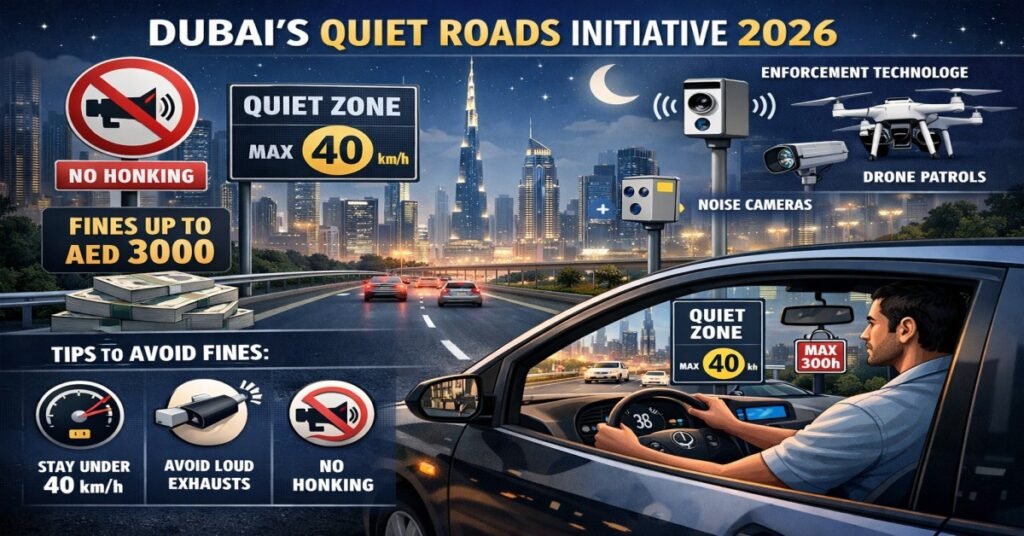

Dubai is a city that never stops moving. From the gleaming skyscrapers of Downtown to the sprawling residential communities of Jumeirah and Arabian Ranches, millions of vehicles navigate its roads every single day. But alongside its reputation for world-class infrastructure and futuristic urban planning, Dubai has long grappled with a challenge familiar to every major global city — noise pollution on its roads.
Enter the Quiet Roads Initiative — one of the most talked-about and widely debated traffic enforcement programs in the United Arab Emirates in recent years.
Launched under the broader framework of Dubai’s commitment to livability, environmental quality, and road safety, the Quiet Roads Initiative targets a specific and often underappreciated form of traffic offense: unnecessary vehicle noise. This includes aggressive horn honking, excessively loud exhaust systems, high-decibel audio systems, and engine revving in residential and designated quiet zones across the emirate.
For residents, tourists, and business owners operating vehicles in Dubai, understanding this initiative is no longer optional — it is essential. Violations can attract substantial fines, black points on your driving license, and in serious cases, vehicle impoundment. Yet many drivers remain unaware of the specific rules, the designated zones, and the enforcement mechanisms that give the initiative its teeth.
This comprehensive guide covers everything you need to know about Dubai’s Quiet Roads Initiative — its origins, objectives, detailed rules, fine structure, enforcement technology, and practical strategies to stay fully compliant and penalty-free.
Background: Why Dubai Launched the Quiet Roads Initiative
To understand the Quiet Roads Initiative, it helps to understand the broader context in which it was born.
Dubai’s Urban Growth and the Noise Challenge
Over the past two decades, Dubai has transformed from a regional trading hub into one of the world’s most densely populated and traffic-intensive metropolitan areas. The emirate’s population has grown from approximately 1 million in 2000 to well over 3.5 million today, with vehicle registrations increasing in near-perfect proportion.
This explosive growth brought with it a sharp increase in traffic-related noise. Studies conducted by environmental agencies across the Gulf region have consistently identified road traffic noise as one of the primary contributors to urban noise pollution — a phenomenon linked to sleep disturbance, elevated stress hormones, cardiovascular health risks, and reduced quality of life for residents.
Dubai’s Vision for Livability
Dubai’s leadership has consistently articulated an ambition to make Dubai one of the most livable cities on the planet. The Dubai 2040 Urban Master Plan — an ambitious blueprint for the emirate’s long-term development — places significant emphasis on environmental quality, including noise reduction, green spaces, and sustainable urban mobility.
The Quiet Roads Initiative sits squarely within this vision. By enforcing noise standards on public roads, particularly in residential neighborhoods, school zones, hospital corridors, and recreational areas, Dubai’s Roads and Transport Authority (RTA) and Dubai Police aim to create an urban environment where road infrastructure serves the community without degrading the quality of life of the people who live alongside it.
Regional and International Precedent
Dubai is not alone in tackling vehicle noise through dedicated enforcement programs. Cities including London, Amsterdam, Paris, and New York have implemented noise camera technology and acoustic enforcement zones in recent years. Dubai’s initiative draws on international best practices while adapting them to the specific conditions and driving culture of the UAE.
What Exactly Is the Quiet Roads Initiative?
The Quiet Roads Initiative is a structured traffic enforcement program operated by Dubai Police in coordination with the Roads and Transport Authority (RTA). It designates specific roads, zones, and timeframes as noise-sensitive areas and prohibits a defined range of noise-generating driver behaviors within those zones.
The initiative operates through a combination of:
- Fixed and mobile noise detection cameras positioned at key locations across designated quiet zones
- Patrol-based enforcement by Dubai Police traffic units trained in noise violation identification
- Community reporting mechanisms that allow residents to report persistent noise violations through official channels
- Automated fine issuance linked to vehicle registration plates captured by enforcement cameras
The program is not limited to a single type of noise offense. It encompasses a broad spectrum of vehicle-related noise behaviors that collectively contribute to urban noise pollution and resident disturbance.
The Core Rules of Dubai’s Quiet Roads Initiative
Understanding precisely what is prohibited under the initiative is the foundation of compliance. The following rules represent the primary categories of noise offense targeted by the program.
Rule 1: Prohibition on Unnecessary Horn Use
The most commonly enforced offense under the Quiet Roads Initiative is the unnecessary or aggressive use of a vehicle horn.
Under UAE traffic law, a vehicle horn is a safety device — it exists to alert other road users to immediate danger. Its use is legally appropriate in genuine emergency situations, such as alerting a pedestrian who is about to step into traffic or warning another driver of an imminent collision.
What is explicitly prohibited:
- Honking at traffic lights when the light turns green
- Using the horn to express frustration or impatience in traffic
- Prolonged horn use in residential areas
- Horn use outside schools, hospitals, mosques, and government buildings
- Using the horn to greet or attract the attention of pedestrians or other drivers in non-emergency situations
This offense is particularly targeted in the early morning (before 8:00 AM) and late evening (after 10:00 PM) hours when residential disturbance is greatest.
Rule 2: Excessive Vehicle Exhaust Noise
Modified or poorly maintained exhaust systems that produce noise levels above the legally permitted threshold are a significant enforcement target under the Quiet Roads Initiative.
The UAE Federal Traffic Law specifies maximum permissible noise levels for vehicles on public roads. Vehicles that have been fitted with aftermarket exhaust modifications designed to increase engine sound — a practice popular in certain car enthusiast communities — are directly targeted.
This rule applies to:
- Motorcycles with modified or straight-pipe exhaust systems
- Sports cars and performance vehicles with aftermarket exhaust upgrades
- Commercial vehicles with poorly maintained exhaust systems producing excessive noise
- Any vehicle deliberately operated in a manner designed to maximize exhaust noise, such as aggressive downshifting or engine braking in residential zones
Rule 3: High-Volume In-Car Audio Systems
Playing music or audio at volumes audible from outside the vehicle — particularly in residential areas, near educational institutions, hospitals, and places of worship — constitutes a violation under the initiative.
The threshold for enforcement is not defined by a precise decibel measurement that drivers can easily monitor but is broadly interpreted as audio that is clearly audible to pedestrians or occupants of nearby properties with windows closed.
Key contexts where this rule is most strictly enforced:
- Residential streets during nighttime hours
- School drop-off and pick-up zones
- Hospital and healthcare facility approach roads
- Areas adjacent to mosques, particularly during prayer times
- Public parks and recreational areas
Rule 4: Engine Revving and Aggressive Acceleration
The deliberate revving of an engine — whether at traffic lights, in parking areas, or while driving through residential zones — is prohibited under the initiative.
This behavior, sometimes associated with car meets, performance vehicle culture, or simply impatient driving, generates significant noise disturbance and is treated as both a noise offense and a reckless driving offense in certain circumstances.
Prohibited behaviors include:
- Revving engines at traffic signals
- Aggressive acceleration from stationary positions (commonly called “launching” or “burnouts”)
- Deliberate engine revving in parking structures, which amplifies sound significantly
- Repeated aggressive gear changes designed to produce engine noise
Rule 5: Vehicle Alarm Misuse and Malfunction
Vehicles with faulty alarm systems that trigger repeatedly without cause represent a chronic source of residential noise disturbance. Under the Quiet Roads Initiative, vehicle owners are responsible for ensuring their alarm systems are properly maintained and do not cause repeated false activations.
Owners of vehicles with persistent alarm malfunctions that disturb residents may receive notices requiring remediation within a specified timeframe.
Rule 6: Noise Violations Near Sensitive Locations
Certain locations in Dubai carry enhanced enforcement status under the initiative, meaning violations in or near these areas attract stricter scrutiny and in some cases higher penalties:
- Schools and educational institutions — particularly during school hours (7:00 AM to 3:00 PM on school days)
- Hospitals and medical facilities — at all times
- Mosques — especially during the five daily prayer times
- Government buildings and courts
- Designated residential quiet zones — typically enforced most strictly between 10:00 PM and 7:00 AM
Fine Structure: What Are the Penalties?
The financial penalties associated with Quiet Roads Initiative violations are substantial enough to serve as a genuine deterrent. The UAE’s approach to traffic enforcement is characteristically firm, and noise violations are treated with the same seriousness as other traffic infractions.
Unnecessary Horn Use
- Fine: AED 400 to AED 1,000 depending on location and frequency
- Black Points: 4 black points added to driving license
- Repeat Offenses: Escalating fines and potential license suspension
Excessive Exhaust Noise / Modified Exhaust Systems
- Fine: AED 500 to AED 2,000
- Black Points: 4 to 6 black points
- Additional Action: Vehicle may be impounded for technical inspection; modifications may be required to be reversed at owner’s cost before vehicle is returned
High-Volume Audio Systems
- Fine: AED 500 to AED 1,000
- Black Points: 4 black points
- Additional Action: Repeat offenses may result in audio equipment being confiscated or vehicle impoundment
Engine Revving and Aggressive Acceleration
- Fine: AED 500 to AED 2,000
- Black Points: 6 black points
- Additional Action: In cases classified as reckless driving, fines can exceed AED 2,000 and vehicle impoundment for up to 60 days may be applied
Noise Violations in Sensitive Zones
- Fine: AED 1,000 to AED 3,000
- Black Points: 6 to 12 black points depending on severity and location
- Additional Action: Violations near hospitals or schools carry the most severe penalty tiers
Black Points Accumulation Consequences
Under UAE traffic law, accumulating 24 black points results in automatic license suspension for 3 months. Accumulating black points beyond this threshold leads to increasingly severe consequences including mandatory driving rehabilitation courses and permanent license revocation in extreme cases.
How Enforcement Works: The Technology Behind Quiet Roads
One of the most significant aspects of the Quiet Roads Initiative is its deployment of advanced enforcement technology that removes the element of subjectivity from noise violation detection.
Noise Detection Cameras
Dubai has progressively deployed acoustic monitoring cameras — commonly referred to as noise cameras or sound radars — at strategic locations across designated quiet zones. These devices function similarly to speed cameras but measure sound levels rather than vehicle velocity.
How they work:
- A directional microphone array captures sound levels in the surrounding environment
- When a vehicle-generated sound exceeds the preset threshold (typically measured in decibels), the system triggers
- A high-resolution camera simultaneously captures the vehicle’s image and license plate
- The data is transmitted to a processing center where violations are reviewed and confirmed
- Fines are automatically issued to the registered vehicle owner
These cameras operate 24 hours a day, seven days a week, regardless of weather conditions. Their presence is not always signposted, which means drivers cannot rely on visual cues to modify behavior only when cameras are visible.
Mobile Enforcement Units
Dubai Police traffic units equipped with portable noise measurement devices conduct mobile enforcement operations throughout the emirate. Officers can stop vehicles suspected of noise violations, conduct on-the-spot acoustic measurements, and issue fines immediately.
Mobile units are particularly active during:
- Late night and early morning hours in residential areas
- Periods surrounding major car events and gatherings
- School peak hours in educational districts
- Ramadan and other significant religious observance periods when noise sensitivity is heightened
Community Reporting
Dubai Police operates an official community reporting system through the Dubai Police app and website that allows residents to report persistent noise violations. Reports can include vehicle descriptions, registration plate numbers, location details, and where possible, video or audio evidence.
Reports from community members are reviewed by enforcement officers and can form the basis for targeted patrols and enforcement actions in specific areas.
Designated Quiet Zones in Dubai
While the Quiet Roads Initiative applies broadly across the emirate, specific areas carry designated Quiet Zone status with enhanced enforcement. Key quiet zone categories include:
Residential Quiet Zones: Established residential communities including Jumeirah, Arabian Ranches, Meadows, Springs, The Lakes, Mirdif, and Al Barsha carry heightened noise enforcement status, particularly during evening and nighttime hours.
Educational Zones: All roads within 500 meters of schools, universities, and educational institutions during operational hours fall under enhanced enforcement protocols.
Healthcare Zones: Roads surrounding major hospitals including Rashid Hospital, Dubai Hospital, American Hospital, Mediclinic City Hospital, and all other licensed healthcare facilities are subject to continuous enhanced enforcement.
Religious Zones: All mosques and their immediate surroundings carry permanent noise-sensitive status, with enforcement intensified during the five daily prayer times and throughout the holy month of Ramadan.
Recreational and Park Zones: Major public parks and waterfront recreational areas including Jumeirah Corniche, Al Mamzar Park, Creek Park, and Safa Park fall within recreational quiet zones during designated operating hours.
How to Avoid Penalties: Practical Tips for Every Driver
Understanding the rules is half the battle. The following practical strategies will help every driver in Dubai maintain full compliance with the Quiet Roads Initiative and avoid costly penalties.
Tip 1: Retrain Your Horn Habits
For many drivers — particularly those who learned to drive in cultures where horn use is routine and social — breaking the horn habit requires conscious effort. Before reaching for the horn, ask yourself: is there a genuine immediate safety reason to use it? If the answer is anything other than yes, keep your hand off the horn.
Tip 2: Have Your Exhaust System Inspected
If you drive a performance vehicle, motorcycle, or any vehicle with aftermarket exhaust modifications, have the system professionally assessed for UAE compliance before driving on Dubai roads. Reputable workshops can advise on whether modifications meet the legal noise threshold and can fit compliant components if necessary.
Tip 3: Invest in Quality Audio Without Excessive Volume
Enjoying music while driving is entirely legal. The key is keeping audio at a volume that does not penetrate beyond your vehicle’s cabin. As a practical rule of thumb, if you can clearly hear music from your car with the windows closed while standing 5 meters away, the volume is almost certainly too high.
Tip 4: Practice Smooth, Measured Acceleration
Smooth acceleration is not only noise-compliant — it is also significantly more fuel-efficient and reduces mechanical wear on your vehicle. Avoid aggressive starts from traffic lights, unnecessary high-rev gear changes, and any driving style designed to showcase engine performance in urban environments.
Tip 5: Know the Quiet Zones in Your Daily Routes
Identify the schools, hospitals, mosques, and residential quiet zones along your regular driving routes and consciously adjust your driving behavior when approaching and passing through these areas.
Tip 6: Maintain Your Vehicle Regularly
A well-maintained vehicle is a quieter vehicle. Regular servicing ensures that exhaust systems, engine components, and suspension elements operate within noise-compliant parameters. Rattling panels, worn exhaust gaskets, and poorly maintained engines are common sources of excessive vehicle noise that drivers often normalize but that can attract enforcement attention.
Tip 7: Use the Dubai Police App
Download and familiarize yourself with the Dubai Police app, which provides access to traffic fine checking, violation reporting, and regular updates on traffic enforcement campaigns. Being informed about active enforcement initiatives in your area gives you the awareness to adjust your behavior proactively.
Tip 8: Be Especially Mindful During Ramadan
During the holy month of Ramadan, noise sensitivity across Dubai intensifies significantly. Dubai Police historically increases traffic enforcement activity during this period, and violations near mosques and residential areas carry heightened scrutiny. Extra caution during Ramadan is both legally prudent and culturally respectful.
Impact of the Quiet Roads Initiative: What the Data Shows
Since the initiative’s implementation and progressive expansion, measurable improvements in urban noise quality have been reported in targeted zones. Community satisfaction surveys conducted in pilot residential areas have shown notable increases in resident satisfaction with nighttime noise levels.
From an enforcement perspective, the deployment of automated noise detection technology has significantly increased the volume of violations detected and fines issued compared to patrol-only enforcement periods. This data-driven approach allows the RTA and Dubai Police to identify noise hotspots, direct resources efficiently, and track improvements over time.
The initiative has also had a notable deterrent effect on the car modification community, with several prominent workshops reporting increased demand for noise-compliant exhaust replacements from customers seeking to bring their vehicles into legal compliance ahead of anticipated enforcement.
The Bigger Picture: How Quiet Roads Fits Dubai’s Smart City Vision
The Quiet Roads Initiative is a microcosm of Dubai’s broader approach to urban governance — data-driven, technology-enabled, and firmly oriented toward long-term livability rather than short-term convenience.
By treating noise pollution with the same regulatory seriousness as speeding, reckless driving, and vehicle safety compliance, Dubai signals a sophisticated understanding of the full spectrum of factors that determine whether a city is truly world-class.
As autonomous vehicles, electric mobility, and smart traffic management systems become increasingly integrated into Dubai’s road network over the coming decade, noise pollution from traditional combustion engine behaviors will naturally decline. But until that transition is complete, the Quiet Roads Initiative provides the enforcement framework to protect residents and communities in the present.
For drivers who adapt their behavior accordingly, the initiative represents nothing more than a small adjustment in habits. For those who ignore it, the financial and legal consequences are substantial and entirely avoidable.
Frequently Asked Questions (FAQs)
FAQ 1: What is Dubai’s Quiet Roads Initiative and who enforces it?
Dubai’s Quiet Roads Initiative is a traffic enforcement program managed by Dubai Police in cooperation with the Roads and Transport Authority (RTA). It targets noise-generating driver behaviors including unnecessary horn use, modified exhaust systems, high-volume audio, and aggressive engine revving — particularly in designated residential, educational, healthcare, and religious zones across the emirate. Enforcement is carried out through fixed noise detection cameras, mobile patrol units, and a community reporting system available through the Dubai Police app.
FAQ 2: How much is the fine for honking unnecessarily in Dubai?
The fine for unnecessary horn use in Dubai ranges from AED 400 to AED 1,000 depending on the location and circumstances of the violation. Honking near sensitive locations such as hospitals, schools, mosques, and government buildings attracts fines at the higher end of this range. In addition to the monetary fine, 4 black points are added to the offending driver’s license. Repeat offenses can lead to escalating penalties and potential license suspension.
FAQ 3: Can tourists and visitors to Dubai be fined under the Quiet Roads Initiative?
Yes. The Quiet Roads Initiative applies equally to all drivers on Dubai roads regardless of nationality or residency status. Tourists driving rental vehicles are subject to the same rules and fine structure as UAE residents. Fines issued to rental vehicles are typically passed on to the renter by the rental company. Visitors driving their own vehicles registered in other emirates or GCC countries are also subject to enforcement under the initiative.
FAQ 4: How do noise detection cameras work and where are they located?
Noise detection cameras used in Dubai’s enforcement program combine directional acoustic sensors with high-resolution imaging systems. When a vehicle generates sound exceeding the preset noise threshold, the system automatically captures the vehicle’s image and license plate, which is then used to issue a fine to the registered owner. The precise locations of all fixed noise cameras are not publicly listed to maximize deterrent effect. Cameras are generally deployed in residential quiet zones, near schools and hospitals, and at locations identified as noise hotspots through enforcement data.
FAQ 5: What happens if my vehicle has a modified exhaust system in Dubai?
Driving a vehicle with a modified exhaust system that exceeds UAE noise limits on Dubai roads exposes you to fines ranging from AED 500 to AED 2,000, plus 4 to 6 black points on your driving license. Your vehicle may also be detained for technical inspection, and you may be required to restore the exhaust system to a legally compliant standard at your own expense before the vehicle is released. It is strongly advisable to have any aftermarket exhaust modifications assessed for UAE compliance by a reputable automotive workshop before driving on public roads in Dubai.
FAQ 6: How can I check if I have received a fine under the Quiet Roads Initiative?
You can check for any outstanding traffic fines — including those issued under the Quiet Roads Initiative — through several official channels. These include the Dubai Police website at dubaipolice.gov.ae, the Dubai Police smart app available on iOS and Android, the RTA website and app, and select government service centers across Dubai. You will need your vehicle registration number or driving license number to conduct a fine check. It is recommended to check regularly, as unpaid fines accrue and can affect vehicle registration renewal.