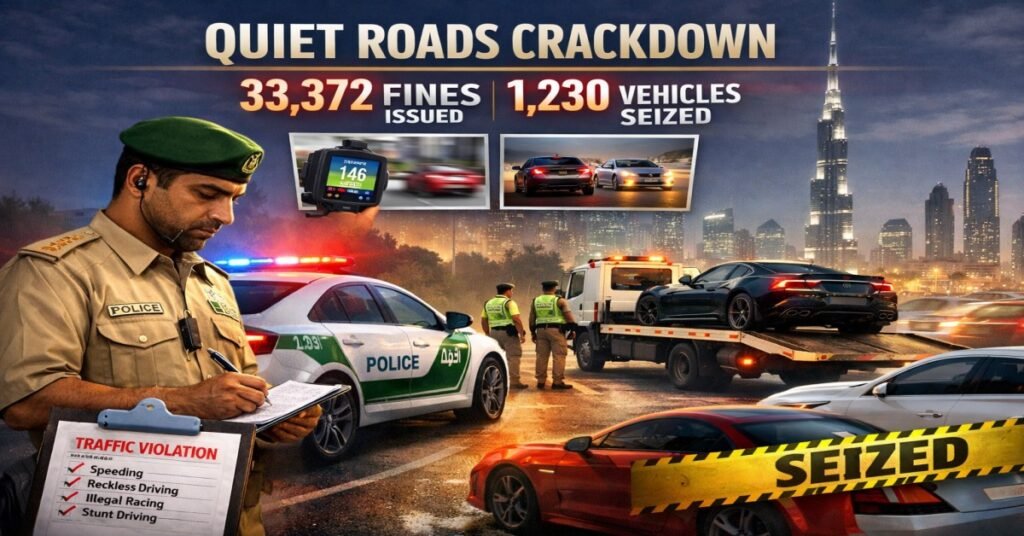

If you drive in Dubai, 2026 is not the year to take shortcuts on road safety. Dubai Police have officially announced the results of their sweeping “Quiet Roads” initiative, and the numbers are impossible to ignore: more than 33,372 traffic fines issued and 1,230 vehicles seized — all in one ongoing crackdown.
This is not just another routine enforcement campaign. The “Quiet Roads” initiative represents a significant shift in how Dubai authorities approach traffic management, moving from reactive policing to a data-driven, community-integrated strategy designed to protect residential neighbourhoods and improve quality of life for every resident in the emirate.
Whether you ride a motorcycle, cycle an e-bike, or drive a modified car, this crackdown likely affects you. Here is everything you need to know.
What Is the Dubai Police ‘Quiet Roads’ Initiative?
The “Quiet Roads” campaign is an ongoing traffic enforcement initiative led by the General Department of Traffic at Dubai Police. Its core purpose is to reduce disruptive driving behaviour — particularly in and around residential areas — and to make Dubai’s streets safer, calmer, and more community-friendly.
The campaign was born out of a pattern of repeated complaints from residents about specific nuisance behaviours on the roads. Rather than simply increasing patrols, Dubai Police took an analytical approach: they studied complaint data, identified hotspot locations where violations were most concentrated, and then deployed officers precisely and efficiently to those zones.
This intelligence-led model is what makes “Quiet Roads” different from past crackdowns. Instead of blanket enforcement, it is surgical, targeted, and built around measurable outcomes.
Brigadier Jumaa Salem bin Suwaidan, Director of the General Department of Traffic at Dubai Police, confirmed that the initiative is directly aligned with Dubai Police’s broader strategic mission to preserve public tranquillity and strengthen the sense of safety across all communities in the emirate.
The Numbers: A Crackdown on a Massive Scale
Let’s break down what Dubai Police have actually achieved under this initiative so far:
Total Traffic Fines Issued: 33,372
Total Vehicles Seized: 1,230
These headline numbers alone are staggering, but the breakdown of specific violations tells an even more revealing story about what behaviour Dubai authorities are cracking down on most aggressively.
Unauthorised Vehicle Modifications — 1,178 Cases
The single largest category of violations in this campaign involves illegal changes to vehicle engines or chassis. This includes modifications that alter engine performance, exhaust noise levels, suspension, or structural components without proper authorisation from the relevant authorities. Many drivers modify their vehicles for aesthetic or performance reasons without realising — or without caring — that such changes violate UAE road regulations.
Noise Disturbance — 412 Violations
Causing noise disturbance on public roads led to 412 fines. This category covers a wide range of behaviours, from revving engines unnecessarily in residential zones to playing extremely loud music from car audio systems, all of which directly affect the peace and quality of life of nearby residents.
Reckless Driving Endangering Lives and Property — 341 Violations
Three hundred and forty-one fines were handed out for reckless driving — a serious category that covers manoeuvres and behaviours that put both other road users and bystanders at immediate risk of harm.
Misuse of Horns or Audio Systems — 230 Violations
Unnecessary honking and audio system abuse that creates public nuisance led to 230 fines. In many urban communities, horn misuse is one of the most common and most irritating sources of noise pollution, and Dubai Police are clearly sending a message that it will not be tolerated.
Motorcycles, E-Bikes, and Bicycles: A Hidden Focus of the Campaign
One of the most significant — and perhaps least anticipated — aspects of the “Quiet Roads” initiative is just how heavily it has focused on two-wheel and non-motorised vehicles.
The campaign recorded 17,117 violations involving motorcycles alone. This is an extraordinary figure and suggests that motorcycle riders are currently one of the highest-risk groups when it comes to road disturbance and unsafe behaviour in Dubai’s residential zones.
Additionally, 14,094 violations were recorded involving electric bikes and bicycles. As e-bikes and cycling have grown enormously popular in the UAE in recent years, particularly in communities, they have also become a growing source of traffic complaints. Riders who ignore pedestrian zones, speed through residential streets, or operate without lights at night are all squarely in the crosshairs of this campaign.
Together, these two categories account for a massive portion of the total violations recorded, making it clear that “Quiet Roads” is not just about cars — it is about every type of road user.
How Dubai Police Are Using Data to Drive Enforcement
One of the most forward-thinking elements of this campaign is the way Dubai Police are using data to guide their enforcement activities. Rather than relying solely on officer presence and random patrols, the General Department of Traffic is analysing the volume and location of public complaints to identify where problems are most concentrated.
This allows police to deploy resources precisely where they are most needed, making enforcement more efficient and more effective. Hotspot mapping also means that drivers in neighbourhoods where complaints have been high are far more likely to encounter active enforcement operations.
Brigadier bin Suwaidan has emphasised that “Quiet Roads” will continue to evolve through collaboration with the community. Residents are being actively encouraged to report negative traffic behaviours through official Dubai Police channels. This public-reporting mechanism feeds directly back into the data system, allowing authorities to stay ahead of emerging problem areas rather than always responding after the fact.
This is a community policing model applied to traffic enforcement, and it is one that appears to be delivering concrete results.
Why This Campaign Matters: The ‘Sense of Safety’ Metric
Perhaps the most interesting aspect of “Quiet Roads” from a policy perspective is how Dubai Police are measuring its success. The key performance indicator for this initiative is not simply the number of fines issued or vehicles seized — it is something called the “sense of safety.”
This metric captures how secure and comfortable residents actually feel in their neighbourhoods. It is a qualitative, community-centred measure that goes beyond raw enforcement statistics. By using this as the benchmark, Dubai Police are signalling that the ultimate goal of “Quiet Roads” is not revenue from fines or vehicle seizures — it is a genuinely calmer, safer living environment for all Dubai residents.
This framing reflects the broader vision that Dubai’s leadership has for the emirate: a world-class city where quality of life is protected not just in terms of infrastructure and amenities, but also in everyday community experience.
What This Means for Drivers in 2026: Practical Guidance
If you live, work, or drive in Dubai, the “Quiet Roads” crackdown has direct practical implications for you. Here is what you should know to keep yourself protected:
1. Do not modify your vehicle without proper authorisation
With 1,178 violations for unauthorised engine or chassis modifications already recorded, this is clearly a priority target for Dubai Police. If your vehicle has been modified in any way — even modifications that seemed minor — verify that those changes are compliant with UAE road regulations. Getting caught with an unauthorised modification can result in your vehicle being seized, not just fined.
2. Be extremely mindful of noise in residential areas
Whether you are driving a sports car, riding a motorcycle, or simply using your horn, the rules around noise in residential communities are being enforced actively and aggressively. Keep music at reasonable levels, avoid unnecessary revving or honking, and be especially conscious of your behaviour in residential zones, particularly during early morning and late evening hours.
3. Motorcycle riders need to take special care
The 17,117 violations recorded for motorcycles in this campaign is a number that every rider in Dubai needs to take seriously. If you ride a motorcycle, ensure your bike is properly registered, not modified illegally, and that you are riding within the speed limit and not in a way that disturbs or endangers others.
4. E-bike and bicycle users are not exempt
With over 14,000 violations recorded for e-bikes and bicycles, two-wheel users who previously may have felt below the enforcement radar need to recalibrate. Follow designated lanes, observe speed restrictions in applicable zones, and ensure your e-bike complies with UAE regulations on power output and lighting.
5. Report violations through official channels
Dubai Police are actively asking the public to serve as partners in this initiative. If you witness reckless driving, noise disturbance, or illegal modifications in your neighbourhood, report it through the Dubai Police app or official hotlines. Your report could directly contribute to making your community safer.
6. Know how to check your fines
If you want to check whether you have received any fines, you can do so quickly through the Dubai Police website, the Dubai Police mobile app, the RTA portal, or the Dubai Now app. Enter your traffic file number, vehicle plate number, or driving licence details to view any outstanding violations.
The Bigger Picture: Dubai’s Vision for Road Safety
The “Quiet Roads” initiative does not exist in isolation. It is part of a broader and long-standing commitment by Dubai’s authorities to make the emirate’s roads among the safest and most orderly in the world.
Dubai has consistently invested in road infrastructure, smart traffic management technology, public awareness campaigns, and legislative updates to strengthen road safety outcomes. The UAE federal traffic law carries penalties ranging from hundreds of dirhams for minor offences all the way up to AED 100,000 for the most serious violations such as illegal road racing.
The integration of community feedback, data analytics, and targeted enforcement seen in “Quiet Roads” represents the next evolution of this approach — one that is smarter, more responsive, and more aligned with the lived experience of Dubai’s residents.
As urbanisation continues and Dubai’s population grows, maintaining order and quality of life on the roads will only become more important. Campaigns like “Quiet Roads” are the foundation of that effort.
Conclusion: Compliance Is No Longer Optional
The message from Dubai Police in 2026 is clear, consistent, and backed by numbers: disruptive and dangerous driving behaviour will not be tolerated in this city. With 33,372 fines issued, 1,230 vehicles seized, and an ongoing, data-driven enforcement strategy in place, the “Quiet Roads” initiative is not slowing down.
For drivers, riders, and cyclists alike, the most important takeaway is simple: follow the rules, respect your community, and do not assume that residential areas are low-enforcement zones. Dubai Police are watching, data is guiding them to exactly where violations are happening, and the consequences — financial and otherwise — are significant.
Drive responsibly. Ride quietly. Respect the road.