
Your forties are not when skin aging begins. But they are when you can no longer ignore it.
The fine lines that used to disappear overnight are now staying. Your complexion looks less luminous than it did a few years ago. The firmness you once took for granted is quietly retreating. And if you are in perimenopause, your skin may feel like it has changed overnight — drier, thinner, less resilient in ways that seem to have arrived without warning.
None of this is imagined, and none of it is inevitable. What is happening beneath the surface of your skin in your forties is well understood by science, and the skincare industry in 2026 has finally caught up with what dermatologists have known for years: targeted serums with proven active ingredients genuinely work. The key is knowing which ingredients solve which problems — and which claims are just marketing.
This guide covers everything you need: why skin changes so dramatically after 40, which active ingredients dermatologists consider non-negotiable, the best serums in each category, and how to layer them correctly for real results.
Why Skin Changes So Dramatically After 40
To understand which serum to use, you first need to understand what is actually happening inside your skin.
From your mid-twenties onward, you lose approximately 1% of your skin’s collagen every year through normal aging. That loss is gradual and barely perceptible for a long time. Then perimenopause arrives — typically beginning in the mid-40s — and everything accelerates.
After 40, falling estrogen levels accelerate collagen loss significantly. Women can lose up to 30% of their skin’s total collagen content in the first five years after menopause. That is not a slow erosion. That is a rapid and visible restructuring of the skin’s foundation.
Estrogen plays a central role in skin physiology. Estrogen insufficiency decreases collagen content, reduces elasticity, increases wrinkling, and compromises the skin’s moisture-retaining barrier function. Your skin’s ability to hold water drops. The outer layer becomes thinner. Fine lines deepen into full wrinkles. The jawline loses definition.
Estrogen also supports the synthesis of hyaluronic acid in the skin’s dermal layer — the molecule responsible for moisture and plumpness. When estrogen drops, so does natural hyaluronic acid production, which is why skin over 40 often feels persistently dry regardless of how much moisturiser you apply.
There is also the matter of cellular turnover. Younger skin sheds and replaces itself roughly every 28 days. By your mid-40s, that cycle has slowed to 45–60 days. Dead skin cells linger longer on the surface, creating dullness, uneven texture, and a complexion that lacks the glow it once had.
The good news is that all of these changes have corresponding solutions. The active ingredients in today’s best serums are not skincare trends. They are clinically validated tools that directly address each of these biological processes.
The 5 Ingredients Dermatologists Consider Essential After 40
Not every ingredient that promises anti-aging results actually delivers it. Dermatologists consistently return to the same small group of actives — not because nothing else exists, but because these have the most robust evidence behind them.

1. Retinol (and Retinoids)
Retinol is the most clinically validated over-the-counter anti-aging ingredient available. It is a derivative of vitamin A that works by accelerating cell turnover, stimulating fibroblasts to produce more collagen, and inhibiting the enzymes that break down the collagen you already have.
Board-certified dermatologist Dr. Brendan Camp explains that retinol has a proven track record as an effective anti-aging ingredient, directly stimulating collagen production and promoting cellular renewal.
For women in their 40s, retinol addresses the slowdown in cell turnover, the deepening of wrinkles, and the loss of skin density. It is typically used at night because it degrades under UV exposure.
The single most common mistake is starting too strong too fast. Begin with a low concentration — 0.025% to 0.1% — two to three nights per week, and allow six to eight weeks before increasing frequency. Expect some initial dryness and flaking. This is known as the retinization period and it passes. Using a hydrating moisturiser 20 minutes after application (a technique called buffering) significantly reduces irritation without compromising results.
If traditional retinol proves too irritating — particularly for sensitive or post-procedure skin — retinal (retinaldehyde) is a more potent but gentler alternative. It sits one step closer to the active form of vitamin A than retinol does, making it faster-acting while remaining more tolerable for reactive skin types.
2. Vitamin C
If there is one morning serum that dermatologists unanimously agree on for women over 40, it is vitamin C. Vitamin C is a critical cofactor in your skin’s production of collagen — meaning your skin cannot make new collagen without it. It also provides antioxidant protection against the UV-related and environmental damage that accelerates the breakdown of existing collagen.
The form of vitamin C that research consistently supports is L-ascorbic acid, ideally at a concentration of 10% to 20%. The gold-standard formulation pairs it with vitamin E and ferulic acid — the combination significantly extends the stability of the vitamin C and dramatically amplifies its antioxidant power.
Board-certified dermatologist Dr. Anna Chacon notes that vitamin C formulas combining all three actives are particularly valuable for mature skin because they simultaneously even skin tone and support firmness.
Apply vitamin C in the morning, after cleansing and before sunscreen. It works synergistically with SPF — vitamin C neutralises the free radicals that sunscreen does not fully block.
A note on stability: vitamin C oxidises when exposed to air and light. A properly formulated serum will be stored in an opaque, airtight bottle. If your serum has turned orange or brown, the vitamin C has oxidised and is no longer effective.
3. Peptides
Peptides are short chains of amino acids that function as chemical messengers inside the skin. They signal fibroblasts — your skin’s collagen-producing cells — to ramp up production. Next-generation peptide serums in 2026 address multiple signs of aging simultaneously, targeting skin laxity, collagen renewal, redness, and surface texture in single formulations.
Peptides are the ingredient dermatologists reach for when patients want the collagen-stimulating benefits of retinol without the irritation. They are safe during pregnancy, suitable for the most sensitive skin types, and can be layered with virtually every other active in your routine.
For women over 40 dealing with visible sagging, loss of jawline definition, or thinning skin around the eyes and mouth, peptide serums are a foundational tool. Results come with consistent daily use over 8–12 weeks. Unlike retinol, which shows results through cellular turnover, peptides work by gradually rebuilding the structural proteins in the dermis.
Palmitoyl tripeptide-1, palmitoyl tetrapeptide-7, and matrikine peptides are among the most well-studied options in this category.
4. Hyaluronic Acid
Hyaluronic acid does not stimulate collagen or accelerate cell turnover. Its role is hydration — and in the context of skin over 40, that role is critical.
A single molecule of hyaluronic acid can hold up to 1,000 times its weight in water. Applied to the face, it draws moisture into the outer layers of the skin and creates a temporary plumping effect that visibly softens fine lines within minutes. Used consistently, it supports the skin barrier and reduces the transepidermal water loss that makes mature skin feel perpetually dry.
Look for serums that contain multiple molecular weights of hyaluronic acid — low molecular weight forms penetrate deeper into the skin, while high molecular weight forms create a moisture-sealing film on the surface. Together, they address dehydration at multiple skin depths.
Hyaluronic acid should be applied to damp skin immediately after cleansing. It works by drawing moisture from its surroundings — if applied to a completely dry face in a dry climate, it can actually draw moisture out of the skin rather than into it. Follow immediately with a moisturiser to seal it in.
5. Niacinamide
Niacinamide — a form of vitamin B3 — is one of the most versatile actives in modern skincare. For women over 40, its key benefits are pore minimisation, skin barrier strengthening, brightening of age spots and hyperpigmentation, and oil regulation.
Board-certified dermatologist Dr. Rachel Westbay recommends niacinamide serums specifically for women dealing with age-related pigmentation — it addresses uneven tone and brightens existing spots without the irritation that some brightening actives cause on mature, sensitive skin.
Niacinamide is also one of the most compatible active ingredients in skincare — it can be layered safely with retinol, vitamin C, peptides, and acids, making it an excellent addition to a complex routine without causing reactions.
Best Anti-Aging Serums for Women Over 40 in 2026
Best Overall: SkinCeuticals C E Ferulic
This is the serum that appears on every dermatologist’s recommendation list without exception. The formulation combines 15% L-ascorbic acid, vitamin E, and ferulic acid in a pH-optimised base that dramatically improves both vitamin C’s stability and its antioxidant effectiveness. It brightens, firms, and defends — all in one morning application. The price point is high, but in terms of clinical evidence supporting real-world results, nothing in the vitamin C category comes close.
Best for: daytime antioxidant protection, brightening, collagen support When to use: morning, after cleansing, before SPF
Best Retinol Serum: La Roche-Posay Pure Retinol B3 Serum
Board-certified dermatologist Dr. Kunal Malik specifically recommends the La Roche-Posay retinol serum for women over 40, noting that its combination of pure retinol, gradual-release retinol, vitamin B3, and niacinamide reduces fine lines and improves skin texture while remaining gentle enough for sensitive skin. The inclusion of niacinamide in the formula helps counteract the dryness that retinol can cause, making this a particularly intelligent formulation for mature skin that has less tolerance for irritation.
Best for: wrinkle reduction, cell turnover, skin texture improvement When to use: evenings only, two to three nights per week to begin
Best Budget Retinol: The Ordinary Retinol 0.5% in Squalane
Board-certified dermatologist Dr. Noah Gratch calls this an outstanding choice for women new to retinol, citing its clinically effective concentration at a price that makes daily consistent use financially accessible. The squalane base — a lightweight, non-comedogenic oil — helps deliver retinol into the skin while reducing the dryness and flaking that often comes with introducing retinoids into a routine.
Best for: women beginning their retinol journey, budget-conscious skincare When to use: evenings, two to three nights per week
Best Peptide Serum: Olay Regenerist Micro-Sculpting Serum
Olay’s peptide serum has decades of clinical testing behind it and remains one of the most widely dermatologist-recommended mid-price options in the category. The amino-peptide complex works with niacinamide and vitamin B5 to improve surface hydration, firmness, and overall skin texture. Results are visible within four to six weeks of consistent use. Its lightweight texture layers seamlessly under moisturiser and SPF, making it practical for daily morning use.
Best for: firmness, hydration, everyday maintenance routine When to use: morning or evening
Best for Sensitive Skin: Byoma Hydrating Serum
For women over 40 whose skin has become reactive — a very common shift as the skin barrier weakens during perimenopause — this ceramide-rich, fragrance-free formula restores barrier function before addressing any other concern. A compromised skin barrier amplifies every sign of aging: fine lines look deeper, redness is more persistent, and active ingredients cause more irritation. Rebuilding the barrier first makes every other serum in your routine work better.
Board-certified dermatologist Dr. Sonia Badreshia-Bansal recommends bakuchiol-based formulas as a first choice for women who cannot tolerate retinoids, noting that bakuchiol offers collagen-boosting benefits without the irritation, making it safe even for sensitive or acne-prone skin.
Best for: sensitive, reactive, or barrier-compromised skin When to use: morning or evening
Best for Dark Spots and Hyperpigmentation: Paula’s Choice 10% Niacinamide Booster
Age spots, sun damage, and post-inflammatory hyperpigmentation are among the most common skin concerns for women over 40 — and niacinamide at a clinically relevant 10% concentration is one of the safest and most consistent ways to address them. Paula’s Choice formulation is fragrance-free, non-comedogenic, and can be mixed with your moisturiser or used alone. It is particularly effective when layered under SPF, since sun exposure re-darkens spots faster than any brightening serum can fade them.
Best for: uneven skin tone, age spots, post-breakout marks When to use: morning or evening
Best for Deep Hydration: Neutrogena Hydro Boost Hydrating Serum
The Neutrogena Hydro Boost formula uses a hyaluronic acid concentrate in a lightweight gel texture that absorbs immediately without leaving any tackiness on the skin. For women experiencing the dry, tight, dull skin that comes with perimenopause-related hyaluronic acid loss, this is one of the most effective and accessible solutions in the drugstore category. Use it immediately after cleansing on slightly damp skin, then seal with a moisturiser.
Best for: dehydration, dullness, plumping fine lines When to use: morning and evening
How to Layer Anti-Aging Serums Correctly
Using multiple serums is only effective if you apply them in the right order. The general rule is thinnest texture first, thickest last.
A practical morning routine for women over 40 looks like this: gentle cleanser, followed by hyaluronic acid serum on damp skin, followed by vitamin C serum, followed by moisturiser, followed by SPF 50+. This sequence ensures your antioxidant protection is fully in place before the day’s UV and environmental exposure begins.
An evening routine looks like this: cleanser, niacinamide serum or peptide serum, then retinol (two to three nights per week), then a rich moisturiser or facial oil to seal. On non-retinol nights, apply your peptide serum and a hydrating overnight mask or moisture cream.
One important rule: do not mix retinol and vitamin C in the same application. Both are acidic and can destabilise each other’s effectiveness while increasing irritation. Keep vitamin C strictly for mornings and retinol strictly for evenings.
How Long Until You See Results?
Hydration and plumping effects from hyaluronic acid are visible within hours of application. Brightness improvements from vitamin C typically appear within one to two weeks of daily use. Niacinamide begins visibly reducing dark spots after four to eight weeks.
Retinol and peptides operate on a longer timeline because they are restructuring the skin at a cellular level. Expect to see meaningful improvement in texture, firmness, and wrinkle depth after eight to twelve weeks of consistent use. Dramatic results — the kind that make people ask what you have been doing differently — typically arrive between the three and six month mark.
The single most important factor is consistency. Applying a serum two or three times per week will not produce the results that daily use delivers. Skin responds to reliable signals. Give it one.
What Ingredients to Avoid After 40
Dermatologist Dr. Melanie Palm recommends avoiding serums that contain artificial fragrances, alcohol high on the ingredient list, parabens, phthalates, and formaldehyde-releasing preservatives — all of which are more likely to trigger irritation and inflammation in mature, barrier-compromised skin.
Alcohol as a primary solvent deserves particular attention. It creates an immediate dry-tight feeling that some interpret as a sign the product is working — it is not. It dehydrates the skin, weakens the barrier, and over time makes every sign of aging more visible, not less. Check your current serum’s ingredient list: if ethanol or denatured alcohol appears in the first five to seven ingredients, replace it.
Frequently Asked Questions
1. At what age should I start using retinol?
There is no strict age rule, but most dermatologists suggest introducing retinol in your early 30s as a preventative measure. In your 40s, it becomes one of the most valuable tools in your routine.
2. Can I use vitamin C and retinol in the same routine?
Yes — but not at the same time. Use vitamin C in the morning and retinol in the evening.
3. How many serums can I layer at once?
Two to three active serums is the practical maximum for most skin types. Beyond that, you risk over-sensitising the skin and reducing the effectiveness of each individual product.
4. Is an expensive serum always better than a budget option?
Not necessarily. The Ordinary, Neutrogena, and Olay all produce formulas with clinically validated concentrations of effective ingredients. Price often reflects brand positioning, packaging, and fragrance — not active ingredient quality.
5. Do I still need moisturiser if I use a hydrating serum?
Yes. A serum delivers actives into the skin. A moisturiser creates the surface barrier that locks those actives in and prevents water loss. They serve different functions and both are necessary.
6. How do I know if a serum is working?
Take a close-up photograph in consistent lighting before you start, then again at 8 weeks and 12 weeks. The changes from serums are gradual and easy to miss day-to-day. Side-by-side photos often reveal improvements that feel invisible in the mirror.
Final Word
The 40s are not the beginning of losing the skin you want. They are the moment when what you put on your skin starts to genuinely matter — when the right active ingredients make a measurable, visible difference in the texture, tone, and firmness of your face.
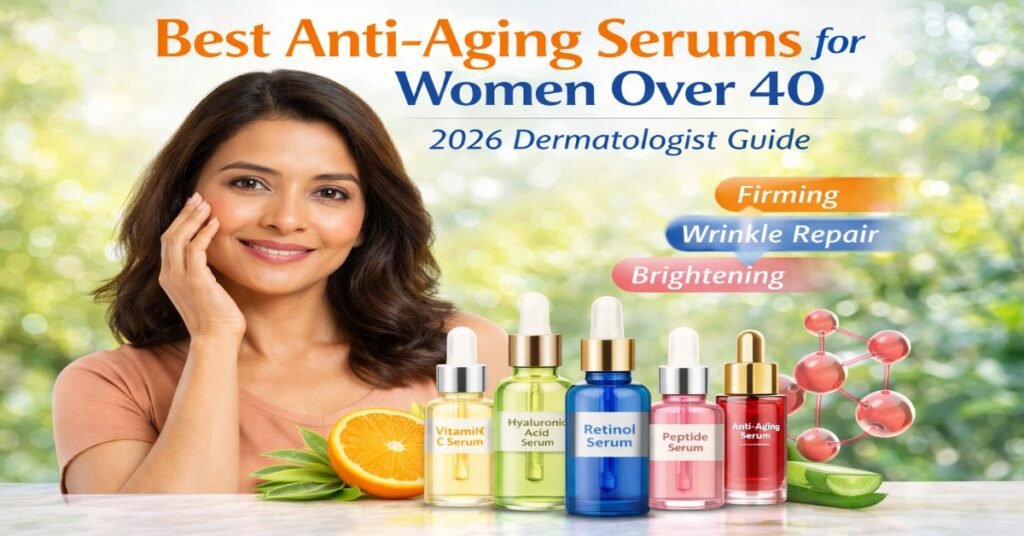
Retinol for cell renewal and collagen stimulation. Vitamin C for brightness and antioxidant defence. Peptides for firmness and barrier rebuilding. Hyaluronic acid for lasting hydration. Niacinamide for tone and resilience. These five ingredients cover every significant skin change that happens after 40, and the serums that deliver them in proven concentrations are available at every price point.
The best routine is the one you actually follow every day. Start with one targeted serum for your primary concern, build the habit, and add from there. Consistent application over months is what creates the results that make a real difference — not the most expensive bottle on the shelf.
Your skin in your 40s and 50s can look and feel genuinely healthy. The science is there. The products are there. All that remains is putting them on.