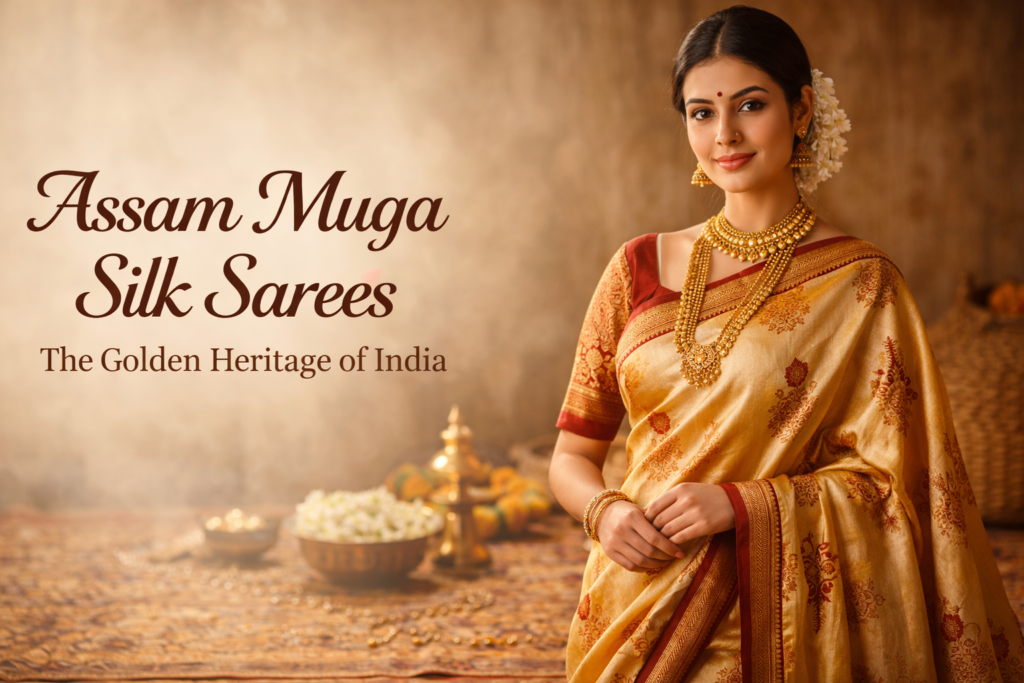
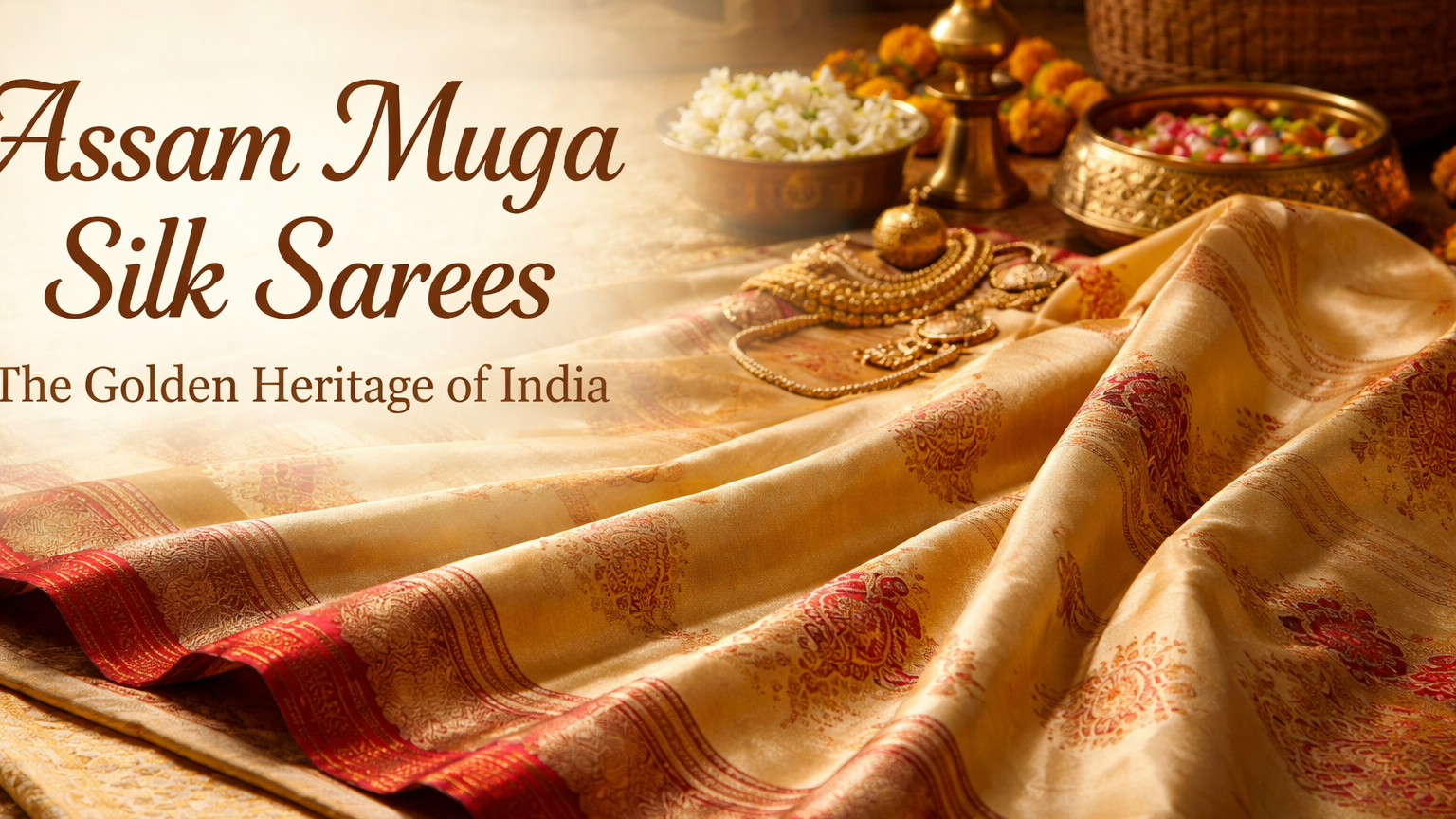
Assam Muga silk sarees represent one of the rarest intersections of nature, culture, and craftsmanship in the world of textiles. Revered for their natural golden radiance, unmatched strength, and centuries-old legacy, these sarees are not merely fashion items—they are cultural artifacts woven from tradition, ecology, and human skill. Produced exclusively in Assam, Muga silk stands apart from every other silk variety found globally.
1. The Origin of Muga Silk: Nature’s Golden Miracle
Muga silk is obtained from the silkworm species Antheraea assamensis, a semi-domesticated silkworm native only to Assam. What makes this silk extraordinary is its exclusive dependence on Assam’s geography—its climate, soil, vegetation, and humidity together create conditions that cannot be replicated elsewhere.
Unlike mulberry silk, Muga silk is:
- Seasonal rather than continuous
- Climate-sensitive
- Forest-linked, relying on Som and Soalu trees
This ecological dependence makes Assam Muga silk sarees geographically irreplaceable, elevating their global value.
2. Why Muga Silk Is Naturally Golden (The Science Behind the Glow)
The iconic golden hue of Assam Muga silk sarees is not added artificially. It originates from:
- Natural pigments in the silkworm secretion
- Minerals absorbed from host plants
- Unique protein structure of Muga fibroin
Scientific Uniqueness
- Muga silk contains higher tensile protein bonds
- Its surface reflects light differently, producing a warm metallic glow
- Washing removes surface impurities, enhancing shine instead of dulling it
This is why Assam Muga silk sarees grow more luminous with age, a property no other silk possesses.
3. Historical Legacy: Royal Silk of Ancient Assam
Historical texts and oral traditions indicate that Muga silk was:
- Reserved for royal families
- Used in temple offerings
- Exchanged as diplomatic gifts
In ancient Assam, gifting Muga silk symbolized:
- Prosperity
- Divine blessings
- Social prestige
Commoners rarely wore full Muga garments, reinforcing its elite status. This royal lineage is still reflected in the saree’s aura today.
4. Traditional Weaving Ecosystem of Assam
Assam Muga silk sarees are deeply tied to a community-based weaving system, not factories.
The Weaving Chain
- Silkworm rearers nurture larvae in semi-forest conditions
- Reelers extract yarn manually from cocoons
- Spinners refine threads for strength
- Weavers—often women—work on handlooms at home
This decentralized process preserves:
- Artisan livelihoods
- Indigenous knowledge
- Low environmental impact
Each saree reflects hundreds of human hours, not machine efficiency.
5. Motifs and Symbolism in Assam Muga Silk Sarees
Traditional motifs are inspired by Assamese life and beliefs:
- 🌸 Floral vines – fertility and growth
- 🦚 Peacock forms – grace and beauty
- 🔺 Geometric borders – cosmic balance
- 🌾 Nature symbols – harmony with environment
These motifs are not decorative alone—they are visual storytelling tools embedded in fabric.
6. Types of Assam Muga Silk Sarees (Detailed Classification)
A. Pure Traditional Muga Sarees
- Undyed golden body
- Minimal borders
- Preferred for rituals and weddings
B. Muga Silk Sarees with Contrast Borders
- Red or maroon borders symbolize prosperity
- Common in festivals like Bihu
C. Muga Mekhela Chador
- Two-piece Assamese attire
- Often mistaken for saree but culturally distinct
D. Contemporary Designer Muga Sarees
- Subtle pastel or natural dye accents
- Fusion of tradition with modern aesthetics
7. Durability & Heirloom Value
Assam Muga silk sarees are among the strongest natural fibers in the world.
Longevity Facts
- Tensile strength higher than mulberry silk
- Resistant to humidity and heat
- Can last 100–150 years with care
This durability makes Muga sarees:
- Ideal heirlooms
- Valuable assets
- Sustainable alternatives to fast fashion
8. Economic and Ethical Importance
Buying an Assam Muga silk saree supports:
- Rural Assamese families
- Women-led home industries
- Indigenous ecological practices
Unlike mass-produced textiles, Muga silk sustains an entire cultural economy, not just a supply chain.
9. How to Authenticate a Genuine Assam Muga Silk Saree
- Natural matte-golden tone (never glossy)
- Slight stiffness that softens with wear
- Irregular weave marks (proof of handloom)
- Gradual shine increase over years
- GI-certified sources when possible
Fake versions often use:
- Artificial dyes
- Blended yarns
- Machine-perfect patterns
10. Care and Preservation (Advanced Guide)
- Dry clean only or expert hand wash
- Store wrapped in unbleached cotton
- Avoid plastic covers
- Refold every few months
- Never starch Muga silk
Proper care ensures your saree outlives generations.
11. Assam Muga Silk Sarees in Global Luxury Fashion
Today, Assam Muga silk sarees are admired by:
- Sustainable fashion designers
- Textile historians
- Ethical luxury consumers
Their carbon-light production, rarity, and cultural depth make them globally relevant in an era moving toward slow fashion.
12. Why Assam Muga Silk Sarees Are Irreplaceable
No other fabric in the world:
- Is naturally golden
- Is region-exclusive
- Improves with age
- Combines strength with elegance
- Embodies ecological balance
This makes Assam Muga silk sarees not just rare—but irreplaceable.
Frequently Asked Questions – Assam Silk
What is the price of Assam silk Mekhela Sador?
The price of an Assam silk Mekhela Sador generally starts from ₹6,000 to ₹12,000 for basic handwoven varieties. Mid-range designs with traditional motifs usually cost between ₹15,000 and ₹25,000, depending on weaving quality and silk purity.
What is the price of Assam silk Mekhela Sador with Muga silk?
Assam Muga silk Mekhela Sador is a premium traditional attire. Prices typically range from ₹25,000 to ₹60,000, while exclusive handcrafted or bridal pieces can exceed ₹1,00,000 due to the rarity and durability of pure Muga silk.
What is the speciality of Assam silk?
Assam silk is known for its natural texture, durability, and cultural heritage. Assam is the only region in the world that produces three distinct silks—Muga, Eri, and Pat—each valued for unique qualities such as natural golden shine, warmth, and eco-friendly production.
Which is the costliest silk of Assam?
Muga silk is the costliest silk of Assam. Its natural golden colour, exceptional strength, limited geographical production, and labor-intensive process make it one of the most expensive and prestigious silks in the world.
Which place in Assam is famous for silk?
Sualkuchi is the most famous place in Assam for silk production and is often called the “Silk Village of Assam.” Other notable silk-producing regions include Jorhat, Dibrugarh, and Nagaon.
Why is Assam silk costly?
Assam silk is costly because it is entirely handwoven, produced in limited quantities, and depends heavily on natural climatic conditions. The long production cycle, skilled artisan labor, and rarity of silks like Muga contribute to its high value and heirloom status.