Your wedding day is one of the most photographed, most witnessed, and most emotionally significant days of your entire life. Every photograph taken will be treasured for decades. Every guest will remember how you looked. And you — more than anyone — will carry the memory of how you felt in your own skin on that extraordinary day.
This is precisely why bridal skincare is not something to begin two weeks before the wedding. It is not a last-minute beauty appointment or a single facial the day before. Genuinely transformative bridal skin — the kind that glows with health, photographs luminously, and makes you feel your most beautiful and confident self — is built methodically over months of consistent, intelligent skincare investment.
Six months is the ideal timeline. It is long enough to address stubborn concerns like hyperpigmentation, acne, and uneven texture that require sustained treatment. It is long enough to introduce powerful active ingredients like retinol and AHAs at a safe, gradual pace that builds tolerance without crisis reactions in the weeks before the wedding. And it is long enough to discover — well in advance of the big day — which products and treatments work beautifully for your skin and which require adjustment.
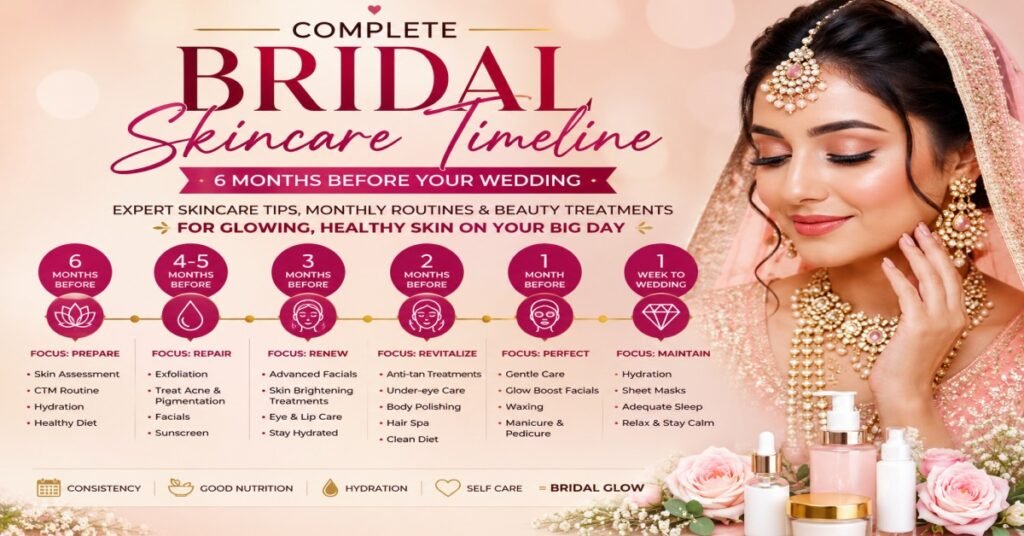
This comprehensive six-month bridal skincare timeline gives you a month-by-month roadmap — from the foundational work of Month One through the refinement and final preparation of Month Six — covering professional treatments, home routine building, ingredient introductions, lifestyle factors, and the specific steps that transform good skin into genuinely radiant bridal skin.
Before You Begin: The Bridal Skin Assessment
Before starting your six-month countdown, spend time honestly assessing your current skin condition and identifying your primary concerns. This assessment focuses your efforts and ensures you address what matters most for your specific skin.
Questions to ask yourself:
What is my primary skin concern — hyperpigmentation, acne, dullness, fine lines, uneven texture, or dehydration? Is my skin barrier currently healthy or showing signs of compromise — sensitivity, redness, or tightness? Am I currently using any active ingredients — retinol, AHAs, Vitamin C — or starting from scratch? Do I have any diagnosed skin conditions — rosacea, eczema, melasma — that require medical management alongside cosmetic care?
The professional consultation:
Book a consultation with a qualified dermatologist or licensed aesthetician at the six-month mark. A professional assessment identifies concerns you may not recognize yourself, recommends appropriate professional treatments, and helps you build a home routine that is genuinely calibrated to your skin’s needs rather than generic advice.
This consultation is not optional — it is the most important investment in your bridal skincare journey.
Month 6: Building the Foundation
Primary focus: Assessment, foundation routine establishment, and professional baseline treatments
Month Six is about building the infrastructure upon which everything else will be built. Introducing too many active ingredients simultaneously is one of the most common bridal skincare mistakes — it makes it impossible to identify what is helping, what is causing reactions, and what your skin genuinely needs.
Establish Your Core Routine
Begin with the simplest, most foundational routine possible — a gentle cleanser appropriate for your skin type, a basic moisturizer, and broad-spectrum SPF 50 applied every single morning without exception.
These three products are the non-negotiable foundation of every effective skincare routine — and for many brides, simply committing to daily SPF application from Month Six onward produces meaningful improvement in hyperpigmentation and skin tone by the wedding day.
Morning routine:
Gentle cleanser → Moisturizer → SPF 50
Evening routine:
Double cleanse (oil cleanser followed by gentle foam or gel cleanser) → Basic moisturizer
Introduce Vitamin C Serum
Once your foundation routine is established and skin is tolerating it well — typically after one to two weeks — introduce a Vitamin C serum into your morning routine between cleansing and moisturizing. Start with a stable, gentle form — ascorbyl glucoside at 10% or sodium ascorbyl phosphate — rather than jumping immediately to high-concentration L-ascorbic acid.
Vitamin C serum is arguably the highest-priority active ingredient for bridal skincare — delivering antioxidant protection, collagen synthesis support, and progressive brightening that addresses hyperpigmentation and uneven tone over consistent use.
Professional Treatment: First Facial and Skin Analysis
Book your first professional facial in Month Six — ideally a thorough skin analysis facial rather than a results-specific treatment. This session establishes your professional relationship with an aesthetician who will guide your treatments over the coming months, provides a baseline assessment of your skin’s current condition, and begins the professional treatment program that will progressively refine your skin over the timeline.
Important rule: Never try a new professional treatment within three months of your wedding date — always test all treatments on your skin well in advance to ensure you know how your skin responds.
Month 5: Targeted Treatment Introduction
Primary focus: Introducing targeted active ingredients and beginning professional treatment program
With your foundation routine running smoothly and your skin adapting positively to Vitamin C, Month Five introduces the targeted active ingredients that will address your specific primary concerns.
Introduce Niacinamide
Add a niacinamide serum — 5% to 10% concentration — to your evening routine. Niacinamide is one of the most versatile and well-tolerated skincare actives available — simultaneously strengthening the skin barrier, reducing melanin transfer (progressively lightening dark spots), regulating sebum production, and reducing the inflammation that triggers post-inflammatory hyperpigmentation.
For Indian bridal skin specifically — where hyperpigmentation is typically the primary concern — niacinamide’s melanin transfer inhibition makes it particularly valuable as a complementary brightening ingredient alongside Vitamin C.
Introduce Hyaluronic Acid
Add a hyaluronic acid serum to both morning and evening routines — applied to slightly damp skin before moisturizer. Hyaluronic acid is the fundamental hydration ingredient that plumps fine lines, supports skin elasticity, and creates the dewy, bouncy skin texture associated with youthful radiance. Wedding photographs in particular reveal hydration levels clearly — well-hydrated skin photographs with a luminous quality that dehydrated skin cannot replicate.
Begin Retinol Introduction (Very Gradually)
Month Five is the ideal time to begin introducing retinol — powerful enough for meaningful anti-aging and skin renewal benefits, but early enough to complete the full adjustment period (commonly called retinization) well before the wedding, leaving no risk of active irritation or peeling in the critical final months.
Start at the absolute lowest available concentration — 0.025% to 0.1% — applied every third evening for the first two weeks. Increase to every other evening in the third week if skin is tolerating well. Never apply retinol without following with a ceramide-rich moisturizer to support barrier integrity.
Professional Treatment: Regular Facial Series
Establish a monthly professional facial program — ideally HydraFacial, enzyme peel, or a customized brightening treatment — that complements your home routine. Monthly professional treatments accelerate the progress of home care by performing deeper exfoliation, more intensive hydration delivery, and targeted treatment of specific concerns that home products cannot fully address.
Month 4: Deepening the Routine
Primary focus: Refining active ingredient use and introducing exfoliation
By Month Four, your skin has had two full months to adapt to active ingredients and your professional treatment program is producing early visible improvements. This month deepens the routine with exfoliation and more targeted treatment.
Introduce Chemical Exfoliation
Add a chemical exfoliant — mandelic acid or lactic acid at 5% to 10% — to your evening routine, applied two to three times weekly on evenings when retinol is not used. For Indian bridal skin, mandelic acid is the preferred AHA choice — its larger molecular size means gentler penetration, dramatically reducing the risk of post-inflammatory hyperpigmentation that more aggressive glycolic acid can trigger in darker skin tones.
Chemical exfoliation accelerates cellular turnover — revealing fresh, bright skin cells, improving texture, and enhancing the absorption and efficacy of all subsequent skincare products applied after exfoliation.
Upgrade Vitamin C Concentration
If your skin has been tolerating the gentler Vitamin C derivative well through Months Five and Six, consider upgrading to a 10% to 15% L-ascorbic acid formulation for enhanced potency — particularly if brightening is your primary concern. Monitor skin response carefully and revert to the gentler form if irritation occurs.
Professional Treatment: Introduce Targeted Treatments
Month Four is the appropriate time to introduce more targeted professional treatments — chemical peels at appropriate concentrations, microdermabrasion, or LED light therapy — based on your specific concerns and your aesthetician’s recommendation. These treatments require sufficient healing buffer before the wedding — which Month Four provides at three months of comfortable distance.
Body Skincare Focus
Bridal skincare extends beyond the face. Month Four is the ideal time to begin a dedicated body skincare routine focusing on areas that will be visible on the wedding day — neck, décolletage, arms, and hands.
Extend your face Vitamin C serum application to the neck and décolletage daily. Begin using a body exfoliant twice weekly. Apply a rich body moisturizer daily. Begin regular hand and cuticle care — hands are prominently photographed during ring exchange ceremonies and deserve dedicated attention.
Month 3: The Refinement Phase
Primary focus: Optimizing results and beginning treatment tapering
Three months before the wedding, your routine should be producing visible results — improved brightness, more even tone, better texture, and enhanced hydration. This month focuses on optimization and beginning to identify what is working most effectively for your specific skin.
Review and Optimize
Photograph your skin in consistent lighting — same time of day, same light source — and compare with your Month Six baseline photographs. This objective visual comparison reveals real progress and identifies any concerns that require adjustment.
Book a review consultation with your dermatologist or aesthetician — share your observations, discuss treatment response, and refine your program based on actual results rather than theory.
Introduce Targeted Brightening Boosters
For brides with stubborn hyperpigmentation — dark spots, uneven patches, or melasma that has not responded sufficiently to Vitamin C and niacinamide alone — Month Three is the appropriate time to introduce additional brightening actives under dermatologist guidance.
Alpha arbutin at 1% to 2% provides complementary tyrosinase inhibition that works through a different mechanism than Vitamin C — making the combination more effective than either used alone. Kojic acid at 1% to 2% provides additional brightening support for particularly stubborn pigmentation.
Professional Treatments Continue
Monthly professional facials continue — and if your skin is responding well, your aesthetician may introduce slightly more intensive treatments at this three-month mark, knowing there is comfortable recovery buffer before the wedding.
Lifestyle Optimization
Skin health is profoundly influenced by lifestyle factors that no topical product can compensate for. Month Three is the ideal time to audit and optimize the lifestyle factors that most directly affect skin:
Sleep: Prioritize seven to nine hours of quality sleep consistently — skin undergoes its most intensive cellular repair during deep sleep stages.
Hydration: Commit to two to three liters of daily water intake — dehydration manifests visibly in skin within days.
Diet: Increase antioxidant-rich foods — colorful vegetables, berries, green tea, and turmeric — that support skin health from within. Reduce sugar, which drives glycation — a process that degrades collagen.
Stress management: Wedding planning is inherently stressful — and chronic stress elevates cortisol, which directly degrades collagen and triggers inflammation-driven skin concerns. Build stress management practices into your routine actively.
Month 2: Pre-Wedding Preparation
Primary focus: Consolidating gains and beginning preparation for wedding day
Two months before the wedding, your skin should be looking meaningfully better than it did at the six-month starting point. This month is about consolidating the gains you have made and beginning to prepare specifically for wedding day performance.
Begin Tapering Aggressive Actives
Start gradually reducing retinol frequency — from every other evening to two to three times weekly. This begins the process of calming any potential irritation and ensuring skin is in its calmest, most resilient state for the wedding day. Do not stop retinol abruptly — gradual tapering maintains benefits while reducing irritation risk.
Wedding Makeup Compatibility Testing
Begin testing your wedding makeup look on your prepared skin — working with your makeup artist to ensure that your skincare products layer compatibly with the makeup products they plan to use. Some skincare ingredients — particularly silicone-based serums and heavy face oils — can interfere with makeup application and longevity.
Test the complete makeup look on your face for a full day to assess wear time, transfer, and comfort before committing to products and techniques for the wedding itself.
Intensive Hydration Focus
Shift your routine’s emphasis toward intensive hydration — adding a hydrating essence or toner between cleansing and serums, using a richer moisturizer in the evening, and incorporating weekly hydrating sheet mask sessions. Beautifully hydrated skin is the single quality that most transforms wedding photographs from merely good to genuinely luminous.
Professional Treatment: Final Intensive Sessions
Complete any more intensive professional treatments in Month Two — ensuring all recovery time is completed well before the wedding month. Book your aesthetician for a schedule that ensures the final pre-wedding professional facial falls approximately one week before the wedding date.
Month 1: The Final Month
Primary focus: Maintaining, protecting, and preparing for the wedding day
The final month before your wedding is not the time for experimentation, new products, or intensive treatments. It is the time for calm, consistent maintenance of the beautiful skin you have built over the preceding five months.
The Golden Rule of Month One
Introduce absolutely nothing new to your skincare routine in the final month. No new products. No new treatments. No new ingredients. Your skin is in its best condition — the goal is simply to maintain and protect that condition through the wedding day.
Final Professional Facial
Schedule your final professional facial for approximately one week before the wedding — not closer. This gives any potential reaction time to resolve while leaving skin looking its freshest.
Wedding Week Routine
Simplify your routine in the final week — focusing on gentle cleansing, hydration, and SPF without any active ingredients. Do not use retinol, AHAs, or any potentially irritating actives in the seven to ten days before the wedding.
Day Before and Morning of Wedding
The evening before your wedding: gentle double cleanse, hydrating toner, sheet mask for fifteen minutes, light moisturizer, and sleep on your silk pillowcase.
Morning of your wedding: gentle cleanser, Vitamin C serum, hyaluronic acid, lightweight moisturizer, SPF. Keep the routine simple and focused on hydration — your makeup artist will work with this as the perfect prepared canvas.
Frequently Asked Questions (FAQs)
FAQ 1: When should I book my first dermatologist appointment before the wedding?
Book your first dermatologist or aesthetician consultation at the six-month mark — as soon as you begin your bridal skincare timeline. Early professional assessment identifies your specific skin concerns accurately, recommends appropriate treatments, and gives you maximum time to complete professional treatment courses safely before the wedding date.
FAQ 2: Is it safe to use retinol during the bridal skincare timeline?
Yes — and Month Five is the ideal time to introduce it, giving full retinization adjustment time well before the wedding. Begin at the lowest concentration available, apply every third evening, and always follow with ceramide moisturizer. Never use retinol within four to six weeks of the wedding date to ensure skin is fully calm and barrier-intact for the big day.
FAQ 3: What should I absolutely avoid doing in the month before my wedding?
Avoid introducing any new skincare products or ingredients, trying new professional treatments, getting any facial waxing that your skin has not previously experienced, using aggressive exfoliants, trying new makeup products on your face, and significantly changing your diet or lifestyle in ways that might trigger skin reactions. Month One is for maintenance — not experimentation.
FAQ 4: How do I handle a pre-wedding breakout?
If a breakout occurs in the weeks before your wedding, resist the temptation to aggressively treat it with new products. Apply a targeted spot treatment containing salicylic acid or benzoyl peroxide at low concentration to active spots. Keep the rest of your routine gentle and hydration-focused. Consult your dermatologist if breakouts are severe — a cortisone injection can resolve an individual large spot within forty-eight hours safely.
FAQ 5: Should bridal skincare be different for Indian skin tones?
Yes — Indian skin’s higher melanin levels make hyperpigmentation management the primary priority alongside general skin health. Choose brightening ingredients that specifically address melanin production — Vitamin C, niacinamide, alpha arbutin, and kojic acid — and avoid aggressive glycolic acid treatments that risk triggering post-inflammatory hyperpigmentation. Daily SPF 50 is non-negotiable for Indian skin in India’s high-UV climate.
FAQ 6: Do I need to change my diet for better bridal skin?
Diet significantly influences skin health — but dramatic dietary overhauls immediately before a wedding carry their own risks. Instead, make consistent progressive improvements from Month Six onward: increase water intake to two to three liters daily, add antioxidant-rich foods, reduce processed sugar and alcohol, and increase omega-3 rich foods. These gradual changes produce cumulative improvements without the digestive disruption or potential skin reactions that dramatic sudden dietary changes can trigger.