
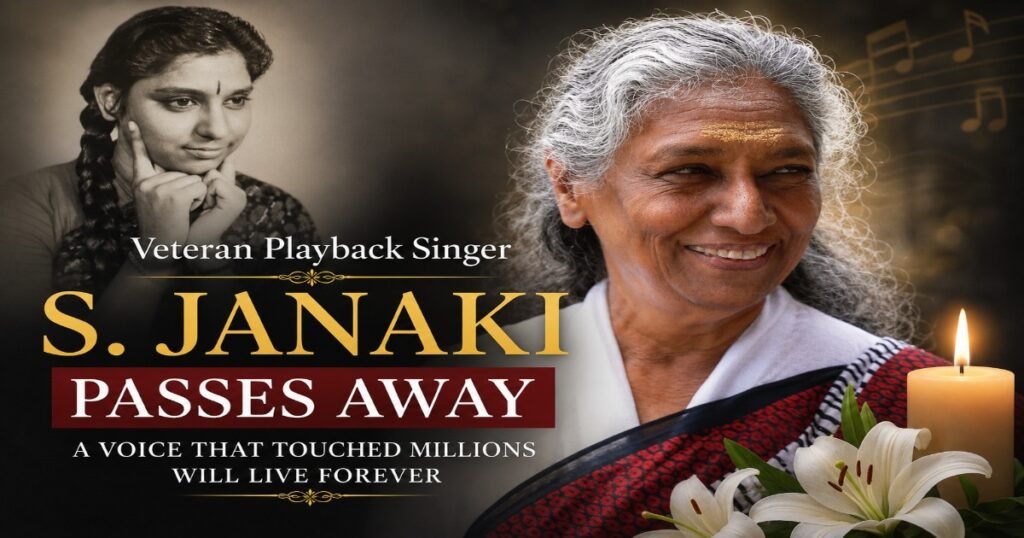
Mysuru, India — July 12, 2026: India has lost one of its most cherished musical voices. S. Janaki, the legendary playback singer affectionately known as “Janaki Amma” and celebrated across the country as the “Nightingale of South India,” passed away on Saturday, July 11, 2026, at a private hospital in Mysuru. She was 88 years old and reportedly succumbed to age-related health complications.
Her passing marks the end of an era for Indian film music, closing a career that spanned nearly seven decades and touched the lives of listeners across generations, languages, and borders.
A Voice That Defined Generations
Born Sistla Sreeramamurthy Janaki on April 23, 1938, in Pallapatla, a small town in Guntur district, Andhra Pradesh, Janaki’s journey into music began humbly before blossoming into one of the most decorated careers in Indian playback singing history. On the advice of her uncle, she moved to Chennai in her twenties to train and work under noted music composer R. Sudarsanam at AVM Studios, a decision that would set the course for the rest of her life.
She made her playback debut in 1957 with the Tamil film Vidhiyin Vilayattu, at just 19 years of age. What followed in that very first year was a remarkable feat rarely matched since — she recorded songs in six different languages within twelve months, offering an early hint of the versatility that would come to define her.
An Unmatched Musical Legacy
Over the course of her career, S. Janaki recorded more than 48,000 songs, spanning films, private albums, television, and radio. Her voice graced solos, duets, chorus numbers, and title tracks in an astonishing 20 Indian languages, including Kannada, Telugu, Tamil, Malayalam, Hindi, Sanskrit, Odia, Tulu, Urdu, Punjabi, Bengali, and Konkani, among others. Her artistry even crossed international boundaries, with recordings in English, Japanese, German, and Sinhala.
Interestingly, the language in which she sang the most was Kannada, closely followed by Malayalam — a reflection of the deep, decades-long partnerships she built with regional music directors and film industries far from her native Andhra Pradesh.
Janaki’s career reached extraordinary heights through the 1960s, 70s, 80s, and well into the 1990s. She became the most sought-after female voice in the Kannada, Malayalam, Tamil, and Telugu film industries, working with virtually every major composer of her time — from G. K. Venkatesh, Rajan–Nagendra, and Hamsalekha in Kannada cinema, to V. Dakshinamoorthi, M. S. Baburaj, and Salil Chowdhury in Malayalam films.
Her collaboration with fellow legendary singer S. P. Balasubrahmanyam remains one of the most celebrated pairings in Indian music, with estimates suggesting the duo recorded somewhere between 5,000 and 10,000 songs together. She also delivered timeless duets with stalwarts like K. J. Yesudas, P. B. Srinivas, Kishore Kumar, and Dr. Rajkumar.
Notably, it was composer Bappi Lahiri who introduced her to Bollywood after being struck by one of her Hindi recordings for a Tamil film, opening yet another chapter in her already prolific career.
In the 1990s, Janaki lent her voice to several early A. R. Rahman compositions in Tamil and Telugu, delivering hits that remain popular even today. Her rendition of “Margazhi Thinkal Allava” from the film Sangamam earned her the Tamil Nadu State Film Award for Best Female Playback Singer.
Awards and Recognition
S. Janaki’s contribution to Indian music was recognized with numerous prestigious honors throughout her lifetime, including four National Film Awards and 33 State Film Awards — making her one of the most awarded playback singers in the country’s history. She also received:
- The Kalaimamani award from the Tamil Nadu government
- The Rajyotsava Prashasti from the Government of Karnataka (2014)
- An honorary doctorate from the University of Mysore
- Twelve Nandi Awards from Andhra Pradesh, including ten for films and two for television serial songs
- The Odisha State Film Award for the Odia film Sata Kebe Luchi Rahena (1986)
Retirement and Final Years
After a career spanning six decades, Janaki announced her retirement from singing in 2016, choosing the Malayalam lullaby “Amma Poovinum” from the film 10 Kalpanakal as her swan song. She held a farewell concert in Mysuru on October 28, 2017, closing a remarkable chapter of Indian musical history. She briefly returned in 2018 to lend her voice to the Tamil film Pannaadi, delighting fans one last time before stepping away from public performances for good.
A Nation Mourns
Tributes poured in swiftly following news of her passing. India’s President conveyed condolences, describing Janaki’s illustrious six-decade career and noting that her timeless music would always remain a treasure to the nation. Prime Minister Narendra Modi also expressed grief over her passing, saying her songs gave voice to every human emotion with unmatched grace and versatility, and calling her loss an irreparable one for India’s world of music and culture.
Karnataka Chief Minister DK Shivakumar and several other political and cultural figures also expressed their sorrow, with many recalling personal memories of her warmth and professionalism.
Janaki’s last rites were performed with full honors at Kaniyanahundi farm on HD Kote Road in Mysuru taluk, under tight security arrangements, as fans, fellow artists, and admirers gathered to pay their final respects.
A Legacy That Will Live On
S. Janaki’s voice was often described as one capable of expressing every shade of human emotion — joy, sorrow, longing, devotion, and playfulness — earning her the title “Queen of Expression and Modulation.” For nearly seven decades, she was not just a singer but a defining presence in the soundtracks of Indian lives, weaving through weddings, festivals, films, and quiet personal moments alike.
Though she is no longer with us, the tens of thousands of songs she left behind ensure that S. Janaki’s voice will continue to echo through generations of listeners, in homes and theatres across India and beyond, for many years to come.
Her family, admirers, and the entire Indian film fraternity mourn the loss of a true legend of Indian playback singing.
Related posts:
 Maa Behen (2026): Release Date, Cast, Story, Trailer, OTT Platform and Complete Movie Preview
 Dhamaal 4 (2026): Release Date, Cast, Story, Budget & Everything You Need to Know
 The Paradise (2026): Release Date, Cast, Story, Budget & Everything You Need to Know
 Diljit Dosanjh Responds to Satluj Ban, Explains Guerrilla Release Strategy


Pingback: July 2026 Astrology: Complete Horoscope & Transit Guide